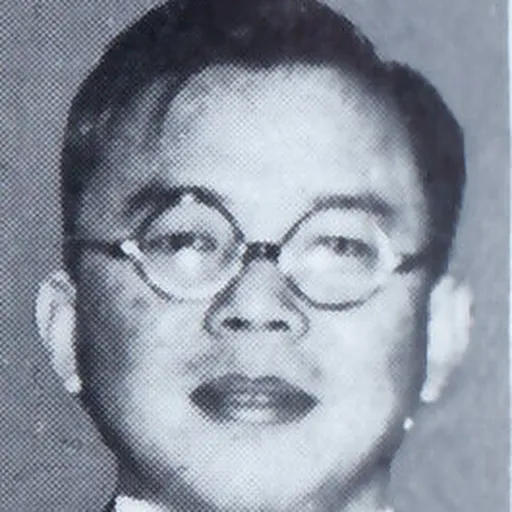
About Tsiang Tingfu
Lived 1895 – 1965 (aged 69). Tsiang Tingfu was a Taiwanese and Chinese diplomat, historian and journalist, known for Qing.
Tsiang Tingfu (; 17 February 1895 – 9 October 1965), was a historian and diplomat of the Republic of China who published in English under the name T.F. Tsiang.
Early life and education Tsiang was born in Shaoyang, Hunan. Tsiang's education from his teenage years had been Western and largely Christian, and he converted to Christianity at 11. Having been urged to study in the US by his teacher from a missionary school, he was sent in 1911 to study in the United States, where he attended the Park Academy, Oberlin College and Columbia University. His dissertation, "Labor and Empire: A Study of the Reaction of British Labor, Mainly as Represented in Parliament, to British Imperialism Since 1880," led him into issues in the relation of foreign relations and domestic politics, which would structure his scholarship after he returned to China. After obtaining a Ph.D., he returned to China in 1923, where he took up a position at Nankai University and then at Tsinghua University.
Academic career
At Tsinghua, Tsiang became the head of the History Department, where he edited and published a number of works on Chinese history and edited the English-language journal Chinese Social and Political Science Review. Using newly opened Qing dynasty archives and diplomatic publications, Tsiang argued that China should adopt Western approaches if it wanted to score diplomatic victories. Tsiang blamed China's unequal treatment by Western powers after the First Opium War (1839–42) on Chinese unequal treatment of Western powers before the war. During his tenure at Tsinghua, he mentored a number of historians in the study of Qing history, including John K. Fairbank.
Diplomatic career Following mounting tensions in China's relations with imperial Japan, Tsiang left academia in 1935 and joined the Chinese Nationalist government, which he served in many different capacities throughout the Sino-Japanese War. Between 1947 and 1962, Tsiang served as the Permanent Representative of China to the United Nations. Following the establishment of the People's Republic of China on the Chinese mainland, Tsiang defended the exclusive right of the Taipei-based Republic of China to represent China in the United Nations and in the UN Security Council. In 1955 Tsingfu made use of China's veto power in the security council and placed the sole vote against the People's Republic of Mongolia joining the UN, following which Mongolia did not become a member of the UN.
Political theories
In 1938, Tsiang advocated for centralized authority which should override popular will when necessary. He argued that China had to modernize quickly given the multiple threats it faced. Tsiang viewed such a commitment as a necessity of the historical era, not solely one required by the current war.
After spending time in the United States under President Franklin Delano Roosevelt's New Deal, Tingfu's views on political freedom and modernization changed.
Selected writings Tingfu F. Tsiang, "Labor and Empire; a Study of the Reaction of British Labor, Mainly as Represented in Parliament to British Imperialism since 1880," Issued also as thesis (PH D) Columbia university Columbia university, 1923). "New Light on Chinese Diplomacy, 1836-49," The Journal of Modern History 3.4 (1931): 578–591. "The Extension of Equal Commercial Privileges to Other Nations Than the British after the Treaty of Nanking," The Chinese Social and Political Science Review 15.3 (1931): 422–44. "The Present Situation in China: A Critical Analysis," International Affairs (Royal Institute of International Affairs 1931–1939) 14.4 (1935): 496–513. "Chinese and European Expansion," Politica 2.5 (March 1936): 1–18. Zhongguo jindaishi dagang (Outline of Modern Chinese History) (Chongqing: Qingnian shudian, 1939; rpr. Beijing: Dongfang chubanshe, 1996). Jiang Tingfu Xuanji 蔣廷黻選集 (Selected works of Jiang Tingfu) (Taipei: Wenxing, 1965 4 vols. Reprinted)
Don’t just read it —
keep it.
Full-length biographies made to live with: read them, listen on the way to work, watch them tonight.
- E-book
- Audio
- Video
Instant download · yours to keep · every purchase keeps this site free
Important facts
People in Tsiang Tingfu's life
Named in this biography and alive at the same time


Related people
Same field, nearest in time

Contemporaries
People whose lives overlapped Tsiang Tingfu's

Frequently asked questions
Who was Tsiang Tingfu?
Chinese historian and diplomat (1895–1965)
When was Tsiang Tingfu born?
Tsiang Tingfu was born on 7 December 1895 in Shaoyang.
When did Tsiang Tingfu die?
Tsiang Tingfu died on 9 October 1965 in New York City.
What was Tsiang Tingfu's occupation?
Tsiang Tingfu was a diplomat, historian and journalist.
What was Tsiang Tingfu known for?
Tsiang Tingfu was known for Qing.
What nationality was Tsiang Tingfu?
Tsiang Tingfu was Taiwanese and Chinese.
Sources & further reading
Cite this page
APA: Biography.guide. (2026). Tsiang Tingfu. https://biography.guide/tsiang-tingfu/
MLA: "Tsiang Tingfu." Biography.guide, https://biography.guide/tsiang-tingfu/.
Chicago: "Tsiang Tingfu." Biography.guide. https://biography.guide/tsiang-tingfu/.
Data last updated: 2026-09-21 · Spot an error? Report a correction.
Portrait: Wikimedia Commons · author & licence
Page generated 2026-09-27 05:00 UTC