
About Trisno Soemardjo
Lived 1916 – 1969 (aged 52). Trisno Soemardjo was an Indonesian writer, literary critic and translator.
Trisno Sumardjo (Enhanced Spelling: Trisno Sumarjo, 6 December 191621 April 1969) was an Indonesian writer, translator, and painter. Born to a schoolteacher in Surabaya, he took up art and literature in the 1940s while with the Young Artists of Indonesia. After moving to Jakarta in 1950, he edited several publications, translated multiple works by William Shakespeare, and continued to paint. His main source of income was his literary output, which beginning with ('Conscience and Deeds') in 1952 also included several books of prose and poetry. In the late 1960s, he helped establish the Ismail Marzuki Park, which he led until his death.
Sumardjo was generally marginalized within his lifetime by both the literata and painters of Indonesia, with the Dutch scholar of Indonesian literature writing in 1967 that he had had "no great impact". At the same time, he was recognized by his contemporaries for his devotion to intellectual honesty, cultural plurality, and artistic freedom. Critics have identified an undercurrent of pessimism in his literary works and noted a preference for dark colours in his paintings. Sumardjo 's translations of Shakespeare have been praised.
Biography Trisno Sumardjo was born in Tarik Village, Surabaya, on the eastern coast of Java in the Dutch East Indies (now Indonesia), on 6 December 1916. The son of an elementary school teacher, he had access to Dutch-language schooling. He completed his secondary studies in Yogyakarta, with a focus on literature, in 1937. After graduating, he spent four years as a private teacher. In 1942, he began to work for the railroad.
Sumardjo joined the Young Artists of Indonesia while the group was in Surakarta in 1946, and edited the group's magazine . In 1950, he moved to Jakarta, where he became the secretary of the ('Congress of National Culture', BMKN). This organization sought to promote contemporary Indonesian literature, including through a monthly magazine titled Indonesia, to which Sumardjo contributed. He continued to paint, participating in a joint exhibition with Basuki Resobowo, and in September 1952. However, he sold few works; speaking to the American art historian Claire Holt, he described himself as "painting for a year to live half a month".
Sumardjo's main source of income was his literary work. He published his first book, ('Conscience and Deeds') in 1952. This book contained five stories, two short plays, and several poems written between 1946 and 1950. This was followed by a stage play in verse titled ('Youtful Ideals') in 1953. In 1957, he published the short story collection ('The Great House'). To obtain inspiration, he travelled abroad on several cultural missions. This included a six-month journey through the United States and Europe in 1952, funded through a Rockefeller Foundation grant, as well as a trip to China in 1957. Describing these trips, he viewed American art as highly derivative of European art, which he considered representative of a "sterile personality", while also rejecting the highly politicized state of Chinese art.
In 1958, Sumardjo was a co-founder of the Foundation for Indonesian Art and Design alongside Effendi and Zaini. By 1967, the foundation had opened its own art museum, which Holt characterized as among the best in Jakarta. He undertook a second trip to the United States in 1961, arriving in April. He crossed the country, with a stop in Hartford, Connecticut, and a week in Albuquerque, New Mexico, before returning to Indonesia via San Francisco. The following year, he published ('Dry Leaves'), a collection of short stories written between 1951 and 1958 that included several anecdotes from his international travels.
Sumardjo was an active translator, with shorter works of fiction from Europe, Africa, Asia, and the United States included in magazines such as and . Standalone translations included several works by William Shakespeare, mostly published between 1950 and 1955; his translation of Anthony and Cleopatra was serialized in Indonesia between October 1961 and June 1963 and his translation of King Lear was only published in 1976. He also translated Boris Pasternak's Dr. Zhivago (1957), as well as works by Edgar Allan Poe and Jean de La Fontaine. In his translation, Sumardjo used existing English and Dutch sources. According to his notes in the published editions, Sumardjo translated Shakespeare not from the original, but through Dutch-language translations by .
In 1964, Sumardjo was a signatory of the Cultural Manifesto, which challenged the Indonesian government's approach to culture in the Guided Democracy era. Approximately two years later, he published a poetry collection titled ('Silhouette', 1966). Sumardjo published his final short story collection, ('Changing Faces') in 1968. He also helped establish the Ismail Marzuki Park (TIM), a cultural centre in Jakarta, in November of that year, with the backing of Governor Ali Sadikin. He led the centre until his death, concurrently serving as the chairman of the Jakarta Arts Council. He also remained active with the BMKN.
Already sickly, Sumardjo died on 21 April 1969, less than a year after assuming leadership of TIM. Sumardjo's body was lain in repose in the dance hall of TIM. The funeral procession then moved to Karet Bivak Cemetery, where Sumardjo was interred after a speech by the Indonesian literary critic H.B. Jassin.
Legacy and analysis Literature Considered a member of the Indonesian literary canon's "Generation of '45", Sumardjo had published seven original books, thirteen books in translation, and dozens of essays, poems, and short stories by the time of his death. These included both works of literary and arts criticism. According to Nashar, in his lifetime Sumardjo was marginalized by Indonesia's literata and painters; literary critics urged him to focus on painting, while painters described him as a man of letters rather than an artist. The Dutch literary critic similarly described Sumardjo's works as having "no great impact" in 1967. According to the Indonesian writer , within a decade of Sumardjo's death his literary works had been forgotten by most Indonesians. Literary critics, likewise, had not explored his oeuvre.
In a 1950 essay, Sumardjo argued that it was time for pessimism after the optimism promoted by the "hypnosis" of the Indonesian National Revolution. He continued by decrying the tendency to frame the revolution as a political issue handled by oligarchic leaders who made plans they never realized. According to Hadi W.M., such pessimism carried over into Sumardjo's literary works, which questioned whether Indonesia's increasingly decadent society could truly realize its cultural aspirations and seemed to have been "written with a furrowed brow". He cited the short story "Asran" as an exception, one of Sumardjo's few stories with a humouristic tone.
Sumardjo argued that "art is the fruit of honesty". Themes of honesty were found in several of his works, which included stories based on his real life experiences. In the June 1969 edition of magazine Horison, Nashar wrote, "His entire life was only for the arts. ... The truth [he] expressed in the arts was the honest voice of the heart." Teeuw wrote that this emphasis on honesty compelled the artist to follow a lonely path. Taufiq Ismail, also in Horison, similarly described Sumardjo's literary struggles as lonely and bitter, which nonetheless produced works with a unique character.
Reviewing Sumardjo's translations of Shakespeare, Michael Skupin of the Chinese Culture University describes the writer as translating "Shakespeare, not Burgersdijk", producing an "exemplary" works with only minor blemishes. He writes that Sumardjo, as with Shakespeare before him, clearly distinguished between prose and poetry, though the iambic pentameter of the original poetry is not maintained. The language draws freely from Indonesian's diverse roots, including words of Dutch, Arabic, Malay, and Sanskrit etymology. Skupin characterizes the translation as at times matching the tone of the original and at times overly cautious. Several terms are presented without translation, including satyr in Hamlet.
Art In his painting, Sumardjo blended naturalism and impressionism. Many of his works were landscapes. He favoured dark colours, creating what Ismail characterized as "hard and bitter" atmosphere. A reviewer for Tempo magazine wrote that most of his linework seemed tense or even stiff, though some paintingsincluding a view of the Yangtze River held by Ajip Rosidihad more natural lines and lighter colours. A solo exhibition dedicated to Sumardjo, consisting of 34 paintings and 32 sketches, was held at TIM in April 1988.
In his criticism, Sumardjo promoted cultural plurality, and urged Indonesians to look at forms from photography and film to ceramics and architecture. Nashar characterized him as a warrior for freedom, opposing prescriptions to embrace realism and quickly angered by efforts to limit artists' freedom of expression. For instance, he wrote that while he did not understand abstract art, he was still able to appreciate the works of A. Sadali.
Selected publications Original works ('Conscience and Deeds', mixed collection, 1952) ('Youthful Ideals', stage play, 1953) ('The Great House', short story collection, 1957) ('Dry Leaves', short story collection, 1962) ('Silhouette', poetry collection, ) ('Changing Faces', short story collection, 1968)
Translations (from William Shakespeare's Hamlet, 1950) (from William Shakespeare's The Merchant of Venice, 1950) (from William Shakespeare's As You Like It, 1952) (from William Shakespeare's The Tempest, 1952) (from William Shakespeare's Macbeth, 1952) (from William Shakespeare's A Midsummer Night's Dream, 1953) (from William Shakespeare's Romeo and Juliet, 1955) (from Jean de la Fontaine's Fables, 1959) (from Boris Pasternak's Dr. Zhivago, 1960) (stories from Edgar Allen Poe, 1969)
Explanatory notes
Don’t just read it —
keep it.
Full-length biographies made to live with: read them, listen on the way to work, watch them tonight.
- E-book
- Audio
- Video
Instant download · yours to keep · every purchase keeps this site free
Important facts
People in Trisno Soemardjo's life
Named in this biography and alive at the same time



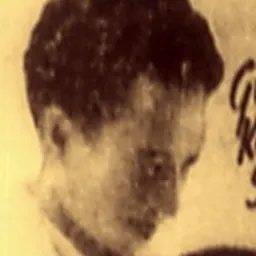
Related people
Same field, nearest in time


Contemporaries
People whose lives overlapped Trisno Soemardjo's





Frequently asked questions
Who was Trisno Soemardjo?
Indonesian writer (1916–1969)
When was Trisno Soemardjo born?
Trisno Soemardjo was born on 6 December 1916 in Surabaya.
When did Trisno Soemardjo die?
Trisno Soemardjo died on 21 April 1969.
What was Trisno Soemardjo's occupation?
Trisno Soemardjo was a writer, literary critic and translator.
What nationality was Trisno Soemardjo?
Trisno Soemardjo was Indonesian.
Sources & further reading
Cite this page
APA: Biography.guide. (2026). Trisno Soemardjo. https://biography.guide/trisno-soemardjo/
MLA: "Trisno Soemardjo." Biography.guide, https://biography.guide/trisno-soemardjo/.
Chicago: "Trisno Soemardjo." Biography.guide. https://biography.guide/trisno-soemardjo/.
Data last updated: 2026-09-26 · Spot an error? Report a correction.
Page generated 2026-09-27 05:16 UTC