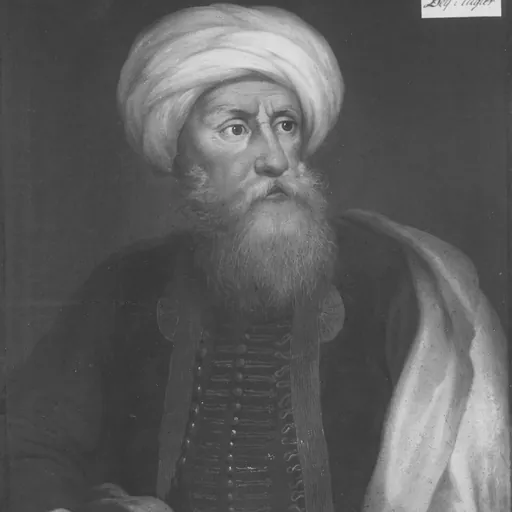
About Trabluslu Ali Pasha
Lived 1750 – 1804 (aged 53–54). Trabluslu Ali Pasha was a Turkish politician.
Trabluslu Ali Pasha (Ali Pasha the Tripolitan; died February 1804), also known as Cezayirli Ali Pasha (Ali Pasha the Algerian) or Seydi Ali Pasha, or Ali Burghol (Burghul) was an Ottoman statesman. He served as the Ottoman governor of Egypt from July 1803 to February 1804.
Background Ali Pasha was born in Georgia and kidnapped together with his brother. He was "fair-complexioned", had an "immense blond beard and mustache", and spoke Turkish as his native tongue, speaking very little Arabic. He was a slave owned by the Dey of Algiers known as Mohammed ben Uthman, but he eventually rose to a post in the provincial government.
After procuring a ship, Ali Pasha sailed to his hometown of Tripoli and briefly wrested control over the Kingdom of Tripolitania from the long-ruling Karamanli dynasty for the Ottoman Empire. The inhabitants of the province reportedly helped him gain control of Tripolitania, since they realized that he was the legitimate Ottoman governor.
Ali Pasha then went on the Hajj (pilgrimage) to Mecca, and there, he was allegedly discovered to be engaging in sexual intercourse with a young boy that he had kidnapped from Tripoli, after which many of the pilgrims attacked him, cut off his beard, and nearly killed him. Ibrahim Bey was also the lifelong career partner of Ali Pasha's friend Murad Bey, with whom he made up the duumvirate that held effective rule over Egypt for decades. Muhammad Ali refused to recognize Ali Pasha's governorship, and thus, Ali Pasha governed from Alexandria in the north while Ibrahim Bey governed from Cairo, the capital, in the south.
Muhammad Ali and his Mamluk ally, Al-Bardisi, therefore descended on Rosetta, which had fallen into the hands of Ali Pasha's brother, al-Sayyid Ali .
At this point, the Albanians managed to seize Ali Pasha's transport boats, capturing soldiers, servants, ammunition, and baggage. They then demanded to know why he had brought such a large host with him, contrary to both custom and a prior warning to not do so. Finding his advance blocked, reluctant to retreat with his forces to Alexandria, and being surrounded by the enemy in any case, Ali Pasha attempted to give battle, but his men refused to fight. He therefore abandoned his troops and went over to the camp of the Mamluk beys. His army was eventually allowed to retire to Syria. This gave the Mamluks a welcome pretext to rid themselves of him. Ali Pasha was sent under an escort and guard of 45 troops towards the Syrian frontier; about a week later on February 2, news was received in Cairo that during a skirmish with some of his own soldiers, he had died.
Don’t just read it —
keep it.
Full-length biographies made to live with: read them, listen on the way to work, watch them tonight.
- E-book
- Audio
- Video
Instant download · yours to keep · every purchase keeps this site free
Important facts
People in Trabluslu Ali Pasha's life
Named in this biography and alive at the same time


Related people
Same field, nearest in time



Contemporaries
People whose lives overlapped Trabluslu Ali Pasha's





Frequently asked questions
Who was Trabluslu Ali Pasha?
Ottoman statesman of Georgian descent (d. 1804)
When was Trabluslu Ali Pasha born?
Trabluslu Ali Pasha was born in 1750 in Georgia (country).
When did Trabluslu Ali Pasha die?
Trabluslu Ali Pasha died on 1 February 1804 in Syria.
What was Trabluslu Ali Pasha's occupation?
Trabluslu Ali Pasha was a politician.
What nationality was Trabluslu Ali Pasha?
Trabluslu Ali Pasha was Turkish.
Sources & further reading
· Wikipedia: Trabluslu Ali Pasha
· DBpedia: Trabluslu Ali Pasha
Cite this page
APA: Biography.guide. (2026). Trabluslu Ali Pasha. https://biography.guide/trabluslu-ali-pasha/
MLA: "Trabluslu Ali Pasha." Biography.guide, https://biography.guide/trabluslu-ali-pasha/.
Chicago: "Trabluslu Ali Pasha." Biography.guide. https://biography.guide/trabluslu-ali-pasha/.
Data last updated: 2026-09-22 · Spot an error? Report a correction.
Portrait: Wikimedia Commons · author & licence
Page generated 2026-09-27 05:03 UTC