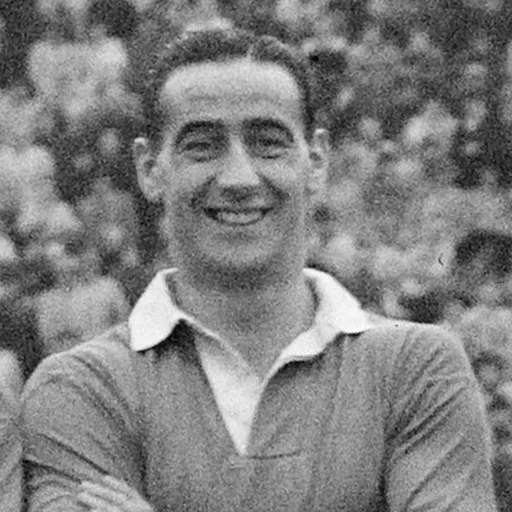
About Tommy Walker
Lived 1915 – 1993 (aged 77). Tommy Walker was a British association football player and association football coach.
Thomas Walker OBE (26 May 1915 – 11 January 1993) was a Scottish footballer, who played as an inside forward for Heart of Midlothian, Chelsea and the Scotland national team. He later managed Hearts and Raith Rovers before becoming a director of Hearts in his later years. Lauded for his Corinthian spirit and gentlemanly conduct, he is remembered as one of Hearts' all-time greats. Walker has been described as the most influential man ever to be associated with Heart of Midlothian.
Playing career
Heart of Midlothian Born in Livingston, West Lothian, Walker had originally harboured an ambition to become a Church of Scotland minister; however, his early footballing skills, which saw him recognised by Scotland at schoolboy level, ensured he was destined for a career on the pitch rather than in the pulpit.
A talented and elegant inside forward, Walker quickly earned a place in the Hearts first team, helping the side to victory in the 1933 Jubilee edition of the Rosebery Charity Cup, in a season in which they finished 3rd in the league. He was a regular first team player by 1933–34 but despite some emphatic victories, inconsistent form limited Hearts to a sixth-place finish.
In 1934–35, Arsenal expressed interest in signing Walker, and the potential £12,000 fee mooted would have been a world record. However, despite this interest and a later enquiry from Liverpool, Walker had by this stage become Hearts marquee player and the threat of a supporters boycott persuaded the Hearts board not to sell.
However, despite scoring 192 league goals for Hearts and playing in sides boasting numerous internationals, such as Scots Dave McCulloch, Barney Battles, Andy Anderson and Alex Massie, Welshman Freddie Warren and Irishman Willie Reid, Walker was destined not to win a major honour as a player at Tynecastle. The closest Hearts came to success during his period there was a second place league finish in 1937–38.
The Army and Chelsea The outbreak of global hostilities in 1939 led to the cessation of League football in Scotland. Many footballers joined the armed forces, particularly in Edinburgh where few local industries were deemed suitable for reserved occupation status. Walker joined the Army as a sergeant in the Signals Regiment, and played for the famous Army footballing "All-Stars" team. Walker also guested for Chelsea, for whom he played several games, during the 1944–45 season. When the war ended, he joined Chelsea permanently The Blues paid Hearts £6,000 for his services in September 1946. Walker's arrival completed the club's impressive new forward line, which also included Tommy Lawton and Len Goulden. He made 103 appearances and scored 24 goals during his two and a half years in west London.
Scotland Walker made his debut for Scotland against Wales in 1934, aged only 19, and he was to remain a regular in the side over the following five seasons. In November 1935 he scored his first international goal on familiar territory, helping Scotland defeat Ireland 2–1 at Tynecastle.
His most important performances for Scotland, and those which endeared him most to the Tartan Army, were against England at Wembley. In 1936, when trailing 1–0, Scotland were awarded a late penalty, which Walker volunteered to take. Twice the young inside forward spotted the ball and twice the swirling wind blew it from the penalty spot. On each occasion, Walker calmly returned the ball and, displaying nerves of steel, converted the penalty at the third attempt. Two years later on 9 April 1938, Walker's 5th minute shot from just inside the penalty box was the only goal of the game against England, which also gave Walker the honour of being the first player to score a goal live on television.
Walker earned a total of 21 caps, during which he scored 9 goals. He scored in five consecutive games from April to December 1938. All but one of these caps were obtained before the age of 25 and had the Second World War not intervened, he would have garnered considerably more. If the ten caps he earned in wartime internationals were to count, he would have become the most capped Scottish player. He also won five Scottish League XI caps, scoring two goals.
Managerial career
1950s In December 1948, Walker left Chelsea to return to Hearts as player-assistant to manager Davie McLean. McLean's intention was that Walker would be a steadying influence in a developing young team. However, after a single emergency appearance standing in at right-half for a regular player in a 1–0 home defeat by Dundee, Walker wisely retired to concentrate fully on learning the managerial ropes. Tangible progress was made in the League championship in 1949–50, when Hearts finished third. As Walker had become more influential, McLean was co-opted to the Hearts board of directors on 16 March 1950.
McLean's death on 14 February 1951 saw Walker promoted to the position of manager. Walker's reign was to prove the most successful period in the club's history. Walker was always quick to acknowledge the contribution made by McLean and his fatherly interest in the welfare and development of the players. The important foundations Walker inherited from McLean included the Terrible Trio forwards (Willie Bauld, Alfie Conn Sr. and Jimmy Wardhaugh), the full back pair of Bobby Parker and Tam McKenzie, and half backs Bobby Dougan and Davie Laing. To this established core John Cumming had recently broken through to the first team, first as a left winger and then in the left half position he was to dominate for many years. Freddie Glidden was already at Tynecastle but yet to first team debut, as was the then schoolboy Dave Mackay. Walker made Parker the team Captain. Both went on to become full Scotland internationalists while playing for Hearts.
The team was boosted by the signing of Ian Crawford in August 1954. Mackay was given a regular place in the team in the 1954–55 season, following the transfer of Laing to Clyde in September. It was from this point that Walker settled on Mackay, Glidden and Cumming as his combination for the number four, five and six jerseys. They promptly became a trophy winning force, lifting the first of seven trophies over nine seasons between 1954 and 1963. In October of the 1954–55 season Hearts won their first trophy since 1906, as they beat Motherwell 4–2 in the 1954 Scottish League Cup Final.
After signing Alex Young and Bobby Kirk, Walker's side proceeded to win the 1955–56 Scottish Cup. They thrashed Rangers 4–0 in the quarter finals with goals from Crawford, Conn and a Bauld double. Cumming's commitment to the team was typified in that 1956 Scottish Cup Final before 132,840 fans. With blood streaming from a first half head injury from a clash with Celtic's Willie Fernie he said, "Blood doesn't show on a maroon jersey". He returned to the playing field in the 3–1 win and was man of the match. Glidden lifted the trophy as Hearts captain in what he recalled as the "sweetest" moment in his footballing career. The days of the Terrible Trio as a combined force were nearing their end. This precipitated a poor run of only two wins from the next seven games. Mackay left for £32,000 the following March for Tottenham Hotspur. Hearts fought back into contention and a 2–0 defeat of Rangers in April gave them a chance with two games remaining. The last day of the season began with Rangers two points clear and needing a point to clinch the title. Rangers lost 2–1 at home to Aberdeen, but Hearts also lost by the same score. and paid for an operation on the offending ankle himself. Walker then signed Smith for Hearts, who had been his boyhood heroes. Subsequently, Hearts were instrumental in pushing through a change to use goal difference to separate teams level on points. Ironically this rule change later denied Hearts the title in 1985–86. National team!!Year!!Apps!!Goals
Scores and results list Scotland's goal tally first, score column indicates score after each Walker goal.
Honours
As manager Heart of Midlothian Scottish League Championship: 1957–58, 1959–60 Scottish Cup: 1955–56 Scottish League Cup: 1954–55, 1958–59, 1959–60, 1962–63
Don’t just read it —
keep it.
Full-length biographies made to live with: read them, listen on the way to work, watch them tonight.
- E-book
- Audio
- Video
Instant download · yours to keep · every purchase keeps this site free
Important facts
People in Tommy Walker's life
Named in this biography and alive at the same time







Related people
Same field, nearest in time



Contemporaries
People whose lives overlapped Tommy Walker's





Frequently asked questions
Who was Tommy Walker?
Scottish footballer (1915-1993)
When was Tommy Walker born?
Tommy Walker was born on 26 May 1915 in Livingston.
When did Tommy Walker die?
Tommy Walker died on 11 January 1993 in Edinburgh.
What was Tommy Walker's occupation?
Tommy Walker was an association football player and association football coach.
What nationality was Tommy Walker?
Tommy Walker was British.
Sources & further reading
· DBpedia: Tommy Walker (footballer, born 1915)
Cite this page
APA: Biography.guide. (2026). Tommy Walker. https://biography.guide/tommy-walker-association-football-player-1915/
MLA: "Tommy Walker." Biography.guide, https://biography.guide/tommy-walker-association-football-player-1915/.
Chicago: "Tommy Walker." Biography.guide. https://biography.guide/tommy-walker-association-football-player-1915/.
Data last updated: 2026-09-21 · Spot an error? Report a correction.
Portrait: Wikimedia Commons · author & licence
Page generated 2026-09-27 04:59 UTC