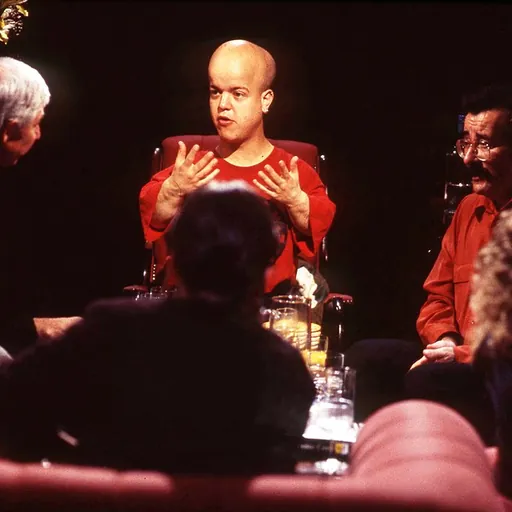
About Tom Shakespeare
Born 1966. Tom Shakespeare is a British sociologist, geneticist, artist, university teacher and researcher.
Sir Thomas William Shakespeare, 3rd Baronet (born 11 May 1966) is an expert on disability rights, genetics and bioethics, as well as an author of two fiction novels. He has achondroplasia and uses a wheelchair.
Early life and education Shakespeare's grandfather, Sir Geoffrey Shakespeare, was made a baronet following long service as a Member of Parliament for Norwich from 1929–1945, occupying various senior government roles. When his father, Sir William Geoffrey Shakespeare, died in 1996, Tom Shakespeare inherited his baronetcy, but does not use the title "Sir". His mother Susan Mary, daughter of A. Douglas Raffel, of Colombo, Sri Lanka, was a nurse of Sri Lankan Burgher descent.
Shakespeare's younger brother is Canon James Douglas Geoffrey Shakespeare, vicar of St John the Evangelist church, Cherry Hinton, Cambridge. His father's maternal half-brother was Conservative politician Sir Nigel Fisher.
Shakespeare was educated at Radley College, Oxfordshire, taking A-levels in English, History, and History of Art; and at Pembroke College, Cambridge, where he matriculated in 1984 to read Anglo-Saxon, Norse and Celtic, completing Part 1 of that tripos in 1986 before switching to read Social and Political Sciences in Part II, graduating in 1987 with a BA Hons in Sociology.
Shakespeare returned to Cambridge in 1989, shifting to King's College, Cambridge, where he completed a PhD in Sociology in 1995.
Shakespeare was a Technical Officer in the Disability and Research Team at the World Health Organization (WHO) from 2008 to 2013, and based in Geneva. He was a coauthor and coeditor of the 2011 World Report on Disability, published by WHO and the World Bank.
He was Professor of Disability Research at Norwich Medical School, University of East Anglia (UEA) from 2013 to 2018. At UEA, his research included group singing and its beneficial effects against depression and anxiety; the findings were published in the academic journal Medical Humanities.
Since 2018 Shakespeare has been Professor of Disability Research in the medical faculty at the London School of Hygiene and Tropical Medicine. His work includes research on disability in sub-Saharan Africa and South Asia.
Shakespeare was a member of the Nuffield Council on Bioethics from 2013 to 2019 during which time he worked on ideas about naturalness in debates about science, technology and medicine and chaired the Council's working group on Non-Invasive Prenatal Testing (NIPT) which published guidelines on the ethical implications of screening for genetic conditions in pregnancy in 2017. thumb Shakespeare giving a speech at De Montfort University in 2017In his writing on disability and public commentary, Shakespeare has at times challenged disability orthodoxy on issues such as the social model of disability, assisted dying, and selective abortion, and emphasised the importance of evidence.
Publications Shakespeare's books on disability include:
The Sexual Politics of Disability (1996) (co-authored) Disability Rights and Wrongs (2006) and Disability Rights and Wrongs Revisited (2014) Genetic Politics: From Eugenics to Genome (Issues in Social Policy) (2002), co-authored with Anne Kerr
He edited Arguing About Disability (2010, Routledge).
He has published two fictional novels which feature protagonists with disabilities, The Ha Ha (2024) and The Ends (2025).
Shakespeare also wrote Awkward Beauty: The Art of Lucy Jones (2019) about Lucy Jones, a British artist with cerebral palsy.
Culture and Media In 1991, Shakespeare helped to set up the Northern Disability Arts Forum in Newcastle, and began compering and working in stand-up comedy, including about his disability and achondroplasia, and also performance art, including performing his theatre lecture No Small Inheritance at The Sage Gateshead in 2006. He served as Chair of Arts Council England, North East and was a member of the Arts Council of England from 2003 to 2008.
Shakespeare's Incarnate series (2008) is held by SHAPE Arts, an important collection of artwork by disabled artists. It is a photographic triptych centring on the theme of human embodiment and inspired by the Gothic Nightmares exhibition at Tate Britain. It includes The Nightmare (After Fuseli), Figure with Meat (After Bacon) and Dead Christ (After Mantegna). The reimagining of Fuseli's The Nightmare alludes to the complex moral dilemmas that modern technology and screening throws up for women in pregnancy, an area of Shakespeare's research.
He regularly contributed to the Ouch! disability blog on the BBC website and was a regular contributor to BBC Radio 4 A Point of View on a variety of topics . He regularly contributes to other radio and TV news and current affairs programmes including BBC Radio 4 Front Row, BBC Question Time, Radio 4 Today, BBC Newsnight, CNN and Al Jazeera. Shakespeare has authored three TV documentaries: Ivy's Genes (about his daughter), Who Stole My Parking Space, and The Unusual Suspects. He represented King's College in the University Challenge 2021 Christmas specials 2021 which featured distinguished alumni, beating University of Bristol . He described his experiences on BBC Radio 4's Point of View. In 2016, Shakespeare featured on the ITV show 500 Questions, winning £14,000 by answering 42 out of 50 questions. He received a standing ovation for his efforts.
Recognition
From 2005-2008 Shakespeare was a Fellow of the National Endowment of Science, Technology and the Arts.
Shakespeare was appointed Commander of the Order of the British Empire (CBE) in the 2021 Birthday Honours for services to disability research.
A 2017 oil on canvas portrait Tom Shakespeare: Intellect, with Wheels by Lucy Jones is displayed in the National Portrait Gallery.
Shakespeare is on the Board of Light for the World International and chair of Light for the World – UK.
Personal life Shakespeare is a Quaker. He delivered the 2020 Swarthmore Lecture, titled "Openings to the Infinite Ocean: A Friendly Offering of Hope".
In 2002, Shakespeare married dancer and disability rights campaigner Caroline Bowditch. By 2010, he had split from his wife and was living in Geneva with his partner, Alana.
Owing to a spinal cord injury in 2008, Shakespeare mainly uses a wheelchair. He has two children, both of whom also have achondroplasia; his daughter Ivy is a social worker, and his son Robert is a civil servant. His first grandchild was born in 2020. He lives in Oval, London.
Don’t just read it —
keep it.
Full-length biographies made to live with: read them, listen on the way to work, watch them tonight.
- E-book
- Audio
- Video
Instant download · yours to keep · every purchase keeps this site free
Important facts
People in Tom Shakespeare's life
Named in this biography and alive at the same time





Related people
Same field, nearest in time
Contemporaries
People whose lives overlapped Tom Shakespeare's


Frequently asked questions
Who is Tom Shakespeare?
British sociologist (*1966)
When was Tom Shakespeare born?
Tom Shakespeare was born on 11 May 1966.
What is Tom Shakespeare's occupation?
Tom Shakespeare is a sociologist, geneticist, artist, university teacher and researcher.
What nationality is Tom Shakespeare?
Tom Shakespeare is British.
Sources & further reading
Cite this page
APA: Biography.guide. (2026). Tom Shakespeare. https://biography.guide/tom-shakespeare/
MLA: "Tom Shakespeare." Biography.guide, https://biography.guide/tom-shakespeare/.
Chicago: "Tom Shakespeare." Biography.guide. https://biography.guide/tom-shakespeare/.
Data last updated: 2026-09-20 · Spot an error? Report a correction.
Portrait: Wikimedia Commons · author & licence
Page generated 2026-09-27 04:57 UTC