
About Tom Burns
Lived 1857 – 1902 (aged 44). Tom Burns was an American baseball player.
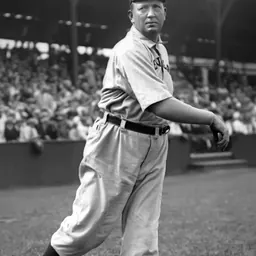
Thomas Everett Burns (March 30, 1857 – March 19, 1902) was an American infielder and manager in Major League Baseball, primarily for the Chicago White Stockings/Colts/Orphans. He also played for, and managed, the Pittsburgh Pirates for part of one season, and he returned to the Chicago team for two years as its manager after his major-league playing career ended.
In the last few years of his life, Burns managed in the minor leagues. He died of heart problems in New Jersey at the age of 44. His brother, John Burns, was a National League umpire.
Early life and playing career Burns was born in 1857 in Honesdale, Pennsylvania. He joined the Chicago team in the National League (then known as the White Stockings) in 1880. A nondrinker and nonsmoker, Burns stayed on the good side of Chicago manager Cap Anson because of his tame lifestyle.
From 1883 to 1889, Burns was part of a Chicago infield combination that manager Cap Anson described as a "stonewall infield". Some sportswriters also picked up the term, even though several infields had better fielding statistics. Burns led the league in putouts and assists multiple times. His three hits and three runs set single-inning records; teammates Ned Williamson and Fred Pfeffer also had three hits in the inning.
In 1888, Burns was a member of an American baseball team that left the U.S. on a world baseball tour that would end up in Australia. Transitioning into a player-manager role, Burns led a talented Pittsburgh Pirates team. Though the team had two future members of the Baseball Hall of Fame – Joe Kelley and Jake Beckley – the team started the season with a 25–30 record and Burns was dismissed.
From 1893 through 1897, Burns became a minor-league manager with the Springfield Ponies of the Eastern League, and he made appearances as a player for the Ponies until 1896. In 1898, the Chicago Orphans initially denied that Burns was being hired to replace Anson. Anson had written a letter to Burns in which he said that Burns was his ideal successor, but Anson said that it had not been written with the thought that he would actually resign.
Despite the initial denials, Burns did become Chicago's manager for 1898 and 1899. Burns returned as the Springfield manager in 1900, and he managed the Buffalo Bisons for part of the 1901 season.
Death Before the 1902 baseball season, Burns was hired as the manager of an Eastern League team based in Jersey City, New Jersey. On a mid-March trip to that area, he became ill. Patrick T. Powers, the president of the Eastern League, invited Burns to his home to rest. Burns said that he felt better on the evening of March 18, but he was found dead in bed at Powers's home the next morning. A doctor was consulted, and he attributed the death to heart disease. He is interred St. Michael Cemetery in Springfield, Massachusetts.
Don’t just read it —
keep it.
Full-length biographies made to live with: read them, listen on the way to work, watch them tonight.
- E-book
- Audio
- Video
Instant download · yours to keep · every purchase keeps this site free
Important facts
People in Tom Burns's life
Named in this biography and alive at the same time



Related people
Same field, nearest in time


Contemporaries
People whose lives overlapped Tom Burns's




Frequently asked questions
Who was Tom Burns?
American baseball player (1857–1902)
When was Tom Burns born?
Tom Burns was born on 30 March 1857 in Honesdale.
When did Tom Burns die?
Tom Burns died on 19 March 1902 in Jersey City.
What was Tom Burns's occupation?
Tom Burns was a baseball player.
What nationality was Tom Burns?
Tom Burns was American.
Sources & further reading
· DBpedia: Tom Burns (baseball)
Cite this page
APA: Biography.guide. (2026). Tom Burns. https://biography.guide/tom-burns-baseball-player/
MLA: "Tom Burns." Biography.guide, https://biography.guide/tom-burns-baseball-player/.
Chicago: "Tom Burns." Biography.guide. https://biography.guide/tom-burns-baseball-player/.
Data last updated: 2026-09-20 · Spot an error? Report a correction.
Page generated 2026-09-27 05:34 UTC