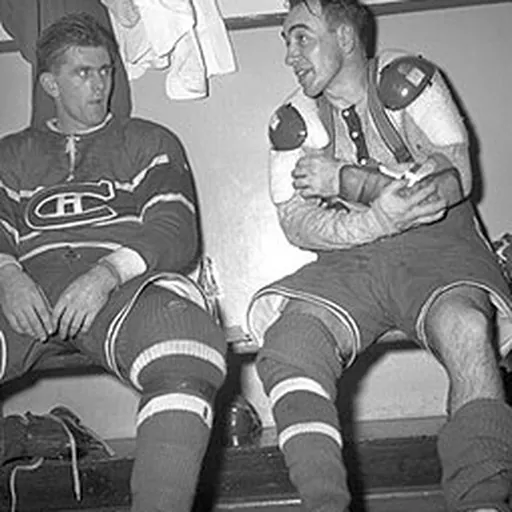
About Toe Blake
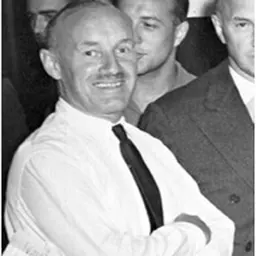
Lived 1912 – 1995 (aged 82). Toe Blake was a Canadian ice hockey player and ice hockey coach.
Joseph Hector "Toe" Blake (August 21, 1912 – May 17, 1995) was a Canadian ice hockey player and coach in the National Hockey League (NHL). Blake played in the NHL from 1935 to 1948 with the Montreal Maroons and Montreal Canadiens. He led the NHL in scoring in 1939, while also winning the Hart Trophy for most valuable player, and served as captain of the Canadiens from 1940 to his retirement. He won the Stanley Cup three times as a player: in 1935 with the Maroons, and in 1944 and 1946 with the Canadiens. While with the Canadiens, Blake played on a line with Elmer Lach and Maurice Richard which was dubbed the Punch line, as all three were highly-skilled players. In 2017, Blake was named one of the '100 Greatest NHL Players' in history. He was also known as "The Old Lamplighter" due to his skill for putting the puck in the net.
Blake retired as a player in 1951, and soon after turned to coaching. After several years in lower leagues he was named the Canadiens' coach in 1955, and would remain in that role until his retirement in 1968. He was the first coach to win 500 games with one team. As coach of the Canadiens he won the Stanley Cup a further eight times, and helped Montreal become one of the most dominant teams in NHL history.
Early life Blake was one of 13 children to Wilmer and Arzélie Blake (11 survived childhood). Wilmer (born 1874) was originally from Massachusetts and had moved to Canada around 1896, and was of English and Irish ancestry. Arzélie was born in Buckingham, Quebec in 1877; her family, the Filions, had arrived in Quebec in the 17th century. Wilmer and Arzélie married in 1898, and shortly after moved to Sudbury, Ontario for work. Soon after Blake's birth the family moved to Coniston, as the mine Wilmer had been working at was slowly closing.
Playing career
Blake played junior and senior hockey in the Sudbury area and was part of the 1932 Memorial Cup champions, the Sudbury Cub Wolves. He played for the Hamilton Tigers of the Ontario Hockey Association during the 1934–35 season before he signed with the Montreal Maroons of the National Hockey League on February 22, 1935; he made his NHL debut two days later on February 24, against the Chicago Black Hawks. Blake played eight games with the Maroons in the 1934–35 season, but was held scoreless; he did not play in any of the team's playoff games, but when the Maroons won the Stanley Cup, Blake's name was added to the trophy. Blake then played for the Canadiens until his retirement in 1948. He won the Hart Memorial Trophy as the NHL's Most Valuable Player in 1938–39; that same year he was also the league scoring champion with 47 points. For the last eight seasons, he was team captain, and led the Canadiens to Stanley Cups in 1944 and 1946. In the latter year, in which he incurred only one minor penalty, he became the first Canadien ever to win the Lady Byng Memorial Trophy for sportsmanship, which only Mats Näslund (in 1987–88) and Cole Caufield (in 2025–26) have replicated.
While playing with the Canadiens, he was part of a trio called the "Punch Line," with Elmer Lach at centre and Maurice Richard at right wing. He scored the Stanley Cup-clinching goal in the 1944 Stanley Cup Final at 9:12 of the first overtime of game four, helping the Canadiens complete a four-game sweep of the Chicago Blackhawks. The following season, the Punch Line became the second set of linemates ever to finish first, second, and third in NHL scoring in one season (Lach had 80 points, Richard 73, and Blake 67). They followed the Boston Bruins' Kraut Line of 1939–40, and would be followed by the Detroit Red Wings' Production Line in 1949–50.
During a loss to the New York Rangers on January 11, 1948, In 1998, he was ranked number 66 on The Hockey News’ list of the NHL's 100 greatest players of all time to date. At the time of his retirement from the NHL Blake was second all-time in career scoring with 527 points, 21 points behind Bill Cowley for the all-time record. He had the all-time record for career points in the playoffs with 62 points in 58 games.
Coaching career After eight years coaching several of the Canadiens' minor-league affiliates, he was named head coach of the Canadiens on June 8, 1955, replacing Dick Irvin. Blake was fluently bilingual in English and French, and Canadiens management also felt that Richard's former linemate was better suited to control the star's explosive temper (which had led to a riot the past spring).
Blake coached the Canadiens for thirteen years, winning the Stanley Cup eight times — the most titles for any coach in the team's history, the most with one team, and second-most league-wide behind Scotty Bowman, who won nine Stanley Cups in total (five Cups with the Canadiens, one with the Pittsburgh Penguins, and three with the Detroit Red Wings.) His 500 regular-season wins are still the most in Canadiens history.
Blake retired after the Habs clinched the Cup in game four of the 1968 Finals, ending 33 consecutive years at ice level with the Canadiens organization.
Personal life Born in what is now the ghost town of Victoria Mines, Blake was raised playing outdoor hockey in the town of Coniston near the city of Sudbury in Northern Ontario.
His nickname came from a childhood experience: his younger sister had difficulty pronouncing his name, rendering it as something like "Hec-toe". Thus, the nickname "Toe" arose, and ultimately replaced the nickname he had been given as a scorer, the Old Lamplighter, because he often activated the light behind the goal. The tavern closed in 1983. When respected writer Red Fisher visited him in the nursing home in 1989, Blake could not recognize his old friend. Blake died on May 17, 1995,
Career statistics
Regular season and playoffs Regular seasonPlayoffs Season Team League GP G A Pts PIM GP G A Pts PIM 1929–30 Cochrane Dunlops NOJHA 7 3 0 3 4 — — — — — 1930–31 Sudbury Cub Wolves NOJHA 6 3 1 4 12 2 0 0 0 6 1930–31 Sudbury Industries NOHA 8 7 1 8 10 3 1 1 2 4 1930–31 Sudbury Cub Wolves M-Cup — — — — — 5 4 1 5 6 1930–31 Sudbury Wolves Al-Cup — — — — — 3 3 1 4 0 1931–32 Sudbury Cub Wolves NOJHA 3 5 0 5 4 — — — — — 1931–32 Falconbridge Falcons NOHA 10 8 1 9 18 2 1 0 1 2 1932–33 Hamilton Tigers OHA Sr 22 9 4 13 26 2 0 0 0 2 1933–34 Hamilton Tigers OHA Sr 23 19 14 33 28 3 4 3 7 4 1933–34 Hamilton Tigers Al-Cup — — — — — 8 5 2 7 4 1934–35 Hamilton Tigers OHA Sr 18 15 11 26 48 — — — — — 1934–35 Montreal Maroons NHL 8 0 0 0 0 1 0 0 0 0 1935–36 Providence Reds Can-Am 33 12 11 23 65 7 2 3 5 2 1935–36 Montreal Canadiens NHL 11 1 2 3 28 — — — — — 1936–37 Montreal Canadiens NHL 43 10 12 22 12 5 1 0 1 0 1937–38 Montreal Canadiens NHL 43 17 16 33 33 3 3 1 4 2 1938–39 Montreal Canadiens NHL 48 24 23 47 10 3 1 1 2 2 1939–40 Montreal Canadiens NHL 48 17 19 36 48 — — — — — 1940–41 Montreal Canadiens NHL 48 12 20 32 49 3 0 3 3 5 1941–42 Montreal Canadiens NHL 48 17 28 45 19 3 0 3 3 2 1942–43 Montreal Canadiens NHL 48 23 36 59 26 5 4 3 7 0 1943–44 Montreal Canadiens NHL 41 26 33 59 10 9 7 11 18 2 1944–45 Montreal Canadiens NHL 49 29 38 67 25 6 0 2 2 5 1945–46 Montreal Canadiens NHL 50 29 21 50 2 9 7 6 13 5 1946–47 Montreal Canadiens NHL 60 21 29 50 6 11 2 7 9 0 1947–48 Montreal Canadiens NHL 32 9 15 24 4 — — — — — 1948–49 Buffalo Bisons AHL 18 1 3 4 0 — — — — — 1949–50 Valleyfield Braves QSHL 43 12 15 27 15 3 0 1 1 0 1950–51 Valleyfield Braves QSHL — — — — — 1 0 0 0 0 NHL totals 577 235 292 527 282 57 25 37 62 23 Source: Total Hockey
Coaching record
Awards Stanley Cup champion — 1935 (with Montreal Maroons as a player) Stanley Cup champion — 1944, 1946 (with Montreal Canadiens as a player) Stanley Cup champion — 1956, 1957, 1958, 1959, 1960, 1965, 1966, 1968 (head coach of Montreal Canadiens) Hart Trophy — 1939 Scoring Leader — 1939 Lady Byng Trophy — 1946 NHL first team All-Star — 1939, 1940, 1945 NHL second team All-Star — 1938, 1946 In January, 2017, Blake was part of the first group of players to be named one of the '100 Greatest NHL Players' in history.
Don’t just read it —
keep it.
Full-length biographies made to live with: read them, listen on the way to work, watch them tonight.
- E-book
- Audio
- Video
Instant download · yours to keep · every purchase keeps this site free
Important facts
People in Toe Blake's life
Named in this biography and alive at the same time

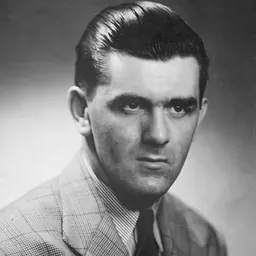

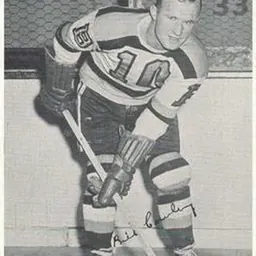




Related people
Same field, nearest in time

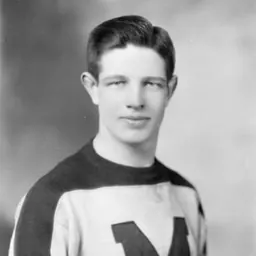



Contemporaries
People whose lives overlapped Toe Blake's





Frequently asked questions
Who was Toe Blake?
Canadian ice hockey player (1912–1995)
When was Toe Blake born?
Toe Blake was born on 21 August 1912 in Ontario.
When did Toe Blake die?
Toe Blake died on 17 May 1995 in Montreal.
What was Toe Blake's occupation?
Toe Blake was an ice hockey player and ice hockey coach.
What nationality was Toe Blake?
Toe Blake was Canadian.
Sources & further reading
Cite this page
APA: Biography.guide. (2026). Toe Blake. https://biography.guide/toe-blake/
MLA: "Toe Blake." Biography.guide, https://biography.guide/toe-blake/.
Chicago: "Toe Blake." Biography.guide. https://biography.guide/toe-blake/.
Data last updated: 2026-09-21 · Spot an error? Report a correction.
Portrait: Wikimedia Commons · author & licence
Page generated 2026-09-27 04:58 UTC