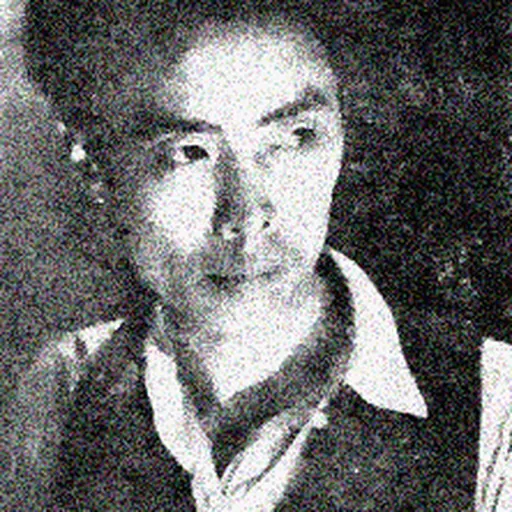
About Tian Han
Lived 1898 – 1968 (aged 70). Tian Han was a Chinese poet, writer, playwright, songwriter and translator.
Tian Han (田漢; simplified 田汉; 12 March 1898 – 10 December 1968), formerly romanized as T'ien Han, was a Chinese drama activist, playwright, a leader of revolutionary music and films, as well as a translator and poet. He emerged at the time of the New Culture Movement of the early 20th century and continued to be active until the Cultural Revolution, when he was denounced and jailed for two years until his death, before being "posthumously rehabilitated" by the Chinese authorities in 1979. He is considered by drama historians as one of the three founders of Chinese spoken drama, together with Ouyang Yuqian and Hong Shen. His most famous legacy may be the lyrics he wrote for "March of the Volunteers" in 1934, which were later adopted as the national anthem of the People's Republic of China.
Biography
During the May Fourth Movement in 1919, Tian became famous for the vigorous anti-imperialist and anti-feudalist activities in the circle of left-leaning artists and intellectuals he gathered.
Tian was educated at Tokyo Higher Normal School (present-day University of Tsukuba) in Japan. Returning from Japan in 1921, Tian established the Creation Society together with Guo Moruo and Yu Dafu, and other Chinese intellectuals. The Southern China Society, also headed by Tian, played a leading role in promoting dramatic performances in southern China. In 1927, Tian taught at the Department of Literature of Shanghai Art University. Later, he joined The League of Chinese Left-Wing Dramatists. In 1934, he collaborated with the activist Liu Liangmo on the patriotic anthem, March of the Volunteers.
Tian used various aliases and pen names including his courtesy name Tián Shòuchāng , Bóhóng , Chén Yú , Shùrén , and Hànxiān .
Tian, then Chairman of the Union of Chinese Drama Workers and Vice-Chairman of the All China's Federation of Literary and Art Circles, was targeted by the Gang of Four and attacked during the Cultural Revolution in 1966 for his historical play Xie Yaohuan (1961), which was regarded as an attack on Chairman Mao's policies and the CCP leadership. Criticism of this play, along with two other historical plays (Hai Rui Dismissed from Office by Wu Han and Li Huiniang by Meng Chao), were the opening salvos of the Cultural Revolution. Tian was denounced in a 1 February 1966 People's Daily article entitled "Xie Yaohuan is a Big Poisonous Weed" (田汉的《谢瑶环》是一棵大毒草 Tián Hàn de Xiè Yáohuán Shì yī kē Dà Dúcǎo). The Jiefang Daily called Xie Yaohuan a "political manifesto". The play was condemned for, among other things, of "being a wholesale inheritance of China's theatrical legacy and promoting traditional plays", "disparaging revolutionary modern plays" and "promoting bourgeois class liberalism and obfuscating the direction for the workers, peasants and soldiers". Tian was subsequently persecuted by the Gang of Four and incarcerated as a "counterrevolutionary" in a prison which was run personally by Kang Sheng, and died there in 1968. Three Modern Women (1932) Sons and Daughters in a Time of Storm (1935) Women Side by Side (1949) A Test of Love (1958)
Song lyrics "March of the Volunteers" (1935) "The Wandering Songstress" (1937)
Translations Salomé (Oscar Wilde) (1921)
In popular culture Tian Han was the prototype for the figure of "Kuang Wentao" (played by Bo Gao) in the 1959 biopic Nie Er, which retold the story of the composition of the Chinese National Anthem on the 10th anniversary of the founding of the People's Republic. For the 50th anniversary in 1999, he was represented directly in the film The National Anthem, played by He Zhengjun. His story was also told in The National Anthem, a 27-episode television series, and in the play Torrent (, Kuángliú), produced in Beijing in the year 2000.
In the 2009 film The Founding of a Republic, he was portrayed by Donnie Yen.
Don’t just read it —
keep it.
Full-length biographies made to live with: read them, listen on the way to work, watch them tonight.
- E-book
- Audio
- Video
Instant download · yours to keep · every purchase keeps this site free
Important facts
Family & relationships
People in Tian Han's life
Named in this biography and alive at the same time




Related people
Same field, nearest in time

Contemporaries
People whose lives overlapped Tian Han's



Frequently asked questions
Who was Tian Han?
Chinese playwright, screenwriter, songwriter (1898-1968)
When was Tian Han born?
Tian Han was born on 12 March 1898 in Changsha County.
When did Tian Han die?
Tian Han died on 10 December 1968 in Beijing.
What was Tian Han's occupation?
Tian Han was a poet, writer, playwright, songwriter and translator.
What nationality was Tian Han?
Tian Han was Chinese.
Sources & further reading
Cite this page
APA: Biography.guide. (2026). Tian Han. https://biography.guide/tian-han/
MLA: "Tian Han." Biography.guide, https://biography.guide/tian-han/.
Chicago: "Tian Han." Biography.guide. https://biography.guide/tian-han/.
Data last updated: 2026-09-24 · Spot an error? Report a correction.
Portrait: Wikimedia Commons · author & licence
Page generated 2026-09-27 05:09 UTC