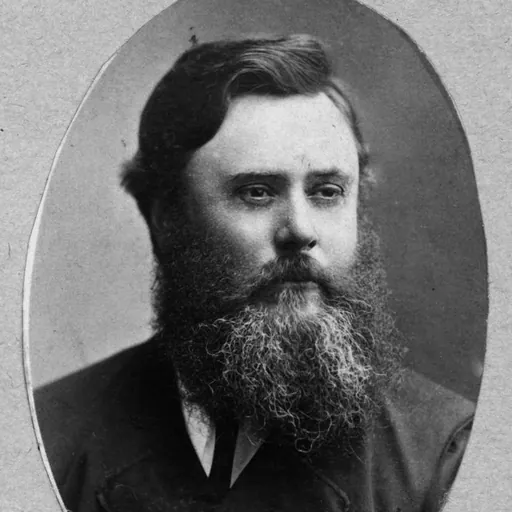
About Thomas Petrie
Lived 1831 – 1910 (aged 79). Thomas Petrie was a British explorer.
Thomas Petrie (31 January 1831 – 26 August 1910) was an Australian explorer, gold prospector, logger, and grazier. He was a Queensland pioneer.
Early life Petrie was born at Edinburgh, fourth son of Andrew Petrie and brother of John. His family travelled to Sydney, arriving in October 1831 and his father entered the government service as a supervisor of building.
They moved to the Moreton Bay penal colony (subsequently Brisbane) in 1837, where Thomas was educated by a convict clerk and allowed to mix freely with Aboriginal children. He learnt to speak the local language, Turrbal and was encouraged to share in all Aboriginal activities. He was witness to convicts labouring in chains on the government farms along the river and saw numerous floggings of convicts on Queen Street. Petrie was also in the crowd that watched the first hangings at the settlement in 1841, that of the Aboriginal men Nungavil and Mullan at The Old Windmill. At 14 he participated in a walkabout to a feast in the Bunya Mountains, chaperoned by Dalaipi. He was accepted by the Aboriginal people and was often used as a messenger and invited on exploration expeditions. He also learned about surveying, bushcraft and the local geography while travelling with his father.
Career In 1851 Petrie prospected for gold in the Turon region of New South Wales and spent the next five years on Victorian goldfields also known as 'finding only enough gold to make a ring!' since it was their motto. He returned to Brisbane a number of times and saw the botched public hanging of Dalla man Dundalli on 5 January 1855 "where now the Post Office stands". Petrie married Elizabeth Campbell in 1859 and shortly after the marriage, Petrie sought the advice of a local Aboriginal elder named Dalaipi for a good place to start a cattle station. Dalaipi's son, Dal-ngang showed him their ancestral land at Mandin (North Pine River) and offered it to Petrie. Dal-ngang expressed indignation when told this land had already been acquired by the Griffens as part of the Whiteside station. Petrie, after consulting with Mrs Griffen bought a ten square mile (26 km2) section of the property in the Pine Creek district and named it Murrumba, an Aboriginal word meaning "good place" (possibly Turrbal or Yugarabul based on location ). Aboriginal people helped him to clear his land and build his farm buildings.
On 26 June 1861, Thomas Petrie appeared at the proceedings of the Select Committee on the Native Police Force to give evidence. Petrie testified that 'nearly all [the old Brisbane tribes (sic) were] dead now' due to 'drink' being illegally supplied to them by Brisbane 'whites'. He testified Aboriginal people were 'useful' employees, and 'the bad conduct of the blacks (sic) [was] in great measure the fault of the white people themselves, and the way in which they treat them. [He had] been living where no one else was able to remain, and [he] had several hundred blacks (sic) about [him]'. Due to his unique experiences and relationship with Indigenous people of the area, Petrie's testimony was nuanced, provided insight into Aboriginal practices and culture, and countered negative myths or rumours about Aboriginal people.
Petrie continued to look for new timber and places suitable for European settlement. In 1862, he headed to the Maroochy River area with a group of 25 Aboriginal people that included Ker-Walli, Wanangga and Billy Dingy. On this journey, he became the first white man to climb Buderim Mountain and also ventured up the tributaries of the Maroochy River looking to exploit the large cedar growing there. At Petrie's Creek, he established a logging camp which was run by Aboriginal labour. At this camp, the Aboriginal workers requested that Petrie brand them with his logging symbol. This was done by using a piece of glass and then rubbing charcoal into the wound. He later surveyed a route from Cleveland to Eight Mile Plains. He also arranged for some Aboriginal people to welcome the Duke of Edinburgh in 1868. In 1877 the Douglas ministry established Queensland's first Aboriginal reserve on Bribie Island with Petrie as its chief adviser and overseer, but the reserve was closed in 1878 by colonial secretary Palmer. He was survived by his wife (who died aged 90 on 30 September 1926) and by two sons and five daughters of their nine children. Though Murrumba had been reduced to 3000 acres (12 km2) the family kept the property until 1952. In 1910 the name of the North Pine district was changed to Petrie in his honour.
Legacy In 1904 Tom Petrie's Reminiscences of Early Queensland was published, written by his daughter, Constance Campbell Petrie. The book is regarded as one of the best authorities on Brisbane's early days.
In 1910 the name of the North Pine district was changed to Petrie in his honour.
Don’t just read it —
keep it.
Full-length biographies made to live with: read them, listen on the way to work, watch them tonight.
- E-book
- Audio
- Video
Instant download · yours to keep · every purchase keeps this site free
Important facts
Family & relationships
People in Thomas Petrie's life
Named in this biography and alive at the same time

Related people
Same field, nearest in time


Contemporaries
People whose lives overlapped Thomas Petrie's



Frequently asked questions
Who was Thomas Petrie?
Australian explorer and linguist (1831-1910)
When was Thomas Petrie born?
Thomas Petrie was born on 31 January 1831 in Edinburgh.
When did Thomas Petrie die?
Thomas Petrie died on 26 August 1910 in Shire of Pine Rivers.
What was Thomas Petrie's occupation?
Thomas Petrie was an explorer.
What nationality was Thomas Petrie?
Thomas Petrie was British.
Sources & further reading
Cite this page
APA: Biography.guide. (2026). Thomas Petrie. https://biography.guide/thomas-petrie/
MLA: "Thomas Petrie." Biography.guide, https://biography.guide/thomas-petrie/.
Chicago: "Thomas Petrie." Biography.guide. https://biography.guide/thomas-petrie/.
Data last updated: 2026-09-22 · Spot an error? Report a correction.
Portrait: Wikimedia Commons · author & licence
Page generated 2026-09-27 05:00 UTC