
About Thomas Parker
Lived 1595 – 1677 (aged 81–82). Thomas Parker was a christian minister.
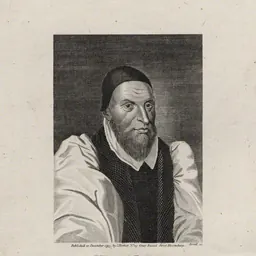
Thomas Parker (1595–1677) was an English nonconforming clergyman and a founder of Newbury, Massachusetts.
Early life in Europe Parker was born at Stanton St. Bernard, Wiltshire, the only son of the Revd. Robert Parker, M.A. and Dorothy Stevens. He received his schooling from his uncle William Noyes of Cholderton, Wiltshire, 'perhaps a godly, but a very severe master', who prepared him successfully for a University education. Following his father's departure into the Netherlands as a religious exile, Thomas matriculated sizar at Trinity College, Dublin at Michaelmas 1610. There he came to the attention of James Ussher, who, finding him a promising student, gave him encouragement. Returning to England he matriculated from Magdalen College, Oxford in April 1613: but a little more than a year later, in July 1614 (the year of his father's death at Doesburg, Gelderland) he registered as a student of Theology in the University of Leyden. He then proceeded to the University of Franeker, in Friesland, where he studied with his father's friend and colleague William Ames, taking his Master's degree on 1 April 1617. Parker returned to England, settling at Newbury in Berkshire, where he taught at St. Bartholomew's School, and served as assistant preacher to William Twisse. the tenth established in the colony. He remained at Newbury for the rest of his life,
With Noyes, Parker also prepared students for Harvard, refusing all compensation for his services. On John Woodbridge's return from England in 1663, he was made assistant to Parker, who had complained of failing eyesight in 1643, and towards the end of his life became quite blind. His blindness did not prevent Parker from continuing to teach, usually twelve or fourteen pupils at the James Noyes House, where he lived with Noyes. He taught languages with ease from memory. Samuel Sewall (a cousin of Shubael Dummer) was one of his scholars and wrote about Parker in his diary. During Parker's pastorate, a bitter controversy on the subject of church government divided his parish. The theses were published in London in 1657 as Methodus Divinae Gratiae in traductione hominis peccatoris ad vitam. They were objected to at the Synod of Dort, and by the theological faculty at Heidelberg, and were criticised in Parkerus Illustratus, authore Philo-Tileno, London, 1660, and The Examination of Tilenus before the Triers, by N.H., London, 1658 (by Laurence Womock). The book was dedicated to Philip, Earl of Pembroke and Montgomery, by Thomas Bayly, who states that the author sent the manuscript over to England with neither title nor dedication. She was his sister; her views were Fifth Monarchist.
Don’t just read it —
keep it.
Full-length biographies made to live with: read them, listen on the way to work, watch them tonight.
- E-book
- Audio
- Video
Instant download · yours to keep · every purchase keeps this site free
Important facts
People in Thomas Parker's life
Named in this biography and alive at the same time




Related people
Same field, nearest in time



Contemporaries
People whose lives overlapped Thomas Parker's





Frequently asked questions
Who was Thomas Parker?
minister (1595-1677)
When was Thomas Parker born?
Thomas Parker was born in 1595.
When did Thomas Parker die?
Thomas Parker died on 24 April 1677.
What was Thomas Parker's occupation?
Thomas Parker was a christian minister.
What nationality was Thomas Parker?
Thomas Parker's recorded nationality: British North America.
Sources & further reading
· DBpedia: Thomas Parker (minister)
Cite this page
APA: Biography.guide. (2026). Thomas Parker. https://biography.guide/thomas-parker-christian-minister/
MLA: "Thomas Parker." Biography.guide, https://biography.guide/thomas-parker-christian-minister/.
Chicago: "Thomas Parker." Biography.guide. https://biography.guide/thomas-parker-christian-minister/.
Data last updated: 2026-09-20 · Spot an error? Report a correction.
Page generated 2026-09-27 05:09 UTC