
About Thomas Hooker
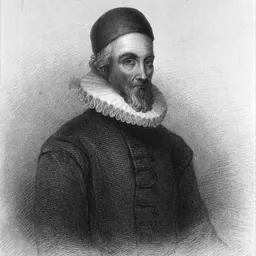
Lived 1586 – 1647 (aged 61). Thomas Hooker was a British christian minister, politician, writer and congregational church.
Life
Early life Thomas Hooker was likely born in Leicestershire at "Marfield" (Marefield or possibly Markfield) or Birstall. He went to Dixie Grammar School at Market Bosworth. Family genealogist Edward Hooker linked Thomas Hooker to the Hooker family in Devon, which produced the theologian and clergyman Richard Hooker. Other Hooker genealogists, however, have traced Thomas Hooker to Leicestershire. Positive evidence linking Thomas to Leicestershire is lacking since the Marefield parish records from before 1610 were lost. Any link to the Rev. Richard Hooker is likewise lacking since the Rev. Thomas's personal papers were disposed of and his house destroyed after his death.
College In March 1604, Hooker entered Queens' College, Cambridge as a sizar but migrated to Emmanuel College. He received his Bachelor of Arts in 1608 and his Master of Arts in 1611. In 1609 he was elected to a Dixie fellowship at Emmanuel, a position he held until 1619.
Around 1626, Hooker became a lecturer or preacher at what was then St. Mary's parish church, Chelmsford (now Chelmsford Cathedral) and curate to its rector, John Michaelson. From the Netherlands, after a clandestine trip to England to put his affairs in order, he immigrated to the Massachusetts Bay Colony aboard the Griffin. His congregation, some of whom may have been members of congregations he had served in England, became known as "Mr. Hooker's Company". When the General Court of Massachusetts allowed residents to split off and found new communities, his group was among the first to go. who, in 1636, founded the settlement of Hartford. It was named for Stone's birthplace, Hertford in England.
They founded the Connecticut Colony. Hooker became more active in politics in Connecticut. The General Court representing Wethersfield, Windsor and Hartford met at the end of May 1638 to frame a written constitution in order to establish a government for the commonwealth. Hooker preached the opening sermon at First Church of Hartford on May 31, declaring that "the foundation of authority is laid in the free consent of the people."
On January 14, 1639, freemen from these three settlements ratified the "Fundamental Orders of Connecticut" in what John Fiske called "the first written constitution known to history that created a government. It marked the beginnings of American democracy, of which Thomas Hooker deserves more than any other man to be called the father. The government of the United States today is in lineal descent more nearly related to that of Connecticut than to that of any of the other thirteen colonies."
In recognition of this, near Chelmsford Cathedral, Essex, England, where Hooker had been town lecturer and curate, there is a blue plaque fixed high on the wall of a narrow alleyway, opposite the south porch, that reads: "Thomas Hooker, 1586–1647, Curate at St. Mary's Church and Chelmsford Town Lecturer 1626–29. Founder of the State of Connecticut, Father of American Democracy."
Death and legacy
Hooker died during the 1647 North American influenza epidemic on July 7, at the age of 61, two days after his birthday. The location of his grave is unknown, although he is believed to be buried in Hartford's Ancient Burying Ground. A crypt was erected there; in addition a plaque on the back of the First Church refers to his burial.
Because there was no known portrait of him, in the 20th century Frances Laughlin Wadsworth used the likenesses of his descendants to sculpt the commissioned statue of Hooker that was erected in 1938 in front of Hartford's Old State House.
Views
Thomas Hooker strongly advocated extended suffrage to include Puritan worshippers, leading him and his followers to colonize Connecticut.
Hooker defended the calling of synods by magistrates, and attended a convention of ministers in Boston whose purpose was to defend Congregationalism. He believed that much of God's favor needed to be re-earned by men. To Hooker, sin was the most crafty of enemies, defeating grace on most occasions. He disagreed with many of the predecessor theologies of Free Grace theology, preferring a more muted view on the subject. He focused on preparation for heaven and following the moralist character. Of Rev. Samuel Hooker, Cotton Mather wrote in Magnalia Christi Americana: "Thus we have to this day among us our dead Hooker, yet living in his worthy son Samuel Hooker, an able, faithful, useful minister at Farmington, in the Colony of Connecticut."
His daughter Mary married Rev. Roger Newton, who was a founder and first minister of Farmington, Connecticut. Newton later was called as minister in Milford, Connecticut.
His grandchildren also had prominent lives. John Hooker, son of Rev. Samuel and grandson of Rev. Thomas, served as Speaker of the Connecticut Assembly, and previously as Judge of the state supreme court. James Hooker, brother of John and son of Rev. Samuel, also became a prominent political figure in Connecticut. He married the daughter of William Leete of Guilford, Connecticut, and subsequently settled there. James Hooker served as the first probate judge, and later as speaker of the Connecticut colonial assembly. Rev. Thomas's granddaughter Mary Hooker, the daughter of Rev. Samuel, married the Rev. James Pierpont. Their daughter Sarah Pierpont married the Rev. Jonathan Edwards.
Other descendants of Thomas Hooker include Henry Hooker, John Hooker, Arthur Atterbury, Charles Atterbury Mary Hooker Pierpont, William Howard Taft, Timothy Dwight V, Aaron Burr, William Gillette, William Huntington Russell, Edward H. Gillette, George Catlin, Emma Willard, J.P. Morgan, Rev. Joshua Leavitt, Rev. Horace Hooker, Roger Hooker Leavitt, Hart Leavitt, Frank Nelson Doubleday, John Turner Sargent, Thom Miller, Adonijah Rockwell and Nathan Watson.
Notable Hooker descendants
Allen Butler Talcott, painter John Butler Talcott, industrialist and founder of the New Britain Museum of American Art Elon Huntington Hooker, industrialist and founder of the Hooker Electrochemical Company.
Works
Don’t just read it —
keep it.
Full-length biographies made to live with: read them, listen on the way to work, watch them tonight.
- E-book
- Audio
- Video
Instant download · yours to keep · every purchase keeps this site free
Important facts
People in Thomas Hooker's life
Named in this biography and alive at the same time



Related people
Same field, nearest in time

Contemporaries
People whose lives overlapped Thomas Hooker's



Frequently asked questions
Who was Thomas Hooker?
Puritan minister (1586-1647)
When was Thomas Hooker born?
Thomas Hooker was born on 5 July 1586 in Leicestershire.
When did Thomas Hooker die?
Thomas Hooker died on 7 July 1647 in Hartford.
What was Thomas Hooker's occupation?
Thomas Hooker was a christian minister, politician, writer and congregational church.
What nationality was Thomas Hooker?
Thomas Hooker was British.
Sources & further reading
Cite this page
APA: Biography.guide. (2026). Thomas Hooker. https://biography.guide/thomas-hooker-christian-minister/
MLA: "Thomas Hooker." Biography.guide, https://biography.guide/thomas-hooker-christian-minister/.
Chicago: "Thomas Hooker." Biography.guide. https://biography.guide/thomas-hooker-christian-minister/.
Data last updated: 2026-09-22 · Spot an error? Report a correction.
Page generated 2026-09-27 05:22 UTC