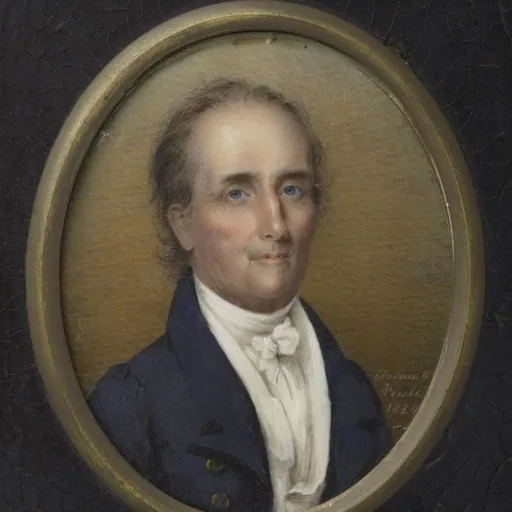
About Thomas Law
Lived 1756 – 1834 (aged 77–78). Thomas Law was a civil servant.
Thomas Law (October 23, 1756 – 1834), was a British administrator, reformer, and intellectual who significantly influenced British India and the early United States. In India, where he served as collector of revenue for the East India Company. Working with Lord Cornwallis, governor-general of India, Law formulated a major policy known as the Permanent Settlement, which served as the basis for land tenure and taxation policy for natives during subsequent decades of British rule. He returned to England for his health in 1791, taking with him his three illegitimate sons borne of his Indian mistress.
Three years later, Law emigrated to the United States and soon settled in Washington, D.C., then undeveloped but designated as the national capitol. Law became a major real estate investor and developer, as well as a prominent civic leader in the developing new capital after the demise of his fortune. A widely read intellectual, he had grand visions for bringing Enlightenment ideas to bear in reshaping both colonial British India and the early American republic. He eventually brought his sons to the US. The eldest, George, died in 1796. John attended Harvard and Edmund attended Yale. In 1796 Law married 19 year old Elizabeth Parke Custis, the eldest granddaughter of Martha Custis Washington. Before their separation in 1804, they had one daughter, Eliza Custis Law, who married Nicholas Rogers of Baltimore.
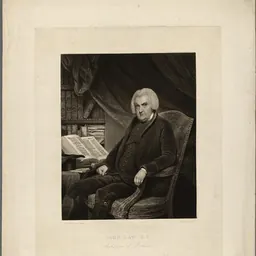
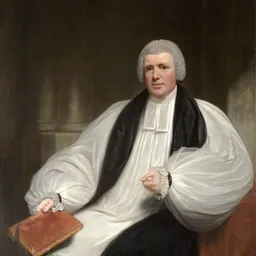
Early life and education Thomas Law was born on October 23, 1756, in Cambridge, England, as the youngest son of a clerical British family. He was raised in the Anglican Church as his father was Edmund Law, Bishop of Carlisle; his brothers were John Law, Bishop of Clonfert and Kilmacduagh in Ireland; Ewan Law MP; Edward Law, 1st Baron Ellenborough, Lord Chief Justice; and George Henry Law, Bishop of Bath and Wells.
Career in India Thomas Law went to India in the service of the East India Company in 1773, as a "writer" or clerk, the entry-level position. He rose through the Company ranks. He became a revenue collector and judge in the province of Bihar and served as the first collector of Gaya and Rohtas district from 1773 to 1791, which had a population of two million, but resigned the position as judge. As collector, in addition to fiscal duties he had responsibilities that combined a judicial and executive nature of a chief magistrate.
Also like many ranking EIC officials, Law made a small fortune in trading in the course of his career. Unlike many of his colleagues, however, Law was also something of an intellectual. As a policy-maker he helped devise the so-called "Permanent Settlement", which transformed the basis of taxation and land tenure for the natives of India, while attempting to establish a secure revenue base for the company. It was so successful that the Board adopted it across the country. When Law returned to England in 1791 because of declining health, he had £50,000. (Accounts of this vary; other sources say £100,000 or higher.)
He had placed bonds with a bank in Calcutta to provide support of his Indian consort. He brought his three Anglo-Indian, mixed-race "natural" sons with him in order to provide them with education. Once returned, Law encountered some personal and professional setbacks, getting into disagreements with company superiors and having difficulties because of the East India Company refused to pay him money that was owed. He also fell out of favor because of his opposition to the projected war with France.
Personal life
On March 20, 1796, Law married 19 year old Elizabeth Parke Custis (d. 1831), the eldest granddaughter of Martha Washington and step-granddaughter of George Washington. The marriage occurred at Hope Park, the home of her stepfather Dr. David Stuart. Soon after their marriage, Law and Elizabeth moved temporarily into a new house built on 6th Street SW as part of development in that area. The Federal-style house became known as "Honeymoon House"; the Laws lived there from about March through August 1796. They next moved to the house they had built for them. Eliza P. C. Law acquired a residence in Alexandria, Virginia (part of Washington D.C. until 1846), and continued active in Washington, DC society.
Their daughter Elizabeth Law (1797–1822) had three children with her husband Lloyd N. Rogers: Edmund Law (1816–1865), Eliza, and Eleanor Rogers. Elizabeth Law Rogers was survived by her husband and children, and both her parents, who at her death had been divorced for more than a decade. But early development in the city was concentrated around the White House and Capitol, the center of its political life, and the Greenleaf syndicate's failure would also deeply affect his finances, and cause litigation. Over time, Law assumed a prominent role in the city's social, political, and economic life, becoming known as an energetic, if somewhat eccentric, promoter of his adopted country. He published poetry, and moral philosophy. He helped found the first theater in the nation's capital, a dancing society, and a learned society called the Columbian Institute for the Promotion of Arts and Sciences.
Following the War of 1812, in which Washington was occupied and partially burnt by British forces in 1814, Law led an effort to retain the national capital there. He directed construction of a temporary Capitol, so Congress would have a place to meet, and to thwart some who proposed moving the national capital elsewhere. Law continued to invest in real estate holdings in the Southwest and Southeast parts of the city. His son John Law served on the American side in the War of 1812; More publicly, he helped found the Columbian Institute (which Congress chartered in 1818 and which closed in 1838, but whose collection later passed to the Smithsonian Institution), and funded many arts endeavors. He invested more in the national capital through thirty years than did the federal government, which a later historian found both remarkable and depressing. In 1817 Law bought a plantation, known as the Retreat or Tusculum, in Prince George's County, Maryland, from which he could see the East Branch of the Potomac and the city. He was elected as president of the county agricultural society. While he did use it as a retreat, he also entertained large parties, reportedly including President Monroe and top-ranking officials. The American Colonization Society was active in this period in supporting relocation of free blacks to the colony of Liberia (originally separate settlements were established by state colonization societies, including one in Maryland). Law had invested most of his fortune in property in Washington, DC, at a time of speculation as the capital was being moved to this new city. He bought some property from the Greenleaf Syndicate, which at one time owned one-third of the saleable property, and went bankrupt in 1797.
By then, this property had appreciated substantially in value, making his estate one of the most valuable in DC. Only the Rogers children and Joseph E. Law survived to see their inheritance.
The Maryland Historical Society maintains the Thomas Law Family Papers (1791–1834), including some of his sons Edmund and John.
The Thomas Law House in Washington, D.C. survived significant redevelopment in the area in the late 20th century, and has been listed on the National Register of Historic Places since 1973 as one of the earliest Federal-style houses built in Washington, DC. It became a rental property after Law and his wife lived there and was used as a hotel by the 1860s.
Don’t just read it —
keep it.
Full-length biographies made to live with: read them, listen on the way to work, watch them tonight.
- E-book
- Audio
- Video
Instant download · yours to keep · every purchase keeps this site free
Important facts
People in Thomas Law's life
Named in this biography and alive at the same time





Related people
Same field, nearest in time


Contemporaries
People whose lives overlapped Thomas Law's





Frequently asked questions
Who was Thomas Law?
Anglo-American reformer
When was Thomas Law born?
Thomas Law was born on 23 October 1756.
When did Thomas Law die?
Thomas Law died in 1834.
What was Thomas Law's occupation?
Thomas Law was a civil servant.
Sources & further reading
· DBpedia: Thomas Law (1756–1834)
Cite this page
APA: Biography.guide. (2026). Thomas Law. https://biography.guide/thomas-law-civil-servant/
MLA: "Thomas Law." Biography.guide, https://biography.guide/thomas-law-civil-servant/.
Chicago: "Thomas Law." Biography.guide. https://biography.guide/thomas-law-civil-servant/.
Data last updated: 2026-09-23 · Spot an error? Report a correction.
Portrait: Wikimedia Commons · author & licence
Page generated 2026-09-27 05:05 UTC