
Thomas Bewick
English engraver and natural history author
About Thomas Bewick
Lived 1753 – 1828 (aged 75). Thomas Bewick was a British ornithologist, printmaker, painter, illustrator, wood engraver and copper engraver.
Thomas Bewick (c. 11 August 1753 – 8 November 1828) was an English wood-engraver and natural history author. Early in his career he took on all kinds of work such as engraving cutlery, making the wood blocks for advertisements, and illustrating children's books. He gradually turned to illustrating, writing and publishing his own books, gaining an adult audience for the fine illustrations in A History of Quadrupeds.
His career began when he was apprenticed to engraver Ralph Beilby in Newcastle upon Tyne. He became a partner in the business and eventually took it over. Apprentices whom Bewick trained include John Anderson, Luke Clennell, and William Harvey, who in their turn became well known as painters and engravers.
Bewick is best known for his A History of British Birds, which is admired today mainly for its wood engravings, especially the small, sharply observed, and often humorous vignettes known as tail-pieces. The book was the forerunner of all modern field guides. He notably illustrated editions of Aesop's Fables throughout his life.
He is "usually considered the founder of wood-engraving" as "the first to realize its full potentialities", The result was high-quality illustration at a low price.
Life
Bewick [pronounced /ˈbjuːɪk/; BYOO-ik] was born at Cherryburn, a house in the village of Mickley, Northumberland, near Newcastle upon Tyne on 10 or 11 August 1753, although his birthday was always celebrated on the 12th. His parents were tenant farmers: his father John had been married before his union with Jane, and was in his forties when Thomas, the eldest of eight, was born. John rented a small colliery at Mickley Bank, which employed perhaps six men.
Bewick did not flourish at schoolwork, but at a very early age showed a talent for drawing. In Beilby's workshop Bewick engraved a series of diagrams on wood for Charles Hutton, illustrating a treatise on measurement. He seems thereafter to have devoted himself entirely to engraving on wood, and in 1775 he received a prize from the Royal Society for the Encouragement of Arts, Manufactures and Commerce for a wood engraving of the "Huntsman and the Old Hound" from Select Fables by the late Mr Gay, which he was illustrating.
In 1776 Bewick became a partner in Beilby's workshop. The joint business prospered, becoming Newcastle's leading engraving service with an enviable reputation for high-quality work and good service. In September 1776 he went to London for eight months, finding the city rude, deceitful and cruel, and much disliking the unfairness of extreme wealth and poverty side by side. He returned to his beloved Newcastle as soon as he could, but his time in the capital gave him a wider reputation, business experience, and an awareness of new movements in art.
In 1786, when he was financially secure, he married Isabella Elliott from Ovingham; she had been a friend when they were children. They had four children, Robert, Jane, Isabella, and Elizabeth; the daughters worked on their father's memoir after his death.
Bewick was also noted as having a strong moral sense and was an early campaigner for fair treatment of animals. He objected to the docking of horses' tails, the mistreatment of performing animals such as bears, and cruelty to dogs. Above all, he thought war utterly pointless. All these themes recur in his engravings, which echo Hogarth's attention to moral themes. For example, he shows wounded soldiers with wooden legs, back from the wars, and animals with a gallows in the background.
Bewick had at least 30 pupils who worked for him and Beilby as apprentices, the first of which was his younger brother John. Several gained distinction as engravers, including John Anderson, Luke Clennell, Charlton Nesbit, William Harvey, Robert Johnson, and his son and later partner Robert Elliot Bewick.
The partners published their History of Quadrupeds in 1790, intended for children but reaching an adult readership, and its success encouraged them to consider a more serious work of natural history. In preparation for this Bewick spent several years engraving the wood blocks for Land Birds, the first volume of A History of British Birds. Given his detailed knowledge of the birds of Northumberland, Bewick prepared the illustrations, so Beilby was given the task of assembling the text, which he struggled to do. Bewick ended up writing most of the text,
The book was an immediate success when published—by Beilby and Bewick themselves—in 1797. and in 1795 an anthological character study of the Kings and Queens of England. Given the success of the 1797 publication of his bird illustrations, Bewick started work at once on the second volume, Water Birds, but the disagreement over authorship led to a final split with Beilby. Bewick was unable to control his feelings and resolve issues quietly, so the partnership ended, turbulently and expensively, leaving Bewick with his own workshop. Bewick had to pay £20, equivalent to about £20,000 in 2011, in lawyer's fees, and more than £21 for Beilby's share of the workshop equipment.
With the assistance of his apprentices Bewick brought out the second volume, Water Birds, in 1804, as the sole author. He found the task of managing the printers continually troublesome, but the book met with as much success as the first volume.
Bewick was fond of the music of Northumberland, and of the Northumbrian smallpipes in particular. He especially wanted to promote the Northumbrian smallpipes, and to support the piper John Peacock, so he encouraged Peacock to teach pupils to become masters of this kind of music. One of these pupils was Thomas's son, Robert, whose surviving manuscript tunebooks give a picture of a piper's repertoire in the 1820s.
Bewick's last wood engraving, Waiting for Death, was of an old bony workhorse, standing forlorn by a tree stump, which he had seen and sketched as an apprentice; the work echoes William Hogarth's last work, The Bathos, which shows the fallen artist by a broken column. He died after a few days' illness on 8 November 1828, at his home. He was buried in Ovingham churchyard, beside his wife Isabella, who had died two years earlier, and not far from his parents and his brother John.
Work
Technique
Bewick's art is considered the pinnacle of his medium, now called wood engraving. This is due both to his skill and to the method, which unlike the woodcut technique of his predecessors, carves against the grain, in hard box wood, using fine tools normally favoured by metal engravers.
Boxwood cut across the end-grain is hard enough for fine engraving, allowing greater detail than in normal woodcuts; this has largely replaced the basic woodcut since Bewick's time. In addition, since wood engraving is a relief printing technique, inked on the face, it requires only low pressure to print an image, so the blocks last for many thousands of prints, and importantly can be assembled into the same forme as the letterpress or metal type for the text, allowing both on the same page, and all the printing to be done in a single run. In contrast, copper plate engravings are an intaglio printing technique, inked in the engraved grooves, the face being wiped clean of ink before printing, so a special type of printing press applying much higher pressure is required, and images must be printed separately from the text, at far greater expense.
Bewick made use of his close observation of nature, his remarkable visual memory, and his sharp eyesight to create accurate and extremely small details in his wood engravings, which proved to be both a strength and a weakness. If properly printed and closely examined, his prints could be seen to convey subtle clues to the character of his natural subjects, with humour and feeling. This was achieved by carefully varying the depth of the engraved grooves to provide actual greys, not only black and white, as well as the pattern of the marks to provide texture. But this subtlety of engraving created a serious technical difficulty for his printers; they needed to ink his blocks with just the right amount of ink, mixed so as to be of exactly the right thickness, and to press the block to the paper slowly and carefully, to obtain a result that would satisfy Bewick. This made printing slow and expensive. It also created a problem for Bewick's readers; if they lacked his excellent eyesight, they needed a magnifying glass to study his prints, especially the miniature tail-pieces. But the effect was transformative, and wood engraving became the main method of illustrating books for a century.
Bewick ran his workshop collaboratively, developing the skills of his apprentices, so while he did not complete every task for every illustration himself, he was always closely involved, as John Rayner explains:
some blocks would be drawn by one brother and cut by the other, the rough work would be done by pupils, who would also, if they showed aptitude, draw and finish designs—on the same principle as the schools of Renaissance painters; and we cannot ... be sure in all cases that the engravings ... are the work of Thomas Bewick from first to last, but he had a hand to a great extent in nearly all, and certainly had the last word in all of them.
Major works
Works using his wood engraving technique, for which he became well known, include the engravings for Oliver Goldsmith's Traveller and The Deserted Village, for Thomas Parnell's Hermit, and for William Somervile's Chase.
The runaway cart is a wonderful mixture of action and danger. The boys have been playing in the cart and the horse has bolted; perhaps the dog's barking was the cause. The drawing of the wheel—an extraordinary depiction for its time—shows that the cart has gathered speed. One boy has already fallen and probably hurt himself. The others hang on shouting with fear. And why has it all happened? The carter with his tankard in his hand runs too late from the inn. Has he been distracted by the shapely girl? And is it an accident that the inn sign looks a little like a gallows? Bewick's bookplates were illustrations made from engravings, containing the name or initials of the book's owner.
Aesop's Fables
The various editions of Aesop's Fables illustrated by Bewick span almost his entire creative life. The first was created for the Newcastle bookseller Thomas Saint during his apprentice years, an edition of Robert Dodsley's Select Fables published in 1776. With his brother John he later contributed to a three-volume edition for the same publisher in 1784, reusing some pictures from the 1776 edition.
Bewick went on to produce a third edition of the fables. While convalescing from a dangerous illness in 1812, he turned his attention to a long-cherished venture, a large three-volume edition of The Fables of Aesop and Others, eventually published in 1818. The work is divided into three sections: the first has some of Dodsley's fables prefaced by a short prose moral; the second has "Fables with Reflections", in which each story is followed by a prose and a verse moral and then a lengthy prose reflection; the third, "Fables in Verse", includes fables from other sources in poems by several unnamed authors. Engravings were initially designed on the wood by Bewick and then cut by his apprentices under close supervision, refined where necessary by himself. This edition used a method that Bewick had pioneered, "white-line" engraving, a dark-to-light technique in which the lines to remain white are cut out of the woodblock. It deals with 260 mammals from across the world, including animals from "Adive" to "Zorilla". It is particularly thorough on some of the domestic animals: the first entry describes the horse. Beilby and Bewick had difficulty deciding what to include, and especially on how to organise the entries. They had hoped to arrange the animals systematically, but they found that the rival systems of Linnaeus, Buffon and John Ray conflicted, and in Linnaeus's case at least changed with every edition of his work. They decided to put useful animals first "which so materially contribute to the strength, the wealth, and the happiness of this kingdom".
The book's coverage is erratic, a direct result of the sources that Bewick consulted: his own knowledge of British animals, the available scholarly sources, combined with George Culley's 1786 Observations on Livestock and the antique John Caius's 1576 On English Dogs. Bewick had to hand the Swedish naturalist Anders Sparrman's account of his visit to the Cape of Good Hope on Cook's expedition of 1772 to 1776, and animals from the Southern Cape figure largely in the book. It was an energetic muddle, but it was at once greeted with enthusiasm by the British public. They liked the combination of vigorous woodcuts, simple and accurate descriptions, and all kinds of exotic animals alongside things they knew. Bewick was helped by his intimate knowledge of the habits of animals acquired during his frequent excursions into the country. He also recounts information passed to him by acquaintances and local gentry, and that obtained in natural history works of his time, including those by Thomas Pennant and Gilbert White, as well as the translation of Buffon's Histoire naturelle.
Many of the illustrations that have most frequently been reproduced in other books and as decorations are the small tailpieces that Bewick had placed at the bottoms of the pages of the original.
Bewick appears to have had a faultless sense of exactly what line was needed, and above all where to stop, as if there were no pause for analysis or reflection between the image in the mind and the hand on the wood. This skill, which has made later generations of engravers pause in awe, could be explained as an innate talent, the je-ne-sais-quoi of "genius". But it also came from the constant habit of drawing as a child, the painstaking learning of technique as an apprentice ... (accompanied by the words "Thomas Bewick his mark"), as well as engraving it in one of his tail-pieces as if it had clouded the tiny image of a rustic scene with a cottage by mistake. Uglow notes one critic's suggestion that Bewick may have meant we are looking at the scene through a playfully smudged window, as well as drawing our attention to Bewick, the maker. Adrian Searle, writing in The Guardian, describes the tiny work as "A visual equivalent to the sorts of authorial gags Laurence Sterne played in Tristram Shandy, it is a marvellous, timeless, magical joke."
Tributes
Poetical tributes came to Bewick even during his lifetime. William Wordsworth began his anecdotal poem "The Two Thieves", composed in 1798, with the line "O now that the genius of Bewick were mine", in which case he would give up writing, he declared.
In 1823, Bewick's friend the Reverend J. F. M. Dovaston dedicated a sonnet to him with the lines
Xylographer I name thee, Bewick, taughtBy thy wood-Art, that from rock, flood, and treeHome to our hearths, all lively, light and freeIn suited scene each living thing has broughtAs life elastic, animate with thought.
Four years after his death, his sixteen-year-old admirer Charlotte Brontë wrote a poem of 20 quatrains titled "Lines on the celebrated Bewick" which describe the various scenes she comes across while leafing through the books illustrated by him. Her 1847 novel Jane Eyre has the title character as a mistreated child reading History of British Birds in Chapter 1: "With Bewick on my knee, I was then happy: happy at least in my way". Later still, the poet Alfred Tennyson left his own tribute on the flyleaf of a copy of Bewick's History of British Birds found in Lord Ravenscroft's library: A gate and field half ploughed, A solitary cow, A child with a broken slate, And a titmarsh in the bough. But where, alack, is Bewick To tell the meaning now?
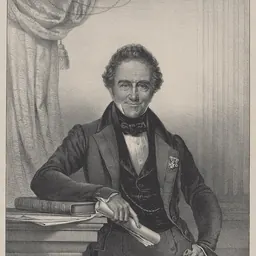
There are numerous portraits of Bewick. In 1825, the Literary and Philosophical Society commissioned Edward Hodges Baily to sculpt a marble portrait bust of Bewick; there are several copies beside the one still at the Society itself. According to Uglow, when Bewick came to sit for the sculptor, he "stoutly refused to be portrayed in a toga. Instead he wore his ordinary coat and waistcoat with neckcloth and ruffled shirt, and even asked for some of his smallpox scars to be shown." Baily was so taken with him that he presented Bewick with a plaster model of the finished bust. A bronze copy now rests in a niche of the building that replaced his workshop in the churchyard of Saint Nicholas (see above) and still another is at the British Museum. There is also a full-length statue of him at the top left of the former chemist's shop designed by M.V.Treleaven at 45 Northumberland Street in the city.
Legacy
Bewick's fame, already nationwide across Britain for his Birds, grew during the nineteenth century. In 1827, the American ornithologist John James Audubon illustrated the North American bird he dubbed Bewick's wren under the binomial name Troglodytes bewickii (now Thryomanes bewickii) in his The Birds of America, explaining in 1831 that he had named it for his friend Thomas Bewick. In 1830, William Yarrell named Bewick's swan in his honour and Bewick's son Robert engraved the bird for later editions of British Birds.
The critic John Ruskin compared the subtlety of his drawing to that of Holbein, J. M. W. Turner, and Paolo Veronese writing that the way Bewick had engraved the feathers of his birds was "the most masterly thing ever done in woodcutting". His fame faded as illustration became more widespread and more mechanical, but twentieth-century artists such as Gwen Raverat continued to admire his skill, and work by artists such as Paul Nash and Eric Ravilious has been described as reminiscent of Bewick.
Bewick's illustrated books, admired since they first appeared, gave him some celebrity in his own lifetime. His Memoir, published a generation after his death, brought about a new interest and a widening respect which has continued to grow ever since. The attraction to his contemporaries of Bewick's observations lay in their accuracy and amusement. Two centuries later these qualities are still recognised; but so, too, is the wealth and rarity of the historical information they have to offer. Bewick's works are held in collections including the British Museum and the Victoria and Albert Museum. Newcastle's City Library has a collection of works and associated items based on the Pease Bequest which was made to the city by John William Pease in 1901. Bewick is memorialised around Newcastle and Gateshead with streets named after him, and plaques mark his former homes and workshops.
Gallery
Birds
Mammals ("quadrupeds")
Tail-pieces and other illustrations
Don’t just read it —
keep it.
Full-length biographies made to live with: read them, listen on the way to work, watch them tonight.
- E-book
- Audio
- Video
Instant download · yours to keep · every purchase keeps this site free
Important facts
Family & relationships
People in Thomas Bewick's life
Named in this biography and alive at the same time





Related people
Same field, nearest in time


Contemporaries
People whose lives overlapped Thomas Bewick's




Frequently asked questions
Who was Thomas Bewick?
English engraver and natural history author (1753-1828)
When was Thomas Bewick born?
Thomas Bewick was born on 10 August 1753 in Cherryburn.
When did Thomas Bewick die?
Thomas Bewick died on 8 November 1828 in Gateshead.
What was Thomas Bewick's occupation?
Thomas Bewick was an ornithologist, printmaker, painter, illustrator, wood engraver and copper engraver.
What nationality was Thomas Bewick?
Thomas Bewick was British.
Sources & further reading
Cite this page
APA: Biography.guide. (2026). Thomas Bewick. https://biography.guide/thomas-bewick/
MLA: "Thomas Bewick." Biography.guide, https://biography.guide/thomas-bewick/.
Chicago: "Thomas Bewick." Biography.guide. https://biography.guide/thomas-bewick/.
Data last updated: 2026-09-20 · Spot an error? Report a correction.
Page generated 2026-09-27 05:29 UTC