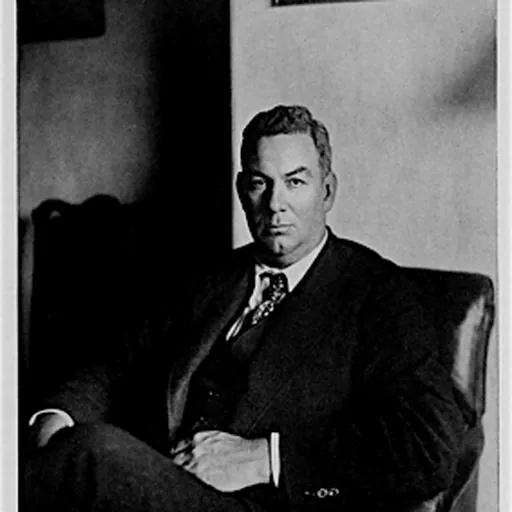
About Thomas Barbour
Lived 1884 – 1946 (aged 61). Thomas Barbour was an American naturalist, zoologist, herpetologist, non-fiction writer and ornithologist, known for Natural history.
Thomas Barbour (August 19, 1884 – January 8, 1946) was an American herpetologist. He was the first president of the Dexter School in 1926. From 1927 until 1946, he was director of the Harvard Museum of Comparative Zoology (MCZ) founded in 1859 by Louis Agassiz at Harvard University in Cambridge, Massachusetts. In his book, Naturalist in Cuba, Barbour writes, "I suspect that I am the only living American naturalist who has visited all parts of the island again and again, for I am not only a Cuban by adoption, but a devoted friend of the land and its people." In addition to the expected scientific discussion of the island's flora and fauna, Barbour provides a description of Cuban society and culture.
He was elected a Fellow of the American Academy of Arts and Sciences in 1916. In 1923 and 1924, he was one of the scientists and financial benefactors who founded the Barro Colorado Island Laboratory in Panama, location of the Smithsonian Tropical Research Institute. The island, originally a hilltop, sits in the middle of Gatun Lake, which was created when the Chagres River was dammed during the Panama Canal building project.
Along with better than 400 scholarly articles, Barbour wrote several books including the autobiographical Naturalist at Large (1943), Naturalist in Cuba (1945), A Naturalist's Scrapbook (1946), and That Vanishing Eden (1944), which explores the natural world of a remote, undeveloped Florida.
In 1906, Barbour married Rosamond Pierce of Brookline, Massachusetts. Dr. Glover Morrill Allen and his student Ralph Nicholson Ellis, medical officer Dr. Ira M. Dixon, and William E. Schevill (a graduate-student in his twenties and Associate Curator of Invertebrate Palaeontology). Barbour said at the time "We shall hope for specimens' of the kangaroo, the wombat, the Tasmanian devil and Tasmanian wolf," and the mission was a success with over 300 mammal and thousands of insect specimens returning to the United States. He was a trustee of the Carnegie Institution of Washington from 1934 until his death in 1946.
During the last two years of his life Barbour was in failing health, following a blood clot that had developed while he was in Miami. He was at the Museum of Comparative Zoology as usual on January 4, 1946, and in a happy mood at home in Boston that evening. But he was stricken later in the night with a cerebral hemorrhage and died on January 8, without regaining consciousness.
Legacy
Thomas Barbour is commemorated in the scientific names of the following species and subspecies of reptiles.
The street he grew up on was named after him, Thomas Barbour Drive, in Melbourne, Florida; it is the street on which Ballard Park is located.
Don’t just read it —
keep it.
Full-length biographies made to live with: read them, listen on the way to work, watch them tonight.
- E-book
- Audio
- Video
Instant download · yours to keep · every purchase keeps this site free
Important facts
People in Thomas Barbour's life
Named in this biography and alive at the same time

Related people
Same field, nearest in time


Contemporaries
People whose lives overlapped Thomas Barbour's
Frequently asked questions
Who was Thomas Barbour?
American zoologist (1884-1946)
When was Thomas Barbour born?
Thomas Barbour was born on 19 August 1884 in Martha's Vineyard.
When did Thomas Barbour die?
Thomas Barbour died on 8 January 1946 in Boston.
What was Thomas Barbour's occupation?
Thomas Barbour was a naturalist, zoologist, herpetologist, non-fiction writer and ornithologist.
What was Thomas Barbour known for?
Thomas Barbour was known for Natural history.
What nationality was Thomas Barbour?
Thomas Barbour was American.
Sources & further reading
Cite this page
APA: Biography.guide. (2026). Thomas Barbour. https://biography.guide/thomas-barbour/
MLA: "Thomas Barbour." Biography.guide, https://biography.guide/thomas-barbour/.
Chicago: "Thomas Barbour." Biography.guide. https://biography.guide/thomas-barbour/.
Data last updated: 2026-09-23 · Spot an error? Report a correction.
Portrait: Wikimedia Commons · author & licence
Page generated 2026-09-27 05:07 UTC