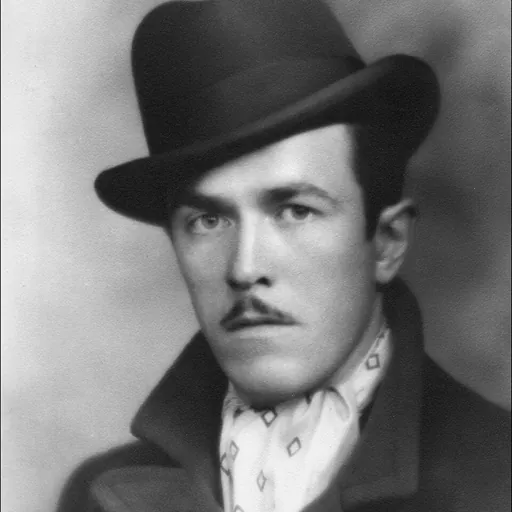
Theodore Wells Pietsch II
American automobile stylist
About Theodore Wells Pietsch II
Lived 1912 – 1993 (aged 80). Theodore Wells Pietsch II was an American car designer.
Theodore Wells Pietsch II (September 23, 1912, in Baltimore, Maryland ‒ August 24, 1993, in Everett, Washington) was an American automobile stylist and industrial designer who, with little formal education, managed to launch a career in automobile design that took him over a period of 38 years to nearly every major automobile company in the nation.
Formative Years: 1912–1934 From an early age, Theodore W. Pietsch showed a strong fascination for cars, reflecting a wide family interest in automobiles and the automotive industry. In the teens and 20s, before the stock-market crash of 1929 took most of it away, the family was quite well-off, able to afford "big Packards" driven by a full-time chauffeur. While his father, Theodore Wells Pietsch I (1869−1930), a well-known Baltimore architect, never learned to drive, his mother, Gertrude Carroll Zell (1888−1968), knew cars very well—she is said to have been the first woman to drive a car in Maryland. One of his uncles, Arthur Stanley Zell (1880−1935), was a pioneer Maryland automobile dealer and sportsman who as president of the Zell Motor Car Company and of Stanley Zell, Inc., was the first automobile distributor in Maryland.
Pietsch attended the Stuyvesant School for Boys in Warrenton, Virginia, and later, from 1930 to 1933, the Maryland Institute, Baltimore, where he majored in design and mechanical drawing. By his mid-teens, he was creating original designs of his own in the flat, two-dimensional style of car catalogs of the time. It was the originality and style of these early drawings that would later get the attention of prospective employers. The uncanny resemblance of this car to the German Volkswagen led to speculation that Pietsch's design was copied by Ferdinand Porsche who had been instructed by Hitler to produce the "People's Car" and who most probably saw the "Star Car" during one or both of his visits to Detroit in 1936. DeSoto, four-door sedan, with waving woman, by T. W. Pietsch, June 21, 1937
Hudson Motor Car Company and War Work: 1940–1944 In 1940, Pietsch left Chrysler for the position of Senior Designer at the Hudson Motor Car Company, where he worked primarily at the drawing board making "quick-idea" sketches, color renderings in a variety of media (including catalog-quality air-brush work), accurate scale and full-size layouts, and rough sketching in three-dimensional clay models. At Hudson Motor he was also assigned to war work that consisted of making accurate perspective drawings of airplane assemblies and subassemblies from blueprints, and air-brush retouching of photographs (that were later used in an instruction manual prepared for the armed services) of mechanical parts of an anti-aircraft gun. It would be projects like this, but in particular the years spent interpreting the blueprints for the B-29, that protected him against the draft and provided military deferment throughout the war. But by September 1944, when Pietsch signed on, they were already looking ahead to post-war car designs, and efforts were underway to secure contracts for automotive bodies from Packard and Chrysler, among other companies. Pietsch arrived too late to participate in the excitement of that period—work on the prototype for the '49 had just been completed, and this meant that much of the exterior work assigned to him was looking ahead to 1950 and beyond.
Back to Chrysler, Virgil Exner, and the Dream Cars of Ghia: 1950–1952 Pietsch went back to Chrysler in 1950, this time to work for Virgil Max Exner (1909−1973), American automotive designer and someone who had, a year earlier, taken over Chrysler's Advanced Styling Group. Exner is credited with making key changes at Chrysler, which contributed to the company's rise in the American automobile design industry during the mid-1950s. By 1953, a half a dozen Italian-built Chrysler show-cars had been created. Responding in early 1952 to an offer from Raymond Loewy, brokered in part by his friend Bob Koto, he moved from Detroit to South Bend, Indiana, to join Raymond Loewy and Associates, which at the time held the Studebaker design contract.
Banshee, Two-door Coupe, with transparent Plexiglas top, by T. W. Pietsch, 1950
Raymond Loewy and Associates and the Studebaker Account: 1952–1955 Raymond Fernand Loewy (1893–1986), perhaps the world's best known industrial designer, established himself in 1934 by designing the first modern, stand-alone refrigerator for Sears, Roebuck and Co., which resulted the following year in huge sales for the company. Shortly thereafter, all kinds of lucrative contracts came his way. By the late 1930s and early 40s, he had sold designs for Greyhound buses, Pensy railcars and locomotives, TWA sleeper planes, Matson ships and large ocean liners, Pepsodent toothpaste tubes, Schick electric shavers, buildings of all kinds, including supermarkets, and hundreds of other products, not the least of which were Studebakers.
White Speedster, with red under-body, by T. W. Pietsch, 1955 Working for Raymond Loewy and Associates, which at that time was responsible for all Studebaker styling, was a unique experience. There were no individual studios set up with all sorts of titles for the designers, just several large rooms located in the old Chippewa Avenue truck plant in South Bend where Studebaker had manufactured its aircraft engines and army trucks during the war. The designers had just one boss, Bob Bourke, and his assistant, Bob Koto, and everyone, including Bourke and Koto, wore many hats. They sketched, and modeled in clay; in fact, the emphasis was on modeling. They often worked into the small hours of the morning with no overtime pay. The clay work was new to Pietsch and by his own admission he never became very adept at it because designers in Detroit, where he had received all his prior training, were not involved in modeling. He strongly believed, however, that designers should be skilled at drawing and rendering as well as modeling. Design for a Studebaker, High-speed Express Truck, by T. W. Pietsch, 24 September 1956
Studebaker had been on the decline since its peak income year in 1949—the failure to understand market conditions, and an inability to appreciate public interest in the better-selling models, which resulted in severe underproduction—were mistakes of managers who seemed to be unable to respond to disappointing sales other than blame Loewy's advanced styling studio. Pietsch remembers management complaining about how European styling ruined Studebaker, but it was, in his opinion, all misplaced condemnation.
Things were so bad by late 1953 that discussion turned to the idea of teaming up with another car company, and by the following June, with sales for 1954 worse than ever, a merger with Packard was approved. The new Studebaker-Packard management decided to sever the expensive relationship with Loewy and Associates, thinking that their own in-house styling team should be given full control of Studebaker design efforts. Thus, in early 1955, the contract with Raymond Loewy, which had existed since 1938, was not renewed, and Pietsch, along with everyone else, was given the option of staying with Loewy or switching over to Studebaker proper. Pietsch decided that the Loewy situation was much too tenuous and, even as shabby as Studebaker was at the time, opted to stay with the sinking ship.
Design for a Studebaker, Cab-forward, Pick-up Truck, by T. W. Pietsch, 8 April 1957
Studebaker-Packard—the End in Sight, and Industrial Design: 1955–1962 It was now mid-1955, Studebaker had fully merged with Packard, and Loewy and his team of designers were gone—both moves described by Pietsch as "desperate clutching at straws by a dying company." In 1958, the situation was so dire that Pietsch and a number of his fellow designers were laid off. Now, for the first time in his career, Pietsch was unable to immediately step into another automotive design job. After several months looking for work in the South Bend area, he went to Chicago, where he was soon offered a position by the industrial design firm of Dave Chapman, Incorporated. Commuting weekly by train between South Bend and Chicago, he was responsible for the account of a department of Montgomery Ward and Company, which included, among other things, the design of water heaters, water softeners, water pumps, furnaces, air-conditioners, incinerators, and ventilating fans. He also did considerable work on the design of boats, outboard motors, and radios. Sovereign Coupe, black airbrush on red paper, by T. W. Pietsch, 1965
Unhappy with the work in Chicago, Pietsch returned to South Bend where he found employment for a few months with another small industrial design firm called Good Design Associates, but then, in late 1959, he got back to cars—this time, with American Motors in Detroit, a job he held for only about a year, quitting abruptly when he was suddenly called back to Studebaker. Randal D. Faurot, newly appointed head of styling, called on Pietsch to help rebuild the department, offering him a position as his assistant that he couldn't refuse. In June 1962, however, frustrated and angry over management's abrupt decision to cancel a project that he had worked for many months—the design for an all-new version of the Studebaker Lark for 1962—Pietsch lost his temper and was fired. But before Pietsch realized it, he was right back where he had been at Chrysler the year before, "doing mostly calibrations of the numerals on dashboard instruments." That his graphics were used without change on the instrument panels of the '72 and '73 Jeep Wagoneer provided little satisfaction. There was nothing about the Jeep line that interested him. Although he did his best every day to appear enthusiastic, Pietsch was so bored at work that he "could hardly see straight," and he worried also that his health was beginning to fail. In February 1972, after only two years with Jeep, he decided to retire.
Personal life On June 24, 1938, Pietsch married Louise Mary Shamlian (December 1, 1914, Watertown, Massachusetts − January 15, 1987, Seal Beach, California), with whom he had three children: Priscilla Esther Pietsch, born December 22, 1941; Theodore Wells Pietsch III, March 6, 1945; and Louise Jean Pietsch May 11, 1948. His health gradually worsening, he died of congestive heart failure in a nursing home in Everett, Washington, on August 24, 1993, at age 80.
Don’t just read it —
keep it.
Full-length biographies made to live with: read them, listen on the way to work, watch them tonight.
- E-book
- Audio
- Video
Instant download · yours to keep · every purchase keeps this site free
Important facts
People in Theodore Wells Pietsch II's life
Named in this biography and alive at the same time






Related people
Same field, nearest in time


Contemporaries
People whose lives overlapped Theodore Wells Pietsch II's





Frequently asked questions
Who was Theodore Wells Pietsch II?
American automobile stylist (1912–1993)
When was Theodore Wells Pietsch II born?
Theodore Wells Pietsch II was born on 23 September 1912 in Baltimore.
When did Theodore Wells Pietsch II die?
Theodore Wells Pietsch II died on 24 August 1993 in Everett.
What was Theodore Wells Pietsch II's occupation?
Theodore Wells Pietsch II was a car designer.
What nationality was Theodore Wells Pietsch II?
Theodore Wells Pietsch II was American.
Sources & further reading
· Wikipedia: Theodore Wells Pietsch II
· DBpedia: Theodore Wells Pietsch II
Cite this page
APA: Biography.guide. (2026). Theodore Wells Pietsch II. https://biography.guide/theodore-wells-pietsch-ii/
MLA: "Theodore Wells Pietsch II." Biography.guide, https://biography.guide/theodore-wells-pietsch-ii/.
Chicago: "Theodore Wells Pietsch II." Biography.guide. https://biography.guide/theodore-wells-pietsch-ii/.
Data last updated: 2026-09-23 · Spot an error? Report a correction.
Portrait: Wikimedia Commons · author & licence
Page generated 2026-09-27 05:08 UTC