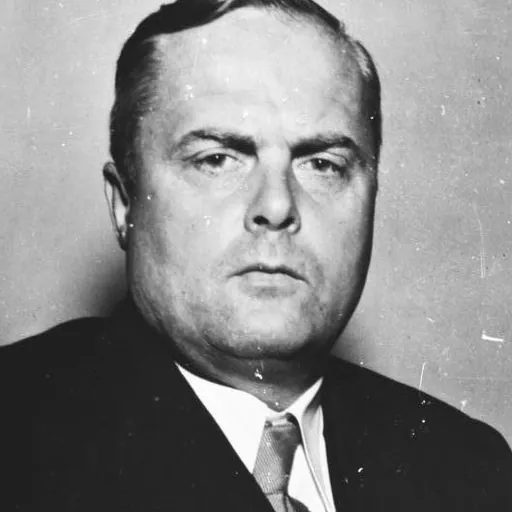
Theodor Oberländer
Minister for Expellees, Ostforscher, Probable war criminal (not convicted)
About Theodor Oberländer
Lived 1905 – 1998 (aged 93). Theodor Oberländer was a German politician, economist, university teacher, farmer, military personnel and political economist.
Theodor Oberländer (1 May 1905 – 4 May 1998) was an Ostforschung scientist and German Nazi official and politician, who after the Second World War served as Federal Minister for Displaced Persons, Refugees and Victims of War in West Germany from 1953 to 1960, and as a member of the Bundestag from 1953 to 1961 and from 1963 to 1965.
Oberländer earned a doctorate in agriculture in 1929 and a second doctorate in economics in 1930. He spent time in the Soviet Union during the 1920s and early 1930s, including as an employee of DRUSAG , a German company involved in developing Soviet agriculture in cooperation with the Soviet government. Subsequently, he became active in Ostforschung, area studies of the Soviet Union, the Baltic states, Poland and other countries of Eastern and Central Europe, advocating elimination of Jews and subjugation of Polish people in Poland, which he characterised in his writings as having "eight million inhabitants too many". In 1933, he became Director of the Institute for East German Economy in Königsberg, and in 1938 he became Professor of Agriculture at the University of Greifswald. He served as a lieutenant in the German military intelligence service (the Abwehr) in the Soviet Union during the Second World War and was promoted to captain of the reserve before his discharge in 1943; in the same year he became Director of the Institute for Economic Sciences. From 1944 he was affiliated with the staff of Andrey Vlasov's collaborationist Russian Liberation Army. He became a member of the Nazi Party in 1933. However, from 1937 until the end of Nazi rule, he was under surveillance by the Sicherheitsdienst (SD), as he was suspected of disloyalty to the Nazi cause.
He entered politics for the liberal Free Democratic Party from 1948. In 1950, he was a co-founder of the All-German Bloc/League of Expellees and Deprived of Rights and served as its chairman from 1954 to 1955. He served as a member of the Parliament of Bavaria from 1950 to 1953 and as Secretary of State for Refugee Affairs in the Bavarian Ministry of the Interior from 1951 to 1953. He then served as Federal Minister for Displaced Persons, Refugees and Victims of War in the Second and Third Cabinets of Chancellor Konrad Adenauer from 1953 to 1960, and as a Member of the Bundestag from 1953 to 1961 and from 1963 to 1965, during which time he represented Hildesheim from 1957 to 1961. In 1956, Oberländer became a member of the Christian Democratic Union (CDU). Oberländer was one of the most staunch anti-communists in the German government. He received the Grand Cross of Order of Merit of the Federal Republic of Germany, the Bavarian Order of Merit and the Legion of Honour.
Background and early career
Oberländer was born in 1905 in Meiningen, Duchy of Saxe-Meiningen, part of the German Empire, to a Protestant family; his father Oskar Oberländer was a civil servant and director of the insurance agency in Thüringen. In 1929, he earned a doctorate in agriculture at the University of Berlin with a dissertation titled Die landwirtschaftlichen Grundlagen des Landes Litauen ("The agricultural base of the country of Lithuania"). In 1930, he earned a doctorate in economics at the University of Königsberg with the dissertation Die Landflucht in Deutschland und ihre Bekämpfung durch agrarpolitische Maßnahmen ("The rural exodus in Germany and its prevention by agricultural policy measures"). From 1930 to 1931, he spent nearly two years in the Soviet Union, China, Canada and the United States, where he worked for the Ford Motor Company. In 1931, Oberländer became an assistant professor at the Institute for East German Economy in Königsberg, and in 1933 he became Director of the institute. From 1934, he was also Associate Professor of Agriculture at the Technical College of Danzig. He became Associate Professor at the University of Königsberg in 1937. In 1938, he became Professor of Agriculture at the University of Greifswald. He also joined the Sturmabteilung (SA), the Nazi paramilitary unit, rising to the rank of SA-Obersturmführer on 1 July 1938. He was a member of the leadership of Gau East Prussia where he served until June 1937. On 4 August 1935, he became an assistant to Gauleiter Erich Koch, under whose authority he started to gather information about non-German minorities in East Prussia. A significant role in this process was played by the "Bund Deutscher Osten" (BDO – "League for a German East"), which advocated radical Germanization of the eastern provinces and the elimination of the Polish language in Masuria. The language's traditional usage in the Protestant churches of the Masurians was outlawed in November 1939, with the Lutheran Prussian Church leadership acquiescing in December.
In March 1935, he attended a meeting of professors, scholars and NSDAP training specialists dedicated to the study of the "East" where he focused his essays on what he described as "border struggle" with Poland. Continuing his studies on the rural population of Poland he noted in his works that "Poland has eight million inhabitants too many". Within Poland, ethnic groups were to be directed into fighting with each other in order to prepare the ground for German rule.
By 1937, Oberländer, however, started to lose influence in the Nazi Party as his views on the treatment of the Polish population (but not the Jewish question) were losing out to more hardline positions As a result, he had lost his position in East Prussia and within the BDO by 1938. From 1937 until the end of Nazi rule he was under surveillance by the Sicherheitsdienst, as he was henceforth suspected of being disloyal to the Nazi cause. From 1 April 1938, he worked as Professor of History at University of Greifswald.
World War II In 1940, Oberländer endorsed the ethnic cleansing of the Polish population and, in 1941, wrote in the German magazine Deutsche Monatshefte: "We have the best soldier in the world who re-conquered German soil in the East. There is no bigger responsibility than educating this colonist to be the best on earth and to secure the living space for all time to come" Oberländer's words echoed the views of Heinrich Himmler, who envisioned settling former soldiers, armed with weapons and ploughs in the East, not just pure peasants. During 1940 he moved to the University of Prague, after which he became active in Ukraine, where he was used by Nazi Germany's military as an expert on "ethnic psychology".
When Germany invaded the Soviet Union in 1941, Oberländer became an advising officer of the Nachtigall Battalion (a Ukrainian Wehrmacht battalion) in occupied Lwów. The participation of the Battalion in The Lwów Civilian Massacre of 1941 has since been subject to controversy, and Oberländer himself was accused after the war of participating in the events.
In January 1942, he sent a report on the situation in Ukraine in which he wrote that success lay in "winning over the masses and pitilessly exterminating partisans as deleterious to the people". In 1943, he was dismissed from the Wehrmacht due to political conflict with his superiors and returned to Prague. In 1944, he joined the staff of Andrey Vlasov's Russian Liberation Army. He was taken prisoner of war by the United States Army in 1945.
Cold War After the war, Oberländer worked for American intelligence as an expert on Eastern Europe until 1949. The BHE itself was connected in various ways to the Nazis, as it openly tried to win over former NSDAP members angry at denazification, calling their crimes to be only "uncritical belief in Germany's future". Oberländer joined the Adenauer government of West Germany in 1953 as Minister for Refugees and Expellees. Oberländer left the GB/BHE for the centrist Christian Democratic Union in 1956 when it broke with Adenauer. Adenauer himself continued to support him, as a matter of principle.
In 1960, Oberländer was sentenced in absentia to life imprisonment by an East German court, for his alleged involvement in the Lviv massacre in 1941. In January 1960, during discussions with 3,000 students of University of Cologne, Adenauer was faced with protests against the continued presence of Oberländer in the German government. At the end of his life, Oberländer became involved in anti-immigration politics.
A preliminary inquiry into Oberländer's role in connection with the unlawful killing of a civilian in Kislovodsk in 1942 during his Bergmann leadership was opened by a district attorney in Cologne in 1996. The allegations involved an interrogation of a female Soviet teacher; it was alleged that she was whipped and, after refusing to talk about suspected partisan activity, shot in the breast by Oberländer, and then left to die. Oberländer called those allegations "old Soviet lies". The inquiry was closed in 1998 due to lack of evidence.
Theodor Oberländer died in Bonn in 1998. He is the father of Professor Erwin Oberländer, a noted expert on Eastern European history, and the grandfather of Christian Oberländer, Professor of Japanese Studies.
Honours Grand Cross with Star and Sash of Order of Merit of the Federal Republic of Germany (1955) Bavarian Order of Merit (1972) Commander of the Legion of Honour
Publications Die agrarische Überbevölkerung Polens, Berlin 1935. Die agrarische Überbevölkerung Ostmitteleuropas, in: Aubin, Hermann u. a. (Hrsg.): Deutsche Ostforschung. Ergebnisse und Aufgaben seit dem ersten Weltkrieg, Bd. 2 (Deutschland und der Osten. Quellen und Forschungen zur Geschichte ihrer Beziehungen, Bd. 21), Leipzig 1943, S. 416 – 427. Der Osten und die deutsche Wehrmacht: sechs Denkschriften aus den Jahren 1941–43 gegen die NS-Kolonialthese. Hrsg. von der Zeitgeschichtlichen Forschungsstelle Ingolstadt. Asendorf, Mut-Verlag. 144 S. In: Zeitgeschichtliche Bibliothek; Bd. 2. Bayern und sein Flüchtlingsproblem, München 1953. – Die Überwindung der deutschen Not, Darmstadt 1954. Das Weltflüchtlingsproblem: Ein Vortrag gehalten vor dem Rhein-Ruhr-Club am 8. Mai 1959. Sonderausg. des Arbeits- u. Sozialministers des Landes Nordrhein-Westfalen. Verleger, Bonn: Bundesministerium f. Vertriebene, Flüchtlinge u. Kriegsgeschädigte. 1959.
Don’t just read it —
keep it.
Full-length biographies made to live with: read them, listen on the way to work, watch them tonight.
- E-book
- Audio
- Video
Instant download · yours to keep · every purchase keeps this site free
Important facts
People in Theodor Oberländer's life
Named in this biography and alive at the same time



Related people
Same field, nearest in time





Contemporaries
People whose lives overlapped Theodor Oberländer's

Frequently asked questions
Who was Theodor Oberländer?
Minister for Expellees, Ostforscher, Probable war criminal (not convicted) (1905-1998)
When was Theodor Oberländer born?
Theodor Oberländer was born on 1 May 1905 in Meiningen.
When did Theodor Oberländer die?
Theodor Oberländer died on 4 May 1998 in Bonn.
What was Theodor Oberländer's occupation?
Theodor Oberländer was a politician, economist, university teacher, farmer, military personnel and political economist.
What nationality was Theodor Oberländer?
Theodor Oberländer was German.
Sources & further reading
· Wikipedia: Theodor Oberländer
Cite this page
APA: Biography.guide. (2026). Theodor Oberländer. https://biography.guide/theodor-oberlander/
MLA: "Theodor Oberländer." Biography.guide, https://biography.guide/theodor-oberlander/.
Chicago: "Theodor Oberländer." Biography.guide. https://biography.guide/theodor-oberlander/.
Data last updated: 2026-09-23 · Spot an error? Report a correction.
Portrait: Wikimedia Commons · author & licence
Page generated 2026-09-27 05:05 UTC