
About Thanasēs Chatzēs
Lived 1905 – 1982 (aged 76–77). Thanasēs Chatzēs was a resistance fighter and writer.
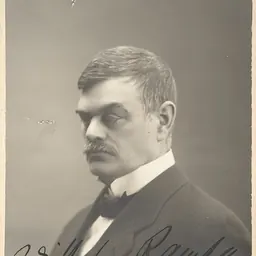
Thanasis Hatzis (Gr: Θανάσης Χατζῆς, 1905-1982) was a Greek communist activist and Resistance fighter during the Axis occupation of Greece, serving during that period as EAM's Secretary General, and then a Democratic Army combatant in the Greek Civil War.
Early years, education, and involvement in politics Ηatzis was born in 1905 in Amyntaion, Florina, of Ottoman-ruled Macedonia, into an agrarian family, involved at the time in the armed battles of local Greeks against Bulgarian nationalists. Their participation in the armed conflict led to the family's exile by the Ottoman authorities to Salonica. While in high school, Hatzis participated in students' demonstrations in support of the railroad workers' major strike of 1925 and is arrested for breach of the peace. His brother-in-law, a deputy commander of the Hellenic Military Academy, confined Hatzis, as a disciplinary measure, in the academy's grounds, from where Hatzis escaped. He was subsequently drafted into the disciplinary unit of Kalpaki military camp and completed his service there. He moved to Athens and enrolled in the university, wherefrom he obtained his degree in dentistry.
Οn 27 September 1941, representatives of the Communist party, the Socialist Party, the People's Democracy Union, and the Agrarian Party held a clandestine meeting in Athens to discuss and agree on the creation of a resistance alliance, to be called Ethnikó Apeleftherotikó Métopo (National Liberation Front). Preparatory contacts undertaken with other parties and politicians, prominent among whom was Themistoklis Sofoulis, inviting them to participate in EAM, had failed. Pre-war non-leftists parliamentarians were instructed by the Greek government-in-exile, led by Liberal party's Emmanouil Tsouderos, to stay clear of resistance activity and, in particular, to refrain from joining any resistance groupings; they were to await developments and instructions from the exiled government.
Lefteris Apostolou, a prominent communist activist and KKE member, who represented the party at the inaugural meeting, was elected EAM's General Secretary. Ιn September 1942, philosopher and politician Dimitris Glinos, a long-time KKE member, wrote and EAM distributed widely the front's political and social manifesto, titled What EAM is and wants. Within two months, Apostolou was arrested by the authorities for "insurrectionist activities" and imprisoned,
In 1942, Hatzis married Heró Hadjimarkou, and they had a son. The corruption and systemic inadequacy of the state authorities significantly deteriorated an already dire situation, born out from both the lack of preparations for such an event and the Occupation authorities seizing extraordinary quantities of foodstuff. Even the German community of Athens suffered from malnutrition. This led the population in the affected cities, and mainly in Athens, to start initiatives of food collection and exchange; oftentimes, local EAM representatives would take over the state's food giveaways, since they were accepted as honest, as opposed to the state's corrupt officialdom. EAM cells initiated, organized, and expanded the feeding activities, an achievement that, although it lessened and not eliminated the famine's impact, it significantly expanded EAM's popularity among the general population. the funeral of "national poet" Kostis Palamas, in which the patriotic eulogy of poet Angelos Sikelianos incited a demonstration with cries against the Occupiers, or the Greek-flag carrying demonstration following the 25th March independence day, which was fired upon by Italian carabinieri; the protests rendered the authority of the collaborationist government virtually non-existent, and EAM's Secretary brought forward measures to extent the organization's influence. The "enthusiasm" of protesting and agitating youth, in particular, enabled the unification of the most significant youth organizations into one, single front, the Eniaia Panelladiki Organosi Neon (United Panhellenic Organization of Youth or EPON, from its initials in Greek), which was soon unofficially under the aegis of EAM. Notable for all observers, including the "astonished" state's authorities, was the "mass" participation in these political protests of young women, not only in urban areas, but even around the country, where the social norms were historically quite strict. In any case, the Communist Party, some weeks after EAM's creation, in early October 1941, called party members who were former Greek army officers in to a committee, the Military Center of Resistance, and assigned them the task of studying the necessary conditions and undertakings for the creation of organized, armed resistance against the Occupation and its domestic collaborators. EAM's Military Organization Committee, led by Hatzis, under the nom de guerre Amyntas, a reference to his birthplace, supported and contributed to the effort.
A number of armed bands had already sprang up in the country, in particular in mountainous regions, engaging in nominal resistance, some of them borne out of the initiative of local communists, while some of these bands took to plain banditry, all taking advantage of the state's inability to impose order. had accelerated developments, though, in practical terms, the creation of ELAS (of Hellinikós Laïkós Apeleftherotikós Stratós, the Hellenic People's Liberation Army) was decided and announced on 16 February 1942, following the report submitted by Aris Velouchiotis, The name itself of the armed wing of the EAM resistance was decided, on 2 February 1942, in meeting most probably between four KKE Central Committee members among whom was Hatzis, Hatzis was a firm supporter of the plan's objective.
The Lebanon agreement
When the defeat of the Axis in Europe seemed certain, if not imminent, the belief among many KKE and ELAS cadres was that the Western Allies would attempt a landing in Greece. That perspective, firmly supported by KKE's Secretary General Siantos, was explicitly expressed in the resolutions of KKE's Central Committee 8th plenum, which was convened in January 1942, as the German armies were failing in their attack against Moscow. According to KKE's records, this also agreed with the information advanced to the party by its numerous informers from inside the state apparatus, including the security forces. In his dissent he was strongly supported by the two most prominent at the time military officers working with EAM, Theodoros Makridis and Polydoros Daniilidis, the former of whom presented to the party specific and detailed objections against the hypothesis of an Allied landing in Eastern Europe; the presentation included estimates for the general prospects of the war in Europe, all of which were to prove accurate.
After the early 1943 mutiny of sections of the Greek Armed Forces, joined by the navy, stationed in Egypt and operating as part of British divisions, was put down, London demanded that all Greek forces, including both those "officially recognized" in the Middle East and the antartes in Greece be placed under Allied/British command. To that end, a conference was called one year later, in May 1944, a few weeks after the wholesale annihilation by ELAS forces of EKKA's nationalist partisans, led by Colonel Dimitrios Psarros, an exemplary republican officer, an event subsequently acknowledged to have been a "major and costly error" by most historians, including KKE and ELAS members. The conference began on 17 May 1944 in a mountain retreat outside Beirut, Lebanon, under the chairmanship of Georgios Papandreou. Taking part were representatives from the exiled Greek Government, headed by Papandreou himself, from the Liberal Party, the People's Party, the Communist Party through , and from smaller parties, as well as by representatives from EAM, EDES, and EKKA the political wing of the annihilated 5/42 Regiment. The subject was the security of post-liberation Greece. The agreement, reached after many days of negotiations, called for the following: The creation of a government of national unity, in which EAM would participate, with Papandreou as prime minister; the rebirth of the nation's Armed Forces, unique command, in which all partisan organizations, including ELAS, would be invited; the unequivocal condemnation of the Greek forces' mutiny in Egypt; and the prospect of a referendum about the future of the monarchy in Greece. When the KKE and ELAS representatives returned home, Hatzis expressed, in a meeting of the party's leadership, his strong disagreement, stating that the people they sent to Lebanon violated their mandate by agreeing to the final document's provisions. In this, he was joined by others, such as Yannis Zevgos and Bartziotas, A few weeks later, Hatzis submitted his resignation as EAM's General Secretary (he was replaced by Dimitrios Partsalidis) and as a member of KKE's politburo. Subsequent historical research suggests an indirect yet decisive intervention by Moscow, "advising" the Greek communists to accept the Lebanon Agreement, as well as the following one, in messages conveyed through the Soviet embassy in Cairo which led the KKE's leadership to reverse its initial "adamant" position, after many delays and hesitations, in August 1944, and accept a provisional government under Papandreou.
Liberation and internecine conflict
After the German armed forces moved out of the country in October 1944, the unity government arrived in Greece and assumed political power, while the military command of Athens was assumed, per the agreements, by a British officer, Lieutenant-general Ronald Scobie, who immediately began issuing orders for all armed, non-National Army units to disband and surrender their weaponry. The subsequent unrest culminated in the Dekemvriana uprising, that began when Greek policemen fired on an unarmed, very large demonstration of EAM & KKE supporters in Syntagma Square, on 3 December, a demonstration that had been forbidden by the British military command. Widespread fighting erupted after ELAS units, in retaliation to the deadly shootings, attacked and occupied almost all police stations in Athens and attempted to control the whole of the capital city. British forces were quickly involved, decisively, in the fighting, and the EAM/ELAS attempt was eventually unsuccessful. An armistice was agreed in mid-January 1945.
Hatzis disagreed with KKE's readiness to respond militarily to the "provocation" of the 3rd of December, arguing that the people were not ready to follow the "forces of progress" into a civil war. in the events following the December 1944 uprising was reached when a general election was proclaimed for the 31st of March. In mid-February 1946, an official delegation from ΕΑΜ, led by its Secretary Dimitrios Partsalidis, traveled to Moscow to discuss with the Soviet leadership the situation in Greece. Partsalidis submitted a report on the overall situation in Greece, the change in the character of the "progressive" forces' struggle from one of "national liberation" to a "national-democratic" struggle, and about preparing "in a military way" to go "over to vigorous offensive." According to all available sources, the EAM delegation received, in response, a message from the Bolshevik Party's Central Committee firmly urging them to "take part in the [upcoming] elections," with the addendum to "later review the situation."
The Communist Party's Central Committee met in February and, there, its Secretary General Nicos Zachariadis proposed "in a very categorical manner" that KKE should abstain from the coming elections in protest against the "white terror" ostensibly undertaken by anti-communist paramilitaries with the assistance of the government. Hatzis objected strongly to the Secretary's proposal, arguing that an abstention would not reflect the "realities of the situation" and that the election, on the contrary, offered the opportunity to have at least one hundred party delegates elected in parliament. Most analysts as well as most participants in the events at the time, from the part of the left, subsequently consider the party's decision to abstain and boycott the elections as erroneous. By June 1946, the Greek government was able to have a Special Law approved without objections, by a parliament without representative from the Communist Party, which punished with the death penalty anyone who was found guilty of taking up arms to have part of the national territory secede.
Civil war combatant and exile Hatzis escaped from exile and joined the KKE-led Democratic Army in the civil war that'd began in 1947. By the end of that year, the Communist Party and EAM were outlawed. In 1948, Hatzis expressed his disagreement with the military-political line of the party's General Secretary Zachariadis and he was expelled from KKE. Hatzis followed the remnants of the defeated Democratic Army to the North, taking refuge in Yugoslavia and eventually in Tashkent, working as a dentist. He never participated again in the Communist Party's workings, and, during the events that led to the major split of 1968, he did not take sides. The funeral procession, followed by thousands of people, delivered Hatzis' body to the First Cemetery of Athens burial ground assigned honoris by the city's mayoral authority.
Don’t just read it —
keep it.
Full-length biographies made to live with: read them, listen on the way to work, watch them tonight.
- E-book
- Audio
- Video
Instant download · yours to keep · every purchase keeps this site free
Important facts
People in Thanasēs Chatzēs's life
Named in this biography and alive at the same time




Related people
Same field, nearest in time



Contemporaries
People whose lives overlapped Thanasēs Chatzēs's


Frequently asked questions
Who was Thanasēs Chatzēs?
Greek communist leader
When was Thanasēs Chatzēs born?
Thanasēs Chatzēs was born in 1905 in Amyntaio.
When did Thanasēs Chatzēs die?
Thanasēs Chatzēs died on 16 November 1982 in Athens.
What was Thanasēs Chatzēs's occupation?
Thanasēs Chatzēs was a resistance fighter and writer.
Sources & further reading
Cite this page
APA: Biography.guide. (2026). Thanasēs Chatzēs. https://biography.guide/thanases-chatzes/
MLA: "Thanasēs Chatzēs." Biography.guide, https://biography.guide/thanases-chatzes/.
Chicago: "Thanasēs Chatzēs." Biography.guide. https://biography.guide/thanases-chatzes/.
Data last updated: 2026-09-20 · Spot an error? Report a correction.
Page generated 2026-09-27 05:29 UTC