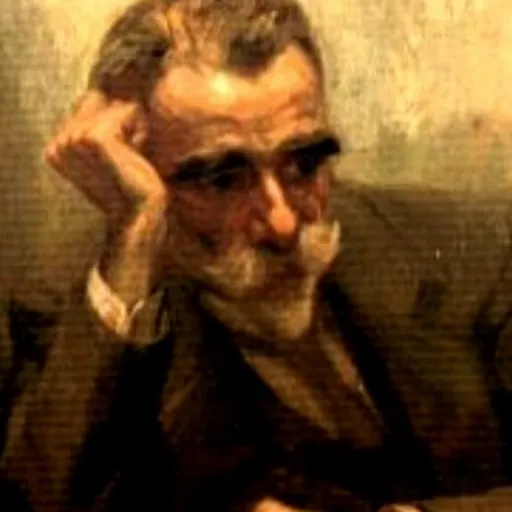
About Kostis Palamas
Lived 1859 – 1943 (aged 84). Kostis Palamas was a Greek journalist, literary critic, poet, playwright and writer.
Kostis Palamas (; ; – 27 February 1943 ) was a Greek poet who wrote the words to the Olympic Hymn. He was a central figure of the Greek literary generation of the 1880s and one of the cofounders of the so-called New Athenian School (or Palamian School, or Second Athenian School) along with Georgios Drosinis and Ioannis Polemis.
Biography Born in Patras, in the same house as born the Italian novelist Matilde Serao, he received his primary and secondary education in Mesolonghi. In 1877 he enrolled at the School of Law, Economics and Political Sciences of the University of Athens, but he soon abandoned his studies. In the 1880s, he worked as a journalist. He published his first collection of verses, Songs of My Fatherland, in 1886.
He was nominated for the Nobel Prize for Literature on 14 occasions, but never received it. He held an administrative post at the University of Athens between 1897 and 1926.
Palamas died on 27 February 1943, during the Axis occupation of Greece in World War II. His funeral at the First Cemetery of Athens on the next day became a major symbolic event of the Greek resistance against the occupation. In a service spontaneously attended by several thousand people, the funerary poem composed and recited by fellow poet Angelos Sikelianos roused the mourners and culminated in a major public demonstration of defiance of the occupying powers, whose representatives, come to lay a wreath at the poet's tomb, were greeted by the crowd with the Greek national anthem and shouts of 'Long Live Freedom'.
Work Palamas wrote the lyrics to the Olympic Hymn, composed by Spyridon Samaras. It was first performed at the 1896 Summer Olympics, the first modern Olympic Games. The Hymn was then shelved as each host city from then until the 1960 Winter Olympics commissioned an original piece for its celebration of the Games, but the version by Samaras and Palamas was declared the official Olympic Anthem in 1958 and has been performed at each celebration of the Games since the 1960 Winter Olympics.
Honors The old administration building of the University of Athens, in central Athens, where his office was located, is now dedicated to him as the "Kostis Palamas Building" and houses the "Greek Theater Museum", as well as many temporary exhibitions.
Parnassos Literary Society. From left: Georgios Stratigis, Georgios Drossinis, Ioannis Polemis, Palamas at the center, Georgios Souris and Aristomenis Provelengios, poets of the New Athenian School (or Palamian School). Painting by Georgios Roilos
Palamas has been informally called the "national" poet of Greece. He was an influential voice in Greek literature for more than 30 years, and greatly influenced the entire political-intellectual climate of his time. Romain Rolland considered him the greatest poet in Europe.
Works
Collections of poems Songs of my Fatherland (1886) Hymn to Athena (1889) Eyes of my Soul (1892) Iambs and Anapaests (1897) The Grave (1898) The Greetings of the Sun-born (1900) Ή Ασάλευτη Ζωή (The Motionless Life)(1904) Twelve Lays of the Gypsy (1907) The King's flute (1910) Yearnings of the Lagoon (1912) Satirical Exercises (1912) The State and Solitude (1912) Altars (1915) Extempora (1919) The 14 verses (1919) The 5 verses - The passionate secret whispers - The Wolves - Two flowers from afar (1925) Cowardly and Harsh verses (1928) The 3 Verse Cycle (1929) Passages and Greetings (1931) The Nights of Phemius (1935) Evening Fire (1944, posthumous edition by his son, Leander Palamas)
Prose Death of a Youth (novel, 1901) Novels (1920)
Theater The Thrice-noble (drama, 1903)
Criticism Palamas was one of the most respected literary critics of his day, and instrumental in the reappraisal of the works of Andreas Kalvos, Dionysios Solomos and the "Ionian School" of poetry, Kostas Krystallis et al.
Translations The King's Flute, tr. T. P. Stephanides, G. C. Katsimbalis (1982) [Greek and English texts] The King's Flute, tr. F. Will (1967) The Twelve Lays of the Gypsy, tr. G. Thomson (1969) The Twelve Words of the Gypsy, tr. T. P. Stephanides, G. C. Katsimbalis (1974; repr. 1975) A Hundred Voices, tr. T. P. Stephanides, G. C. Katsimbalis (1976) Ruins, Grief, On The Trip You Are Taken, Rose Fragrance, tr. A. Moskios
Don’t just read it —
keep it.
Full-length biographies made to live with: read them, listen on the way to work, watch them tonight.
- E-book
- Audio
- Video
Instant download · yours to keep · every purchase keeps this site free
Important facts
People in Kostis Palamas's life
Named in this biography and alive at the same time



Related people
Same field, nearest in time

Contemporaries
People whose lives overlapped Kostis Palamas's



Frequently asked questions
Who was Kostis Palamas?
Greek poet
When was Kostis Palamas born?
Kostis Palamas was born on 13 January 1859 in Patras.
When did Kostis Palamas die?
Kostis Palamas died on 27 February 1943 in Athens.
What was Kostis Palamas's occupation?
Kostis Palamas was a journalist, literary critic, poet, playwright and writer.
What nationality was Kostis Palamas?
Kostis Palamas was Greek.
Sources & further reading
Cite this page
APA: Biography.guide. (2026). Kostis Palamas. https://biography.guide/kostis-palamas/
MLA: "Kostis Palamas." Biography.guide, https://biography.guide/kostis-palamas/.
Chicago: "Kostis Palamas." Biography.guide. https://biography.guide/kostis-palamas/.
Data last updated: 2026-09-22 · Spot an error? Report a correction.
Portrait: Wikimedia Commons · author & licence
Page generated 2026-09-27 05:02 UTC