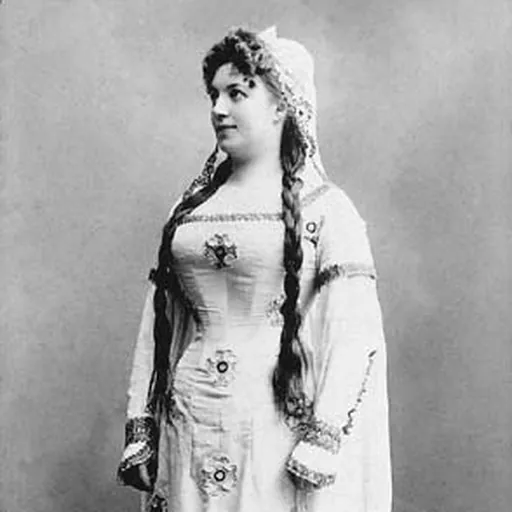
About Teréz Krammer
Lived 1868 – 1934 (aged 65). Teréz Krammer was a Hungarian opera singer.
Teréz Krammer ( 2 August 1868 In Pest – 15 June 1934 In Csömör) was an Hungarian opera singer (soprano).
Life Her father was a post and telegraph official. Of her six children, only Teréz survived to adulthood. She was a student of Imre Bellovics (voice) and Ede Újházi (acting) at the school of the Society of Music Lovers.
She made her debut at the Leipzig Opera on 3 June 1888 as Micaëla in Carmen, and then sang in Elberfeld and Düsseldorf. In 1891, she appeared as a guest at the Opera House in the roles of Senta (Wagner: Flying Dutchman) and Elisabeth (Wagner: Tannhäuser). Due to negative reviews, she could not find work in Budapest at that time. Between 1892 and 1895 she was a member of the Magdeburg City Theatre. There she met her first husband, the tenor Franz Schmidt (1851–1897). In the summer of 1893 they bought a property in Csömör and were married the following year. In 1895, she followed her husband to Breslau. Schmidt died in Csömör on 8 June 1897. Two years later, Krammer remarried, to the conductor Leopold Weintraub, who Hungarianized his name to Lipót Vágó and worked as a singing teacher in the Hungarian capital.
Krammer was under contract to the Semperoper in Dresden from 1899 to January 1902. After further guest appearances, she signed with the Hungarian State Opera House on 1 February 1902. She made her debut as Melinda in Bánk Bán, to the great delight of Hungarian audiences. She was one of the most popular sopranos of the company for close to a decade.
Teaching music When her contract in Budapest expired, Krammer signed a two-year contract in Frankfurt. From January 1914, she worked again as a singer at the City Theatre. The outbreak of World War I put an end to her stage career. her career as a singing teacher began after her return in 1914, at the National Conservatory (Nemzeti Zenede), where she was on the teaching staff until 1920. between 1924 and 1931, she taught at the Fodor Music School. In 1928, she celebrated the fortieth anniversary of her professional career. she achieved her greatest success in dramatic roles, mainly in Wagner operas. Between 1903 and 1908, she made numerous gramophone recordings in Budapest.
Roles
Emil Ábrányi: Monna Vanna – címszerep Eugen d'Albert: Káin – Éva Adolf Bungert: Nausikaa – Leukothea Luigi Cherubini: A vízhordó – Rosette Császár György: A kunok – Margit Gabriel Dupont: A kecskepásztor – Amalia Erkel Ferenc: Hunyadi László – Szilágyi Erzsébet Erkel Ferenc: Bánk bán – Melinda Otto Fiebach: A királynő tisztje – Anna Umberto Giordano: Fedora – Fedora Romazov hercegnő Hermann Goetz: A makrancos hölgy – Katalin; Bianka Karl Goldmark: Sába királynője – Szulamit Karl Goldmark: Berlichingen Götz – Walldorf Adelheid Charles Gounod: Faust – Margit Richard Heuberger: Manuel Venegas – Egy leány Jenő Hubay: Lavotta szerelme – Ilona Engelbert Humperdinck: Jancsi és Juliska – Altató manó; Ébresztő manó Ruggero Leoncavallo: Bajazzók – Nedda Heinrich Marschner: A vámpír – Janthe Pietro Mascagni: Parasztbecsület – Santuzza Jules Massenet: La Navarraise – Anita Giacomo Meyerbeer: A hugenották – Valentine; Urbain Giacomo Meyerbeer: A próféta – Berta Giacomo Meyerbeer: Az afrikai nő – Anna Wolfgang Amadeus Mozart: Figaro lakodalma – Barbarina Wolfgang Amadeus Mozart: Don Giovanni – Donna Anna Wolfgang Amadeus Mozart: A varázsfuvola – Pamina; Első hölgy Viktor Nessler: A säkkingeni trombitás – Maria Victor Neßler: A hamelni patkányfogó – Regina Otto Nicolai: A windsori víg nők – Fluthné; Reich Anna Ignacy Jan Paderewski: Manru – Asa Giacomo Puccini: Manon Lescaut – címszerep Giacomo Puccini: Tosca – Floria Tosca Giacomo Puccini: Bohémélet – Mimì Rékai Nándor: A nagyidai cigányok – Héla William Shakespeare–Felix Mendelssohn: Szentivánéji álom – Tündér Bedřich Smetana: Az eladott menyasszony – Mařenka Johann Strauss: Die Fledermaus – Rosalinda Johann Strauss : A cigánybáró – Szaffi Johann Strauss : 1001 éj – Leila Richard Strauss: Elektra – címszerep Franz von Suppé: A szép Galatea – Galatea Szabados Béla: Mária – címszerep Giuseppe Verdi: A trubadúr – Inez Giuseppe Verdi: Aida – címszerep Richard Wagner: Cola Rienzi, az utolsó néptribun – Irene Richard Wagner: A bolygó hollandi – Senta Richard Wagner: Tannhäuser... – Erzsébet; Vénusz Richard Wagner: Lohengrin – Brabanti Elza; Első nemesi apród Richard Wagner: A nürnbergi mesterdalnokok – Eva Richard Wagner: A Nibelung gyűrűje – Brünnhilde; Woglinde; Gutrune; Sieglinde; Freia; Ortlinde; Harmadik norna Richard Wagner: Parsifal – Kundry Carl Maria von Weber: A bűvös vadász – Agathe; Egy nyoszolyólány Carl Maria von Weber: Euryanthe – Bertha Carl Maria von Weber: Oberon – Roschana Zichy Géza: Nemo – Badinyi Klára Zichy Géza: Rodostó – Hesseni Amália Sarolta
Don’t just read it —
keep it.
Full-length biographies made to live with: read them, listen on the way to work, watch them tonight.
- E-book
- Audio
- Video
Instant download · yours to keep · every purchase keeps this site free
Important facts
People in Teréz Krammer's life
Named in this biography and alive at the same time





Related people
Same field, nearest in time

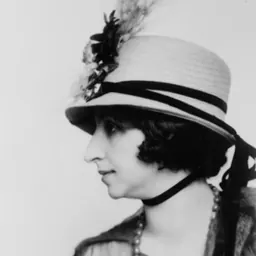

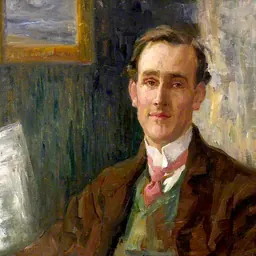
Contemporaries
People whose lives overlapped Teréz Krammer's
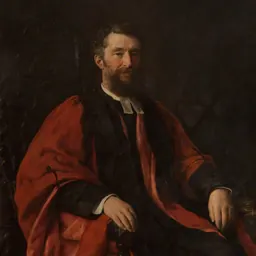
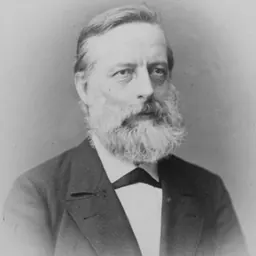
Frequently asked questions
Who was Teréz Krammer?
Hungarian opera singer (soprano) (1868–1934)
When was Teréz Krammer born?
Teréz Krammer was born on 2 August 1868 in Pest.
When did Teréz Krammer die?
Teréz Krammer died on 15 June 1934 in Csömör.
What was Teréz Krammer's occupation?
Teréz Krammer was an opera singer.
What nationality was Teréz Krammer?
Teréz Krammer was Hungarian.
Sources & further reading
Cite this page
APA: Biography.guide. (2026). Teréz Krammer. https://biography.guide/terez-krammer/
MLA: "Teréz Krammer." Biography.guide, https://biography.guide/terez-krammer/.
Chicago: "Teréz Krammer." Biography.guide. https://biography.guide/terez-krammer/.
Data last updated: 2026-09-21 · Spot an error? Report a correction.
Portrait: Wikimedia Commons · author & licence
Page generated 2026-09-27 05:00 UTC