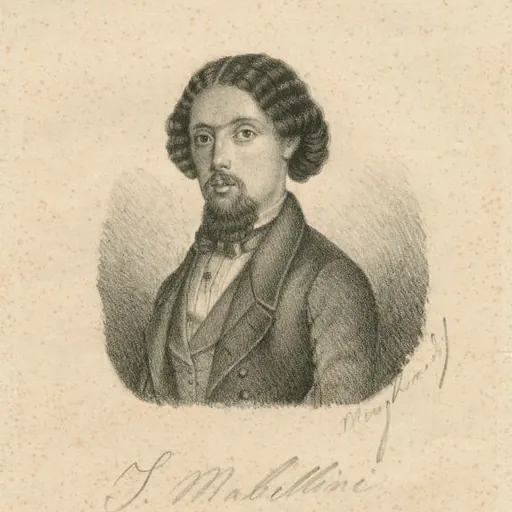
About Teodulo Mabellini
Lived 1817 – 1897 (aged 79). Teodulo Mabellini was an Italian composer, conductor, musicologist, music educator and impresario.
Teodulo Mabellini (2 April 1817 – 10 March 1897) was an Italian composer.
Life Autograph score of the version of Eudossia e Paolo, conserved at the Conservatory in Florence He took his very first music lessons from his father and from the flautist, Giovacchino Bimboni, (future music producer of brass instruments). The education he received from these first teachers was critical in forming the unique style of his orchestral compositions. He continued to have contact with Bimboni throughout his entire life, and together they developed a knowledge of composition for winds that was uncommon in this time period (see Style). In 1832, at the age of 15, Mabellini held a concert of his own compositions (of which only l'Estro armonico remains; the autograph can be found in Pistoia, see Sources) in Pistoia and Grosseto. Immediately after graduating, he was hired as Master of Harpsichord at the Teatro dei Risvegliati in Pistoia and collaborated in productions such as La straniera di Vincenzo Bellini and Anna Bolena by Gaetano Donizetti. The operatic world inspired him to compose his first opera, Matilde e Toledo, which he wrote in only one month when he was just nineteen years old. In spite of the absence of patriotic allusions in his theatrical works, as well as in the commissions by the Grand Duke, Mabellini demonstrated his spirit of the Risorgimento on other occasions. In 1847, one year before the beginning of the bourgeois revolution, a time which is flooded with patriotic choirs, Mabellni wrote L'Italia risorta, a compositions that precedes Michele Novaro’s setting to music of Canto degli Italiani by Goffredo Mameli by only a few months, as well as the attempt by Giuseppe Verdi to put Mazzini's Suona la tromba to music. In the same year, Mabellini also set the Inno all'Italia: sorgi depressa Italia to music, and in 1859 he wrote a mass for the fallen soldiers of the Battle of Curtatone and Montanara, which was performed in the Basilica of Santa Croce. Mabellini wrote an Inno nazionale toscano (Tuscan National Anthem) in 1858, according with his fantasy of a Tuscan Risorgimento (the anthem was published by Lorenzi). as well as some French (Gounod e Meyerbeer). but the project initiated by Verdi remained unfinished, and for the burial of Rossini in the Basilica of Santa Croce, a few months after the funeral in Paris, Mabellini performed Mozart's Requiem, with serious limits imposed by the Archbishop, who prohibited women from the choir (they were substituted at the last minute by a children’s choir from Lucca). ), before abandoning compositions altogether in 1887 (this was the year of his last composition: a cantata based on a character of Dante’s for Ugo Martini, see Sources). From then on, even though in retirement, he continued to preside over some exams at the Musical Institute until 1894, when he was struck by a progressive paralysis that restricted him to bed, until his death in 1897.
Style From a theatrical point of view, he was attracted to the belcanto style; he admired Vincenzo Bellini’s work, A mutual respect bonded him to Giuseppe Verdi, which is demonstrated in the promotion of Verdi’s operas by Mabellini at the Pergola Theater, their collaboration in the incomplete Messa for Rossini, and the fantasies Mabellini wrote on Verdi’s theme for instruments (see Sources). As mentioned in the biography, the sacred music by Mabellini reflects the theoretical oscillation or uncertainty about composing the messe to perfection, which was a point of reflection at the time, and one which he participated in firsthand. His sacred music production, precisely because of its connection to the Zeitgeist was one of the most appreciated of his era. (see also Fortune). These professionals, who were committed to the Cappella Orchestra and were also a musical group on their own, were called the Banda della Real Guardia, and were the musicians the Mabellini composed many of his works for (the Gran fantasia of 1846 is actually dedicated to them), and it guaranteed an extremely high-quality standard. It is also thanks to them that Mabellini was able to use the orchestra in a European way. In fact, his ideas regarding the instruments take on orchestral ideas from the other side of the Alps, that came about at the end of the 1700s (implemented above all by Haydn and Mozart and continued by Beethoven, Schubert, Méhul, Weber and Brahms: authors that Mabellini often new thanks to his career as a conductor) and inserted them into the Italian musical atmosphere, in a way that almost anticipated not only Realism (Pietro Mascagni will continue to call the orchestral parts instrumental until his death in 1945, perhaps because of Mabellini’s influence) but also many Post-Romantic European trends (for example Richard Strauss).
Fortune He was very famous in his time period: the Messa da Requiem of 1851 caused him to receive honors in Spain and in France, and in his necrology, he is almost more remembered as a composer of sacred works than as a composer for the theater or as a conductor. Mabellini was also fortunate to have good relations with publishers, not only the many Florentine publishers, but also Ricordi and Lucca from Milan, and Richault in Paris; a fact that guaranteed the circulation of printed copies of his word throughout Italy. The library possesses, as aforementioned, the majority of the autographs, as well as many drafts, and even an attempt at an autobiography that was left unfinished.
Other autographs Conservatorio Luigi Cherubini of Florence preserves the following autographs the scherzo Il fiume, dated 1870, a copy of an autograph reduction of the sacred cantata Eudossia e Paolo, the anthem Sommo Iddio la cui provvida mano, dedicated «al Granduca e alla sua famiglia», a copy perhaps prepared by Mabellini himself for the Napoletan representation of the opera Rolla, dated 1841, of which the institute preserves also some original drafts by Filippo Del Buono, the introduction of the first act of the opera Il conte di Lavagna, donated by Mabellini to the «illustrious Mercadante»; the Conservatorio Giuseppe Verdi of Milan and the Archive of the publishing house Ricordi possess the autograph and many manuscripts of parts for the opera Rolla. the Research of Musical Manuscripts of Milan (URFM: Ufficio Ricerca Fondi Musicali di Milano) the city that possesses manuscript copies of Mabellini are: Pistoia: the Capitolare Archive preserves a contemporary manuscript copy of the orchestral interlude La congiura from the opera Il Conte di Lavagna, one copy of the cantata (after printed by the Florentine publisher Guidi) Lo spirito di Dante, of 1865 (the drafts are found in Fano); Ostiglia (Mantova): Greggiati Music Collection has two scene from the opera Le illustri rivali by Mercadante in the version for voice and piano that the author commissioned from Mabellini, at that time his student in Novara; Rome: l'Accademia filarmonica romana (the Roman Philharmonic Academy) has manuscript copies of the single parts of the Lux aeterna for Rossini.
Printed editions Mabellini had publications with the most important Italian publishers of not only his time (Ricordi, Lucca, Guidi, Lorenzi, and the Parisian Richault), so the number of printed copies of his work is massive. The Federiciana Library in Fano and the institutions in Pistoia (the Forteguerriana Library and the Capitolare Archive) possess the most extensive amount of the collection of printed editions. In addition, it is known that almost 80 examples are found in the Biblioteca Nazionale Marciana in Venezia, more than 40 are preserved at the Conservatorio in Milan, around 20 at the Accademia di Santa Cecilia in Rome, the Biblioteca Nazionale Centrale and the Conservatorio in Florence, and about ten at the Conservatorio in Genova. After which, other can be found at the conservatories in Bergamo, Milan, Rome and Naples, la Ugo e Olga Levi Collection in Venice, the Seminario Maggiore in Padova, the Biblioteca Palatina in Parma, the Accademia Filarmonica and the Museo internazionale e biblioteca della musica in Bologna, the Biblioteca di Storia Moderna e Contemporanea, the Istituto Storico Germanico, the Biblioteca di Storia dell'Arte in Rome, the Biblioteca Apostolica Vaticana, the Biblioteca «Vittorio Emanuele III» in Naples, the Library of Congress in Washington, the British Library in London. L'Archivio della Società filarmonica of Tremona (Svizzera) has two compositions for band edited by the Florentine publisher Lapini, Baldassar and Il battesimo, without a date.
Letters Very few letters by Mabellini were published, and many remain in the private archives of the receiver. Enormous collections are in the Basevi Collection at the Conservatorio in Florence, in the Piancastelli Collection at the Biblioteca «Saffi» in Forlì, in the Puccini Collection at the Biblioteca Forteguerriana in Pistoia, at the Biblioteca Federiciana in Fano, and in the private Archive «Picozzi-Mancinelli» in Roma.
Frontispiece of the arrangement for band of the finale of the sacred drama Baldassarre present in the Biagini Collection in the Diocese Archive in Pescia.
List of Operas When not otherwise specified, the autographs of the operas are preserved in Fano. 1836 Matilde e Toledo staged on 27 August in Florence. 1840 Rolla staged in Turin on 12 November at the Teatro Carignano. Autograph in the Ricordi Publishing Archive in Milan. 1841 Ginevra degli Almieri staged in Turin on 13 November at Teatro Carignano. The autograph in Fano is incomplete. Domine ad adjuvandum, for choir and orchestra, 1847; Responsori o Responsi per la Settimana Santa, for two choirs (8 voices) and a string orchestra, 1847, printed by Guidi (Florentine) around 1860; Kyrie [Chirie] for 3 voices, for the celebration of Santa Cecilia celebrated in the Chiesa di Novoli in 1849; Messa a cappella for 3 voices, 1849; Te Deum «written in May 1849 for the return to Florence of Leopoldo II and by the same author donated to Masseangeli on 4 March 1850». It is preserved at the Philharmonic Academy, Accademia Filarmonica, in Bologna; Gloria for 3 voices, composed for the celebration of Santa Cecilia celebrated in the Chiesa di Novoli in 1850; Messa a cappella for 3 voices, 1851; Messa di Requiem, is the mass that made him famous throughout Europe and one of his most well-known and most performed compositions during his life. The first performance was in Chiesa dei Santi Michele e Gaetano on 15 May 1851. The autograph is in the Capitolary Archive in Pistoia. It was printed by the parisian Richault in 1853. A modern edition of Mabellini’s Messa di Requiem has been edited recently by german musicologist Guido Johannes Joerg and released at publishing house Christoph Dohr in Cologne, Germany; Messa da vivo o Messa n. 3, written for the marriage of Ferdinando IV di Toscana to Anna Maria di Sassonia. The marriage was celebrated in 1856, but the autograph of the mass is dated 1852. It had already been printed by Richault in Paris in 1853 (copies are found in the Palatina Library in Parma and at the Conservatorio di Firenze); Elima il mago, sacred-dramatic scene to the text of Stefano Fioretti, 1853; Tantum ergo, for tenor, bass and orchestra, 1853; Libera me, Domine, for two tenors, two basses, choir and orchestra, 1856. The autograph is in Fano. It was printed by Richault in Paris in an undated edition, two of which are found in Fano and in Naples (see above, Messa di Requiem); Mottetto «Spes impii», 1856; Ecce Sacerdos magnus, for the arrival of Pope Pio IX in Florence on 18 August 1857 (a piece often erroneously attributed to Gioacchino Maglioni), preserved both in Florence and in Fano; Tantum ergo for alto, two tenors and orchestra, also for the arrival of Pope Pio IX to Florence, 18 August 1857; Unguentum in capite for mixed choir and orchestra, also for the arrival of Pope Pio IX to Florence in August 1857. The autograph is both in Florence and Fano. Inno degi Apostoli «Exultet orbis gaudiis», 1858; Laudate pueri, for tenor, choir and orchestra, 1858; Cum Sancto Spirito, 1859; Messa funebre for the fallen from the Curtatone and Montanara Battle, Battaglia di Curtatone e Montanara, performed in the Basilica di Santa Croce in Florence on 29 May 1859; Messa for choir and orchestra, 1862; Messa n. 4, 1862, incomplete (composed of a Gloria, a Laudamus, a Credo, Sanctus, Agnus Dei, and another Agnus Dei); Messa n. 5, 1863; Mottetto «Ave Maria», was performed by the tenor Pollione Ronzi in Pietrasanta in May 1867 in honor of Princess Margherita di Savoia. It was published in Milan by Lucca Publishers; Inno «Regina Coeli», 1868; Magnificat. The autograph in Fano says «Pietrasanta 24 May 1868»; Salmo «Sub tuum praesidium», for mixed choir and orchestra. The autograph says «Pietrasanta 24 May 1868». Perhaps, it was an element of the composition that also the previous Magnificat took part; In gloria Dei patris amen, canon of 4 voices, 1869: it is the Gloria that Mabellini wrote for Florimo in Naples; In 1980, in the Auditorium della Discoteca di Stato in Rome, Walter Vagnozzi (baritone) and Loris Gavarini (pianist) recorded a series of Italian patriotic songs composed between 1847 and World War I, one of which was La buona andata by Mabellini (composed in 1848 to the text of Giuseppe Tigri, published by the Guidi Publishers of Firenze, of which the autograph can be found in Fano).
Don’t just read it —
keep it.
Full-length biographies made to live with: read them, listen on the way to work, watch them tonight.
- E-book
- Audio
- Video
Instant download · yours to keep · every purchase keeps this site free
Important facts
People in Teodulo Mabellini's life
Named in this biography and alive at the same time





Related people
Same field, nearest in time



Contemporaries
People whose lives overlapped Teodulo Mabellini's




Frequently asked questions
Who was Teodulo Mabellini?
Italian composer (1817–1897)
When was Teodulo Mabellini born?
Teodulo Mabellini was born on 2 April 1817 in Pistoia.
When did Teodulo Mabellini die?
Teodulo Mabellini died on 10 March 1897 in Florence.
What was Teodulo Mabellini's occupation?
Teodulo Mabellini was a composer, conductor, musicologist, music educator and impresario.
What nationality was Teodulo Mabellini?
Teodulo Mabellini was Italian.
Sources & further reading
· Wikipedia: Teodulo Mabellini
Cite this page
APA: Biography.guide. (2026). Teodulo Mabellini. https://biography.guide/teodulo-mabellini/
MLA: "Teodulo Mabellini." Biography.guide, https://biography.guide/teodulo-mabellini/.
Chicago: "Teodulo Mabellini." Biography.guide. https://biography.guide/teodulo-mabellini/.
Data last updated: 2026-09-23 · Spot an error? Report a correction.
Portrait: Wikimedia Commons · author & licence
Page generated 2026-09-27 05:07 UTC