
About Tengku Mahmood Mahyideen
Lived 1908 – 1954 (aged 45). Tengku Mahmood Mahyideen was a politician.
Tengku Mahmood Mahyideen (Jawi: ; 28 October 1908 – 12 February 1954), also known by his nickname Harimau Malaya (Malayan Tiger), was a Siamese-born Malayan–Pattani prince, freedom fighter, businessman, radio announcer, and spymaster in the service of the British Special Operations Executive (SOE). Widely recognised as an "icon of the independence movement", he was regarded by some as a pretender to the throne of the historical Patani Kingdom.
Mahyideen played a prominent role as a reformer of Malays education in Kelantan, acted as a patron of school cooperatives in the state, and established himself as a successful entrepreneur. During the Second World War, he became the first Malay to be recruited as an SOE agent, gaining further renown for his leadership of Force 136's Malay Section. In the post-war years, he served as a member of the Federal Legislative Council of Malaya and founded the Greater Patani Malay Association (, GAMPAR), of which he was chairman.
Early life and education Tengku Mahmood Mahyideen during the early stage of his life (1916–1929). Tengku Mahmood Mahyideen bin Tengku Abdul Kadir Kamaruddeen was born on 28 October 1908 at the Istana Chabang Tiga ("Palace of Chabang Tiga") in Patani, Siam (present-day Thailand). He was the son of Tengku Abdul Kadir Kamaruddeen, the 27th and last King of Patani, who reigned as Sultan Abdul Kadir Kamaruddin Syah from 1898 until his deposition by the Rattanakosin Kingdom in 1902, and his third wife, Tengku Maimunah.
Through his father, he was a descendant of Raja Long Yunus, a prince of the Patani Kingdom who united Kelantan and ruled as its first Raja from 1763 until 1795. His mother, Che Maimunah (styled Tengku Maimunah after marriage), belonged to the House of Long Gaffar, the ruling family of Southern Kelantan. He was the sixth of his father's seven children and his second son. Following the death of his mother in 1912, he was sent to Kelantan to be raised by his stepmother, Tengku Kembang, who was Tengku Abdul Kadir's first wife.
Mahmood Mahyideen began his education in 1916 at Padang Garong Government School in Kota Bharu, later transferring to the Kota Bharu Islamic Religious Council School, where he studied for two years. In 1920, he was sent to Bangkok to continue his studies at Assumption College. He returned to Kelantan in 1923, shortly before his father led the Belukar Semak rebellion against Siamese rule. He continued his education at Penang Free School from 1925 to 1928 and on 18 June 1933 obtained the Senior Cambridge Certificate (Honours, I.M.S.).
Entrepreneurship Following the completion of his secondary education in 1928, Tengku Mahmood's father instructed him to join the Kelantan Civil Service in order to acquire administrative experience. However, he chose instead to pursue a business career and established a shop in Kota Bharu known as Kedai Kita, which specialised in selling bicycles from the Mead Cycle Company, a well-known British manufacturer.
Ismail English School On 30 April 1935, Tengku Mahmood Mahyideen, accompanied by Nik Ahmad Kamil Nik Mahmood (then Secretary of the Kelantan State Government), held an initial meeting and discussion with A.C. Baker and J.A. Harvey at the British Adviser's residence. This discussion led to the formation of the Kelantan Education Committee, specifically tasked with managing the establishment of an English school in Kelantan.
The successful establishment of Ismail English School marked a significant advancement in education. Tengku Mahmood Mahyideen was regarded as "The prime mover of establishing Government English Schools, the first of its kind in Kelantan."
Initially, Zainab English School enrolled 19 students exclusively from affluent families. Later, it began admitting girls from the general public, particularly those residing around Kota Bharu. The initial conclusion drawn from Tengku Mahmood Mahyideen's plans to establish these educational institutions was that progress was not as straightforward as anticipated.
He faced numerous obstacles and challenges. The primary issue was overcoming the British colonial administration's belief that educating Malays would burden their governance. Additionally, shifting the Malay community's early skepticism toward vernacular education proved difficult. However, the success of Tengku Mahmood Mahyideen's proposals to establish English schools demonstrated that his ideas were sound and deserved support, particularly from the state government.
Malayan Security Service, espionage in Thailand and Franco–Thai War Shortly after enlisting in the Kelantan Volunteer Force (KVF) in 1939, Tengku Mahmood Mahyiddeen was recruited by the Malayan Security Service (MSS), the intelligence branch of the British colonial administration in Malaya, to monitor Japanese activities in neighbouring Thailand. His assignment focused on gathering intelligence regarding Japanese contacts with the Thai government and the movement of Japanese forces in the region.
Copies of Tengku Mahmood's correspondence with the Malayan Security Service are preserved at Rhodes House, University of Oxford, within the Political Intelligence Journal files of the Service.
The sinking of the SS Kuala On 14 February 1942, the SS Kuala was attacked by Japanese aircraft off Pom Pong Island (present-day Penyengat Island, near the Riau Archipelago) while en route from Singapore to Padang. The vessel was heavily bombed, resulting in the deaths of an estimated 135 people. Survivors abandoned ship, many swimming to the island to escape the bombardment.
Initial assistance came from local residents of neighbouring islands, who transported a limited number of survivors by tongkang to nearby fishing villages. On 16 February 1942, the small transport vessel SS Tanjong Pinang evacuated about 200 survivors from Pom Pong Island. However, on the following day, the ship was sunk by Japanese aircraft en route to Batavia (present-day Jakarta), with the loss of all passengers.
At the time, British authorities were initially reluctant to recruit Malays into Force 136. Recruitment policy had largely prioritised Chinese volunteers, as they were perceived as more reliable allies due to their hostility towards Japan following the outbreak of the Second Sino–Japanese War in 1937. Malays, by contrast, were viewed with caution, as the Japanese occupation had treated them comparatively less harshly than the Chinese population.
Malay Section of Force 136 Major Tengku Mahmood was tasked with creating and managing the Malay Section of Force 136. Recruitment efforts focused on Malay students abroad, particularly in British Raj (British India), Egypt, Iraq, Jordan, Palestine, Saudi Arabia, and the United Kingdom. Funded by the British, he travelled extensively to persuade students to join the unit. In India, he advertised through local newspapers and convened meetings, eventually assembling about 30 volunteers at a bungalow in New Delhi known as Malaya Lodge. There, he conducted briefings and discussions to outline the mission of the Malay Section, resulting in unanimous agreement among attendees to enlist.
In September 1942, he held a special meeting in New Delhi with Ibrahim Ismail (later General Tan Sri Ibrahim Ismail), then an officer cadet of the Johor Military Forces undergoing training at the Indian Military Academy, Dehra Dun. Tengku Mahmood successfully persuaded him to join the Malay Section of Force 136.
Tengku Mahmood believed that Britain would ultimately retake Malaya and that Malay participation in the resistance would secure political recognition after the war. He urged Malays abroad to unite in supporting the Allies, alongside existing anti-Japanese groups such as the Malayan People's Anti-Japanese Army (MPAJA) and the Malayan Communist Party (MCP).
Major Tengku Mahmood returned to Malaya in October 1945, following the re-establishment of the British Military Administration. Shortly thereafter, Force 136 was formally disbanded. The Malay members, after two years of service, quietly returned to their villages. Though their efforts received little public recognition, they had played a role in undermining Japanese authority during the occupation. Tengku Mahmood's contribution as the 'mastermind' and spymaster of the Malay Section was regarded as critical to the planning and execution of clandestine operations in Malaya.
Struggle for independence and icon of the independence movement During his lifetime, Tengku Mahmood was regarded as one of the icons of the independence movement in Malaya. In addition to his resistance against the Japanese during the Second World War, he was also deeply involved in the independence struggle, first for his birthplace Patani in southern Thailand and later for Malaya. His efforts combined diplomacy, propaganda, and armed resistance.
By mid-1947, according to Malayan Security Service reports, several prominent Patani nobles proclaimed him as the Raja of Patani. By March 1948, he had raised considerable funds to purchase firearms and wireless equipment, which he distributed across Narathiwat, Pattani, Sai Buri, Satun, and Yala for guerrilla operations. Security Service records noted at least 85 rifles and 500 rounds of ammunition distributed in Kampung Kekala, Pattani, though the total number of weapons supplied is unknown.
Through the Greater Patani Malay Association (, abbreviated as GAMPAR), and capitalising on the instability caused by the 1948 Thai coup d'état, Tengku Mahmood managed to unsettle the Thai government. In response, the authorities dispatched Seni Pramoj, then Minister of Education, to negotiate with him and offer him a senior post in the government. However, this move angered members of GAMPAR, who suspected him of betrayal. Although Tengku Mahmood rejected the Thai government's offer, his relationship with GAMPAR deteriorated. Disillusioned, he withdrew from the Patani independence movement and shifted his focus towards Malaya.
Role in Malaya's independence movement Tengku Mahmood was among the first Malay nobles to openly oppose the Malayan Union. Being literate in English, he was able to study the proposal draughted by Sir Harold MacMichael, who in 1945–46 had pressured Malay rulers into signing the scheme. Many of the monarchs, not fully conversant in English, had been misled into signing documents that differed from MacMichael's verbal assurances.
In 1946, Tengku Mahmood joined the newly formed United Malays National Organisation (UMNO), working with other Malay leaders to resist the Malayan Union and pave the way for independence. Although he did not live to witness the realisation of their efforts on 31 August 1957, having died in 1953, his role is remembered as laying important foundations for Malaya's independence struggle.
By 1948, Tengku Mahmood shifted back towards nationalism, although he continued to maintain cordial relations with communist circles. His political activism during this period reflected his pragmatic approach, moving between different ideological groups while maintaining the ultimate goal of achieving independence for Patani and Malaya.
Tengku Mahmood Mahyideen recognised that Malaya needed more than negotiations with the British full independence was his ultimate goal. He supported PKMM for its uncompromising stance on liberation, contrasting with the more moderate approach of UMNO (United Malays National Organisation) at the time. As an influential figure, he became a moral and strategic advocate for Malay freedom. a body pivotal in debating British colonial policies. On 10 November 1947, he raised concerns about economic disparities between ethnic groups, blaming the colonial government for failing to provide equitable opportunities for Malays in education and public administration. He called for more inclusive economic policies and emphasized investing in Malay education as the foundation of national development.
Greater Patani Malay Association (GAMPAR) Apart from his role in the Malay Nationalist Party of Malaya (PKMM), Tengku Mahmood Mahyiddeen was also active in the Greater Patani Malay Association (, abbreviated as GAMPAR, also known as GEMPAR), an organisation advocating for the independence and unification of Malay territories under Siamese rule. GAMPAR claimed the southern provinces of Pattani, Narathiwat, and Yala as part of Malaya, with the movement's ultimate objective being their integration into a free and united Malaya.
UMNO and the Malayan Union Tengku Mahmood Mahyideen played a significant role in Malaya's early political history through his participation in UMNO, though his involvement was often balanced by his reputation as an outspoken independent figure. He first engaged with UMNO when the party became the primary Malay platform opposing the Malayan Union a British administrative system introduced in 1946 that weakened the authority of Malay Rulers and granted liberal citizenship to non-Malays.
He was among the first Malay nobles to openly reject the Malayan Union, arguing that it blatantly undermined the sovereignty of Malay Rulers and threatened the status of Malays as the indigenous people. In a statement published by The Straits Times, he described the Malayan Union as a policy that "destroys the traditional social and political fabric of the Malays" and urged all parties to unite against it.
Renunciation of Royal title The public declaration of the renunciation of the royal title 'Tengku' for himself and his descendants in local newspapers. Tengku Mahmood Mahyideen publicly renounced the title 'Tengku' (Prince) for himself and his descendants through a local newspaper on 25 September 1946. He did not state the reason behind this decision. However, several sources associate it with his disappointment over broken British promises to liberate Patani. Some sources also suggest that he was disillusioned by the formation of the Malayan Union. Following this, Tengku Mahmood Mahyideen was referred to in newspapers simply as 'Inche' or 'Che'.
Death Tomb of Tengku Mahmood Mahyideen at the Kelantan Royal Mausoleum. Tengku Mahmood Mahyideen died on 12 February 1954 at the age of 45 in Kota Bharu after performing the obligatory Friday prayer. His death occurred suddenly, and no official cause of death was disclosed to the public. Although there was curiosity among the community, no reliable sources indicated any criminal elements or poisoning involved. His death was mourned by many, reflecting his profound influence as an educator, social reformer and war hero in Malaya.
Honours and awards Tengku Mahmood Mahyideen wearing traditional Baju Melayu, adorned with the MBE and DPMK medals.
Malaysian Honours
Foreign Honours
Military Honours
Don’t just read it —
keep it.
Full-length biographies made to live with: read them, listen on the way to work, watch them tonight.
- E-book
- Audio
- Video
Instant download · yours to keep · every purchase keeps this site free
Important facts
more
YAM Tengku Mahmood Mahyideen, Prince Tengku Mahmood Mahyideen, Harimau Malaya, Malayan TigerPeople in Tengku Mahmood Mahyideen's life
Named in this biography and alive at the same time



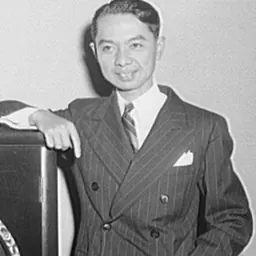
Related people
Same field, nearest in time





Contemporaries
People whose lives overlapped Tengku Mahmood Mahyideen's


Frequently asked questions
Who was Tengku Mahmood Mahyideen?
Malay military officer and politician
When was Tengku Mahmood Mahyideen born?
Tengku Mahmood Mahyideen was born on 28 October 1908 in Pattani.
When did Tengku Mahmood Mahyideen die?
Tengku Mahmood Mahyideen died on 12 February 1954 in Pantai Cahaya Bulan.
What was Tengku Mahmood Mahyideen's occupation?
Tengku Mahmood Mahyideen was a politician.
What nationality was Tengku Mahmood Mahyideen?
Tengku Mahmood Mahyideen's recorded nationality: British Malaya.
Sources & further reading
· Wikipedia: Tengku Mahmood Mahyideen
· DBpedia: Tengku Mahmood Mahyideen
Cite this page
APA: Biography.guide. (2026). Tengku Mahmood Mahyideen. https://biography.guide/tengku-mahmood-mahyideen/
MLA: "Tengku Mahmood Mahyideen." Biography.guide, https://biography.guide/tengku-mahmood-mahyideen/.
Chicago: "Tengku Mahmood Mahyideen." Biography.guide. https://biography.guide/tengku-mahmood-mahyideen/.
Data last updated: 2026-09-25 · Spot an error? Report a correction.
Page generated 2026-09-27 05:12 UTC