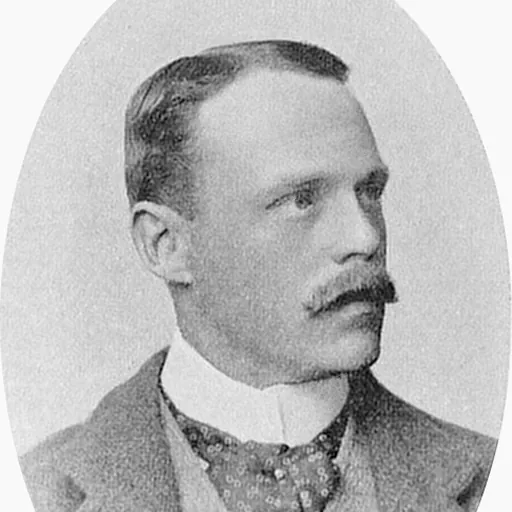
About Teddy Wynyard
Lived 1861 – 1936 (aged 75). Teddy Wynyard was a British cricketer.
Edward George Wynyard (1 April 1861 – 30 October 1936) was an English sportsman and a career officer in the British Army. He was primarily known as a first-class cricketer who played at the domestic level predominantly for Hampshire and the Marylebone Cricket Club (MCC), in addition to playing Test cricket for England on three occasions. He made over 150 appearances in first-class cricket between 1878 and 1912, as a batsman whom Wisden described as "a splendid forcing batsman". He scored over 8,300 runs and made thirteen centuries. He was an important figure in Hampshire's return to first-class status in 1894, and shortly after their re-elevation he was engaged as both their captain and president. Wynyard's administrative duties would later see him serve on the committee of the MCC.
Wynyard was also a successful amateur football centre-forward. In 1881, he was a member of the Old Carthusians team that won the FA Cup Final, in which he scored the opening goal in a 3–0 victory over Old Etonians at The Oval. He also played for both Winchester and the Corinthians. He was adept at winter sports, participating as a tobogganist in the International Championship at Davos in Switzerland, which he won in 1894, 1895 and 1899. He also played hockey for Hampshire and was a keen golfer, forming his own club, "The Jokers".
A career soldier, Wynyard was commissioned into the Warwickshire Militia in September 1879 and later served with the King's Liverpool Regiment from May 1883. He saw action in the Burma Expedition of 1885–87, during the course of which he was awarded the Distinguished Service Order. He joined the Welsh Regiment in 1890, and in the lead-up to the Second Boer War he held a number of staff appointments and instructed at the Royal Military College. He retired from military service in 1903, but returned to active service in the First World War, initially with the Middlesex Regiment. He was seconded later in the war to the Labour Corps, where he was commandant of Thornhill Labour Camp in Thornhill, Southampton. For his role in the conflict, he was appointed an Officer of the Order of the British Empire. Wynyard was the recipient of the medal of the Royal Humane Society in 1894, for bravery at "great personal risk" when he rescued a Swiss peasant who had fallen under the ice on a lake.
Early life The son of the soldier and judge William Wynyard, Edward George Wynyard was born at Saharanpur in British India in April 1861, where his father served in the Bengal Civil Service as a judge in the High Court of Allahabad. His mother, Henrietta, died when he was eight years old. Wynyard and his siblings were recorded as living in Kensington in the 1871 census. He was educated at the Woodcote House preparatory school in Windlesham, before attending Charterhouse School from 1874 to 1877. At the time, Charterhouse had strict academic criteria which 16-year-old students had to meet in order to remain at the school after that age; Wynyard failed to meet these requirements and subsequently left Charterhouse for St Edward's School, Oxford. At St Edward's, he excelled in rugby union, where he was described as "a glorious three-quarter, fast and strong". It was speculated that, had he not pursued a military career, he might have achieved international rugby honours. In preparation for his military career, he enrolled in the fee-paying Oxford Military College.
Military career Wynyard was commissioned as a second lieutenant in the 1st Warwickshire Militia in September 1879, and promoted to lieutenant in May 1881. From the militia, he briefly served with the Middlesex Regiment before transferring to regular service with the King's Liverpool Regiment in May 1883. After just five months service with the latter, he went with the regiment to British India and saw active service in the Burma Expedition of 1885–87, winning the Distinguished Service Order (DSO) in the latter year and being twice mentioned in despatches. His DSO was gained during actions in June 1885, when a large rebel force led by Oo Temah unsuccessfully attacked a small force of the King's Liverpool Regiment and the 2nd Bengal Infantry. Following the death of their commanding officer, Captain Dunsford, during the attack, Wynyard assumed command and "boldly" led the British counterattack against the rebels, who had retreated to a fortified pagoda. His actions were praised by Generals Sir Robert Low and Sir George White. In recognition of his actions, he was appointed to command a company of the Welsh Regiment, and was awarded the Indian General Service Medal.
Wynyard was promoted to captain in March 1890, at which point he formally transferred to the Welsh Regiment. In August 1890, he was appointed an instructor in tactics, military administration and law at the Royal Military College. He was adjutant of the Oxford University Volunteers until late 1899, prior to being appointed an instructor of military engineering at Sandhurst from 26 December 1899 until August 1902, when he returned to his regiment. While in charge of cricket at the college, he arranged an officer cadets' match against W. G. Grace's XI. Two days before the game Grace wrote to say he would be unable to play, but after learning none of the cadets had seen him play, Wynyard disguised himself with make-up and false beard and played in the match with the visiting team, batting, making several runs and getting purposely hit on the hand to retire 'hurt'. He revealed his identity minus beard and cap at the teams' lunch, but no one had seen through the disguise and his realistic imitation of Grace's batting style. Wynyard retired from the army in 1903.
After the outbreak of the First World War, Wynyard was recalled in September 1914 as a temporary major with the King's Liverpool Regiment, then was attached to the Army Ordnance Corps (AOC) in May 1915. He remained with the AOC until November 1916, at which point he ceased to be employed in the corps and relinquished his temporary rank. After leaving the AOC, he was transferred to the Middlesex Regiment. He was then seconded to the Labour Corps, being made a temporary major for the appointment. He was commandant of the Thornhill Labour Camp in Thornhill, Southampton from 1916 to 1919, by which point the war had concluded. He relinquished his commission on account of ill-health in April 1919. Wynyard was appointed an Officer of the Order of the British Empire in the 1919 Birthday Honours, in recognition of his service during the war.
Sporting career Cricket Early first-class career Considered too young to make the cricket eleven at Charterhouse, Wynyard played for the St Edward's cricket eleven. There, it was opined by the School Chronicle that he "would do well to remedy the grave faults of being too eager to make big hits, and of getting before his wicket". Nonetheless, whilst still a schoolboy he came to the attention of Hampshire, whom he qualified to play for by means of his residence at his father's home near Hursley, Hampshire. Thus, he made his debut in first-class cricket for Hampshire at the age of 17 in 1878, against the Marylebone Cricket Club (MCC) at Lord's. In 1879, he captained St Edward's to fifteen victories and only one defeat from nineteen matches, and headed both the batting and bowling averages; the School Chronicle declared that he was "by far the best all round cricketer that has ever been at St Edward's". He made three further first-class appearances for Hampshire in 1880, playing twice more against the MCC and once against Sussex, before playing against Sussex in 1881. Thereafter, his military duties took him to British India, where he remained until 1887, and where he took part in non-first-class matches. During one match in India at Nainital in 1885, he made scores of 123 and 106 for a team named The Visitors against The Residents. In another for his regiment in 1887, he made 237 against the 23rd Battalion, Royal Fusiliers. With his presence in the regimental team, it is believed they only lost one match between 1883 and 1890, with Wynyard averaging around 100 runs per innings. He would later play down his batting feats in India in an 1896 interview, in which he attributed his success to "generally very easy [bowling]".
By the time he had returned home later in 1887, Hampshire had lost their first-class status two years prior, following a number of poor seasons. Following his return, he played two first-class matches for the MCC in 1887, in addition to making 233 in a minor match in the same year for Incogniti against Phoenix Park at Dublin. Further first-class appearances came for the MCC in 1888, and A. J. Webbe's XI and the Gentlemen of England (both 1890). He had a modest 1895 season, scoring 581 runs from thirteen matches, and although he passed double-figures in 19 of his 26 innings, he averaged 22.34. During this season, he also played for I Zingari in their jubilee match against the Gentlemen of England at Lord's. thus he was both captain and president for the forthcoming season. He was prolific in 1896, beginning the season by scoring his maiden first-class century (121 runs) playing for Charles Thornton's personal team against Cambridge University. Later in the season, he made a century against Sussex, and in the match which followed he made 268 runs in a total of 515 against Yorkshire; at the time, this was the highest individual first-class score for Hampshire. He finished the season with 1,038 runs at an average of 49.42, with his average for the season being second only to Ranjitsinhji. His good form led to him being selected to play for England against Australia at The Oval in the Third Test of Australia's tour of England; he made scores of 10 and 3 as England clinched the deciding Test match of the series.
His 1897 season was less productive, with 713 runs from twelve matches at an average of 32.40, though he made centuries. Despite a more modest season, he was still in contention for the 1897–98 tour of Australia, but declined a place on the tour due to his concurrent military duties. however, as of their partnership remains a Hampshire record for the sixth wicket. As captain, he was also inclined to bowl himself during this season, taking 27 wickets at a bowling average of 27.27; he notably claimed his only five wicket haul in 1899, taking 6 for 63 against Leicestershire with his underarm lob bowling.
With the outbreak of the Second Boer War in October 1899, Wynyard felt compelled to resign the Hampshire captaincy in November 1899 to focus on his military duties. His army commitments limited him to just three first-class appearances for Hampshire in the 1900 County Championship, in addition to playing in the North v South fixture, where he made 85 runs for the South in their first innings. In 1901 he made just two appearances for Hampshire and one for the MCC against Yorkshire, Later in the season, he played for I Zingari and made 147, which was to become the highest individual first-class score for the team; his innings was pivotal in helping I Zingari to a six wicket victory, chasing 412 runs in their second innings.
Return to Test cricket During the winter which followed the 1904 season, Wynyard toured the West Indies with Lord Brackley's personal team, making eight first-class appearances during the tour. As in previous seasons, the majority of his first-class appearances during the 1905 English season came for the MCC, the highlight of which was a century opening the batting against Cambridge University at Lord's. He also featured in three matches for Hampshire in the 1905 County Championship, however, he earned selection for the first two Test matches of the series played at the Old Wanderers.
Thereafter, he made just three further first-class appearances for Hampshire, playing twice in the 1906 County Championship and once in the 1908 County Championship, Though the frequency with which he played for Hampshire reduced, Wynyard still featured extensively for the MCC both domestically and on tours. During the winter of 1906, he captained the MCC on their tour to New Zealand, where he made two first-class appearances against Auckland and Wellington. In 1908, he played for a Hambledon XII in a commemorative first-class match against an England XI at Broadhalfpenny Down, In the winter he toured Egypt with the MCC, though the tour featured no first-class matches. After appearing as a guest in Ireland for Stanley Cochrane's personal team against the touring Australians in 1908, He also developed a special method of hitting left-handed bowling over cover point. though could also field at mid-on and as a wicket-keeper.
Football Wynyard was in the school association football XI at Charterhouse in 1876, which was the same year that the school aligned its football rules to the rules of football established by The Football Association. During the final year of his education at Charterhouse, he played for Winchester, who were captained by Henry Bayard Rich. In 1881, he played for the Old Carthusians old boys' club as a centre-forward in the 1880–81 FA Cup, playing in the semi-final against Darwen, which led to an unexpected victory for the Old Carthusians. He also played in the final at Kennington Oval on 9 April. Around 25 minutes into the match, Wynyard scored his team's first goal in a 3–0 win against the Old Etonians. In the same season, he received an invitation to play for England against Ireland, but had to decline. Other clubs he joined were Beaconsfield, Royal Wimbledon (of whom he was an elected honorary member) Wynyard was survived by his wife, Sarah, whom he married in 1914, and their only child, a son who was also called Edward.
Don’t just read it —
keep it.
Full-length biographies made to live with: read them, listen on the way to work, watch them tonight.
- E-book
- Audio
- Video
Instant download · yours to keep · every purchase keeps this site free
Important facts
People in Teddy Wynyard's life
Named in this biography and alive at the same time




Related people
Same field, nearest in time



Contemporaries
People whose lives overlapped Teddy Wynyard's
Frequently asked questions
Who was Teddy Wynyard?
English cricketer (1861-1936)
When was Teddy Wynyard born?
Teddy Wynyard was born on 1 April 1861.
When did Teddy Wynyard die?
Teddy Wynyard died on 30 October 1936.
What was Teddy Wynyard's occupation?
Teddy Wynyard was a cricketer.
What nationality was Teddy Wynyard?
Teddy Wynyard was British.
Sources & further reading
Cite this page
APA: Biography.guide. (2026). Teddy Wynyard. https://biography.guide/teddy-wynyard/
MLA: "Teddy Wynyard." Biography.guide, https://biography.guide/teddy-wynyard/.
Chicago: "Teddy Wynyard." Biography.guide. https://biography.guide/teddy-wynyard/.
Data last updated: 2026-09-21 · Spot an error? Report a correction.
Portrait: Wikimedia Commons · author & licence
Page generated 2026-09-27 04:59 UTC