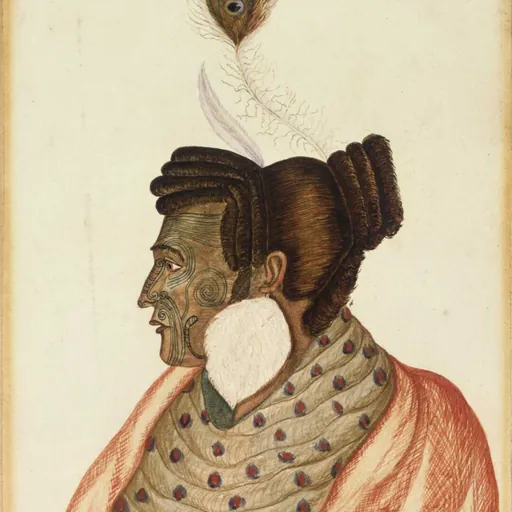
About Te Rangihaeata
Lived 1780 – 1855 (aged 74–75). Te Rangihaeata was a New Zealand military leader.
Te Rangihaeata ( 1780s – 18 November 1855) was a Ngāti Toa chief and a nephew of Te Rauparaha. He played a leading part in the Wairau Affray and the Hutt Valley Campaign.
Early life Te Rangihaeata, a member of the Māori iwi Ngāti Toa, was born at Kawhia in about the 1780s. His father was Te Rākaherea, his mother was Waitohi, the elder sister of Te Rauparaha and an important chief or ariki, and his maternal grandmother was Parekōwhatu of Ngāti Raukawa. Te Rangihaeata grew up in Te Rauparaha's shadow and became his trusted ally. Te Rangihaeata's sister was Rangi Topeora who was also a chief of Ngāti Toa and signed the Treaty of Waitangi at Kāpiti on 14 May 1840.
Musket wars Te Rangihaeata rose to prominence during the period of intertribal fighting known as the Musket Wars. In 1819 while raiding the southern North Island Ngāti Toa attacked Ngāti Apa at Turakina, near Bulls, killing many and taking several high-ranking captives, including Te Pikinga. They took the captives with them as they raided as far south as Wellington Harbour. As they returned north, they sought peace with Ngāti Apa, and Te Rangihaeata married Te Pikinga to conclude a peace alliance thorough a chiefly marriage.
Arriving back in their own tribal territories the war party found that the Waikato and Ngāti Maniapoto Māori had decided the Ngāti Toa were undesirable neighbours and for a long time a state of war existed between them. Although greatly outnumbered and outgunned, Te Rangihaeata conducted a successful defence until Te Rauparaha was able to use his diplomatic skills to extricate the tribe. This was the beginning of their migration down to the Paraparaumu and Kāpiti Coast area. They subsequently conquered most of that region and the upper parts of the South Island, occupying and claiming ownership of the land by right of conquest.
This forcible change of ownership was to be a source of much confusion and conflict when the European settlers arrived and began buying land. There were often at least two sets of generally accepted owners, and the ones who felt they had been dispossessed were often more than willing to sell land they owned but could not occupy.
Te Rangihaeata was not initially anti-Pākehā. He encouraged the whalers and the traders and was prepared to tolerate the missionaries. He valued them for the technology they introduced and the trade goods they were offering. But he quickly recognised that permanent settlers were a different matter, posing a serious threat to the Māori and their traditional ways. Despite that he tried to avoid open conflict.
The Wairau
When in 1843 Arthur Wakefield and the Nelson settlers were claiming the Wairau Valley, chiefs Te Rauparaha and Te Rangihaeata visited Nelson and made their position very clear. Te Rangihaeata promised that he would kill any settlers who tried to take his land from him. Despite this they were prepared to follow the Pākehā legal procedures and await the decision of the Land Commissioner, William Spain. It was the Nelson settlers who jumped the gun and sent surveyors to the disputed land. Te Rangihaeata had his men firmly but nonviolently remove them, being scrupulously careful to return to them all their surveying equipment and personal possessions, but burning their thatch huts.
The Nelson settlers sent out a party to arrest the two chiefs on a charge of arson. The accidental discharge of a musket precipitated a brief battle, and about a dozen of the settlers were shot. The rest either fled or surrendered to the Māori. Among those captured were Arthur Wakefield and Henry Thompson, the two leaders of the arresting party. Several Māori had been killed, including Te Rongo, one of Te Rangihaeata's wives who was also Te Rauparaha's daughter. The captured settlers were promptly executed in accordance with Māori law and custom. However it was Te Rangihaeata who insisted on it. This incident became known as the Wairau Affray. The subsequent Government enquiry exonerated the Māori and decided that the settlers had acted illegally.
The Hutt Valley
A similar situation arose about three years later in the Hutt Valley near Wellington. The settlers were pushing forward aggressively and occupying land that had disputed ownership. Several years of active immigration and the arrival of British Imperial Troops had put the settlers in a much stronger position and much less inclined to tolerate either Māori claims or legal challenges to their occupation of the land.
Despite increasing tension, the ransacking of settler homes, and the burning of Māori property, Te Rangihaeata remained peaceful. However, Governor Grey soon declared martial law on March 3rd, marking the beginning of the Hutt Valley Campaign.
Don’t just read it —
keep it.
Full-length biographies made to live with: read them, listen on the way to work, watch them tonight.
- E-book
- Audio
- Video
Instant download · yours to keep · every purchase keeps this site free
Important facts
People in Te Rangihaeata's life
Named in this biography and alive at the same time

Related people
Same field, nearest in time

Contemporaries
People whose lives overlapped Te Rangihaeata's



Frequently asked questions
Who was Te Rangihaeata?
Māori chief
When was Te Rangihaeata born?
Te Rangihaeata was born in 1780 in Kawhia Harbour.
When did Te Rangihaeata die?
Te Rangihaeata died in 1855.
What was Te Rangihaeata's occupation?
Te Rangihaeata was a military leader.
What nationality was Te Rangihaeata?
Te Rangihaeata was New Zealand.
Sources & further reading
Cite this page
APA: Biography.guide. (2026). Te Rangihaeata. https://biography.guide/te-rangihaeata/
MLA: "Te Rangihaeata." Biography.guide, https://biography.guide/te-rangihaeata/.
Chicago: "Te Rangihaeata." Biography.guide. https://biography.guide/te-rangihaeata/.
Data last updated: 2026-09-21 · Spot an error? Report a correction.
Portrait: Wikimedia Commons · author & licence
Page generated 2026-09-27 04:59 UTC