
About Tatsuo Miyajima
Born 1957. Tatsuo Miyajima is a Japanese sculptor, painter, draftsperson, visual artist, performance artist and video artist.
is a Japanese sculptor and installation artist who lives in Moriya, in Ibaraki prefecture, Japan. His work frequently employs digital LED counters and is primarily concerned with the function and significance of time and space, especially within the context of Buddhist thought.
Early life Miyajima was born in Edogawa City, Tokyo, on January 16, 1957. He graduated from the Oil Painting course in the Fine Arts department of Tokyo National University of Fine Arts and Music in 1984, and completed his MA at the same university in 1986.
Work Tatsuo Miyajima, C.T.C.S. Tricolore No. 8, 2010, LED, IC, electric wire, mirror, stainless steel, 6.73 x 13.62 x 1.57 inches (17.09 x 34.59 x 3.99 centimeters)Although Miyajima originally trained as a painter, and briefly considered himself to be a performance artist, the majority of his work now takes the form of installation and sculpture. He has admitted that, in effect, his work now "performs" on his behalf. His core artistic concepts are: "Keep Changing, Connect with Everything, Continue Forever."
Early work
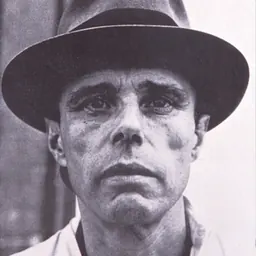
In 1970s, Miyajima practised performance art. He was initially influenced by the work of Joseph Beuys, Allan Krapow and Christo, and considered his performance work as an "action for society". The desire to create more enduring work - in contrast to the necessarily ephemeral nature of his performance and actions - motivated him to begin working on sculpture and installations. Typically, a block will display two digits in red or green, and count from 1 to 9. The counters never register zero, because, for Miyajima, the idea of zero is a purely Western concept. In 1994, Masayuki Ebinuma, an arborist, started to treat the fragile tree and restored its health as to be able to produce “seedlings” from the bombed tree. Then Ebinuma started to hand out the “saplings” from the survivor tree to children who visited Nagasaki as a symbol of peace. After Miyajima learned Ebinuma's activity, he wanted to support Ebinuma as an artist. So then he displayed the saplings and recruited foster parents at an art exhibition in 1995. They received ten applications and selected the former Ryuhoku Elementary School in Taito-ku, Tokyo as a planting site. Through the process, Miyajima had conceived an art project called “Revive Time: Kaki Tree Project” and launched the executive committee. In 1996, the first planting of the project took place at the former Ryuhoku Elementary School. Miyajima himself conducted a workshop at the tree-planting ceremony. The counters in some of his works, he has explained, represent the lives of anonymous individuals.
Exhibitions Miyajima's first solo exhibitions include "Human Stone" at Gallery Parergon, Tokyo in 1983, and "Time" at Maki Gallery, Tokyo in 1986.
In 2020, Miyajima's works will be featured in STARS: Six Contemporary Artists from Japan to the World exhibition in Tokyo. In this exhibition will feature a new work, "Sea of Time – TOHOKU" alongside documentary footage of members of the public helping to set the counter speeds.
Collections The following museums and institutions have works by Miyajima in their collection:
National Museum of Modern Art, Kyoto, Japan Hara Museum of Contemporary Art, Tokyo, Japan Museum of Modern Art, Shiga, Japan Nagoya City Art Museum, Nagoya, Japan Museum of Contemporary Art, Tokyo, Japan FARET Tachikawa, Tokyo, Japan TV Asahi building, Tokyo, Japan Tokyo Opera City, Tokyo, Japan Chiba City Museum, Chiba, Japan Group Home Sala in Florence Village, Akita, Japan The Museum of Modern Art, Saitama, Japan Contemporary Art Museum, Kumamoto, Japan Toyota Municipal Museum of Art, Aichi, Japan Saitama Prefectural University, Saitama, Japan Izumi City Plaza, Osaka, Japan Naoshima Contemporary Art Museum, Kagawa, Japan Iwaki City Art Museum, Fukushima, Japan Hiroshima City Museum of Contemporary Art, Hiroshima, Japan M+ Museum, Hong Kong Taipei Fine Arts Museum, Taiwan Samsung Cultural Foundation, Seoul, Korea Leeum, Samsung Museum, Seoul, Korea Chinese Telecom, Taipei, China Tate Gallery, London, UK Deste Foundation for Contemporary Art, Athens, Greece Fondation Cartier pour l'art contemporain, Paris, France Kunstmuseum Bern, Bern, Switzerland Université de Genève, Switzerland La Caixa, Barcelona, Spain Staatsgalerie Moderner Kunst, Munich, Germany Galerie der Stadt Stuttgart, Germany Fondazione TESECO per l'Arte, Pisa, Italy Chateau La Coste, Aix-en-Provence, France Modern Art Museum of Fort Worth, Texas, U.S.A. San Francisco Museum of Modern Art, San Francisco, U.S.A. Museum of Contemporary Art, Chicago, U.S.A. Dallas Museum of Art, U.S.A. Denver Art Museum, Denver, U.S.A. Dannheisser Foundation, New York, U.S.A. National Gallery of Canada, Ottawa, Canada Oakville Galleries, Oakville, Canada Australian Museum, Sydney, Australia
Don’t just read it —
keep it.
Full-length biographies made to live with: read them, listen on the way to work, watch them tonight.
- E-book
- Audio
- Video
Instant download · yours to keep · every purchase keeps this site free
Important facts
People in Tatsuo Miyajima's life
Named in this biography and alive at the same time

Related people
Same field, nearest in time




Contemporaries
People whose lives overlapped Tatsuo Miyajima's



Frequently asked questions
Who is Tatsuo Miyajima?
Japanese artist (born 1957)
When was Tatsuo Miyajima born?
Tatsuo Miyajima was born on 16 January 1957 in Tokyo.
What is Tatsuo Miyajima's occupation?
Tatsuo Miyajima is a sculptor, painter, draftsperson, visual artist, performance artist and video artist.
What nationality is Tatsuo Miyajima?
Tatsuo Miyajima is Japanese.
Sources & further reading
Cite this page
APA: Biography.guide. (2026). Tatsuo Miyajima. https://biography.guide/tatsuo-miyajima/
MLA: "Tatsuo Miyajima." Biography.guide, https://biography.guide/tatsuo-miyajima/.
Chicago: "Tatsuo Miyajima." Biography.guide. https://biography.guide/tatsuo-miyajima/.
Data last updated: 2026-09-20 · Spot an error? Report a correction.
Page generated 2026-09-27 05:04 UTC