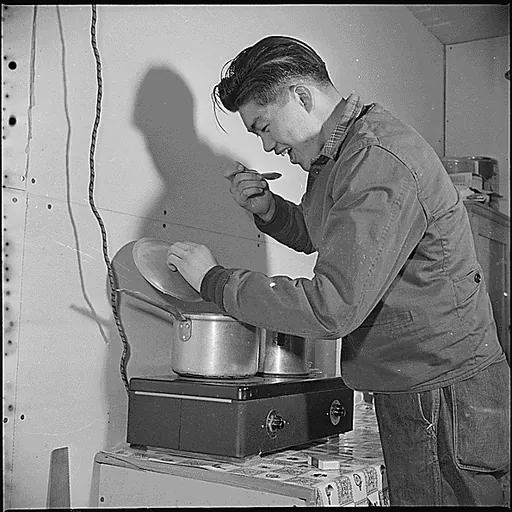
About Tak Shindo
Lived 1922 – 2002 (aged 79). Tak Shindo was an American musician.
Takeshi "Tak" Shindo (, November 11, 1922 – April 17, 2002) was an American musician, composer and arranger. He was one of the prominent artists in the exotica music genre during the late 1950s and early 1960s. Shindo also founded a dance band in 1947 and was a frequent lecturer and writer on Japanese music. He first gained prominence for his work on the 1957 motion picture Sayonara, served as the musical director for the television series Gunsmoke, and composed theme music for The Ed Sullivan Show and Wagon Train. He is most remembered for the exotica albums he released from 1958 to 1962, including Mganga! The Primitive Sounds of Tak Shindo, Brass and Bamboo (1959) and Accent on Bamboo (1960). He also released several albums in Japan during the mid-1960s that blended American and Japanese musical traditions. During the 1950s and 1960s, Shindo was a columnist for the Rafu Shimpo covering classical and popular music. In 1980, Shindo made a documentary film, Encounter with the Past, about the Manzanar relocation camp where he was relocated in 1942 as part of the Japanese American internment policy.
Early years and television work Shindo was born in 1922 in Sacramento, California. He moved with his family to Los Angeles in 1927. He enrolled at Los Angeles State College in 1941, but he was relocated to the Manzanar Relocation Center in early 1942 as part of the Japanese American internment policy that was adopted after the outbreak of war between the United States and Japan. In the late 1950s and 1960s, Shindo was frequently called on by Hollywood film and television productions to serve as a technical consultant on projects incorporating Japanese music and themes. In his article on Shindo, Professor Sheppard noted: "Shindo suddenly found the mainstream spotlight shining on him in the late 1950s as the representative of Japanese musical culture in Hollywood film and television." He first gained general notoriety for his work as technical adviser for the music in the 1957 motion picture, Sayonara. Shindo was charged with blending Japanese and western musical influences, using Japanese instruments and a mixed choral group of 38 voices of which 16 were female Japanese and four were male Japanese. Shindo added, "An important part of what this picture is doing for an understanding of Japanese culture comes from the music. We have, of course, adapted it for the occidental ear." Shindo later recalled what attracted him to the style: "Everyone is looking for a style. So in my case, I decided being Oriental, I had something I should draw upon and so I decided to go 'exotic sound.'" Mganga! has been called "Shindo's orchestral fantasy of Africa" and is probably the best known of his albums in the exotica genre.
Brass and Bamboo In late 1959, Shindo's album Brass and Bamboo was released by Capitol Records. The album featured 10 standards and two original compositions by Shindo, combining the sounds of traditional Japanese instruments, including koto, shamisen, and bamboo flutes, with Western brass with "orchestration in tempos and moods that range from ballads to swing." One reviewer rated it as the "Album of the Month" for April 1960, calling it a "sparkling debut" with "a new, refreshing blend of music of the East and West, big band dance arrangements spiced with exotic instrumental sounds of the orient." Esquire magazine in 1960 wrote: "Tak mixes ancient Eastern and modern Western instruments in a steamy dance sukiyaki." Another reviewer wrote that "the music is neither Oriental nor jazz, but a delightful, different sound" providing "nothing but fun for stereo fanciers."
Accent on Bamboo
In his 1960 album, Accent on Bamboo, Shindo minimized the Japanese musical elements in favor of "largely straightforward big-band arrangements."
Shindo's albums drew attention for their cover art as well as the music. Music professor W. Anthony Sheppard has written that the covers of Brass and Bamboo and Accent on Bamboo are both divided "into two utterly different racial/musical realms." One half of the covers features a Caucasian woman "presented as sexually sophisticated and modern as she appears caressing and surrounded by phallic instruments," while the other half features a Japanese woman dressed in a kimono "demurely holding their instruments and representing an alternative form of sensuality."
Sea of Spring and Nippon Victor recordings Shindo's Sea of Spring, released in 1966, was one of several recorded in Japan for the Nippon Victor label in Japan in 1966. The album features traditional Japanese folk melodies with eastern and western instrumentation. In his review for allmusic.com, Jason Ankeny calls it "clearly the most appealing and imaginative album of the bunch ... A beautiful, thoughtful album, free of kitsch and irony." His other albums for the Nippon Victor label included "Mood in Japan" (1964) and "Midnight in San Francisco" (1966). His work, "Impressions for Piano and Strings," premiered at Cal State Los Angeles in 1967. In 1970, Shindo received a master's degree in Asian Studies from the University of Southern California. He was the arranger and director for the grand opening of the Japanese Pavilion at EPCOT Disney in 1979, the same year that he retired from Cal State LA. In 1980, he released a documentary film, "Encounter with the Past," about the Manzanar relocation camp. Martin Denny, "Primitiva" (1958, Liberty LRP-3087) – Shindo played koto on Denny's album Tak Shindo, "Mganga! Primitive Sounds" (1958, Edison International 100) Tak Shindo, "Brass and Bamboo" (1959, Capitol ST-1345) Rod McKuen, "The Yellow Unicorn" (1960, Imperial LP 12036) Paul Mark and His Orchestra, "East to West" (1961, Imperial LP 9120/LP 12057) Paul Mark and His Orchestra and Voices, "Golden Melodies from Japan: (1961, Imperial LP 9161/LP 12075) Tak Shindo, "Accent on Bamboo" (1961, Capitol T-1433) Tak Shindo, "Far East Goes Western" (1962, Mercury PPS 2031) Hiroshi Watanabe's Star Dust Orchestra, "Mood in Japan" (1964, Nippon Victor) - Arranger Tak Shindo, "Midnight in San Francisco" (1966, Nippon Victor) Tak Shindo, "Sea of Spring" (1966, Nippon Victor)
Film and television credits "Tokyo Joe," (1949, Columbia Pictures) – uncredited assistant composer "Cinerama Seven Wonders of the World" (1955, Warner-Adventure) – composer "Sayonara" (1957, Warner Bros.) – technical supervisor music (uncredited assistant composer) "Stopover Tokyo" (1957) – music supervisor, Japanese music "Escapade in Japan" (1957, RKO Pictures) – uncredited assistant composer "Gunsmoke" (1957, CBS television) – music supervisor for several episodes "Wagon Train" (1958, NBC television) – composer for episode titled The Sakae Ito Story Studio One (1958, CBS television) – composer/director of "The Kurushiki Incident" "Cry for Happy" (1961, Columbia Pictures) – arranger and uncredited assistant composer "A Majority of One" (1962, Warner Bros.) – uncredited assistant composer "Geisha Fantasy" (1962) – arranger for show at Las Vegas Desert Inn "Japan: A New Dawn Over Asia – Japan in the 20th Century" (1965, TV documentary) – composer "Encounter with the Past" (documentary, 1980) "Siegfried and Roy Superstar" (1983) – composer for show at Las Vegas Stardust Hotel
Don’t just read it —
keep it.
Full-length biographies made to live with: read them, listen on the way to work, watch them tonight.
- E-book
- Audio
- Video
Instant download · yours to keep · every purchase keeps this site free
Important facts
People in Tak Shindo's life
Named in this biography and alive at the same time




Related people
Same field, nearest in time

Contemporaries
People whose lives overlapped Tak Shindo's




Frequently asked questions
Who was Tak Shindo?
Japanese-American musician (1922-2002)
When was Tak Shindo born?
Tak Shindo was born on 11 November 1922 in Sacramento.
When did Tak Shindo die?
Tak Shindo died on 17 April 2002 in San Dimas.
What was Tak Shindo's occupation?
Tak Shindo was a musician.
What nationality was Tak Shindo?
Tak Shindo was American.
Sources & further reading
Cite this page
APA: Biography.guide. (2026). Tak Shindo. https://biography.guide/tak-shindo/
MLA: "Tak Shindo." Biography.guide, https://biography.guide/tak-shindo/.
Chicago: "Tak Shindo." Biography.guide. https://biography.guide/tak-shindo/.
Data last updated: 2026-09-22 · Spot an error? Report a correction.
Portrait: Wikimedia Commons · author & licence
Page generated 2026-09-27 05:03 UTC