
About Tahmasp II
Lived 1704 – 1740 (aged 35). Tahmasp II was a sovereign.
Tahmasp II (; 1704 – 11 February 1740) was the penultimate Safavid shah (king) of Iran, ruling from 1722 to 1732.
Name Tahmasp is a New Persian name, ultimately derived from Old Iranian *, meaning "having valiant horses." The name is one of the few instances of a name from the Shahnameh being used by an Islamic-era dynasty based in Iran. In the Shahnameh, Tahmasp is the father of Zaav, the penultimate shah of the Pishdadian dynasty.
Biography Tahmasp was the son of Soltan Hoseyn, the shah of Iran at the time. When Soltan Hoseyn was forced to abdicate by the Afghans in 1722, Prince Tahmasp wished to claim the throne. From the besieged Safavid capital, Isfahan, he fled to Qazvin, where on 10 November 1722 he declared himself shah and assumed the regnal name of Tahmasp II. He gained the support of the Sunni Muslims of the Caucasus (even that of the previously rebellious Lezgins), as well as several Qizilbash tribes (including the Afshars, under the control of Iran's future ruler, Nader Shah).
Russo-Persian War
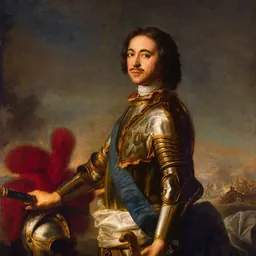
In June 1722, Peter the Great, the then tsar of the neighbouring Russian Empire, declared war on Safavid Iran in an attempt to expand Russian influence in the Caspian and Caucasus regions and to prevent its rival, the Ottoman Empire, from making territorial gains in the region at the expense of the declining Safavid state.
The Russian victory led to Safavid Iran's cession of its territories in the Caucasus and contemporary mainland northern Iran, comprising the cities of Derbent (southern Dagestan) and Baku and the surrounding lands, as well as the provinces of Gilan, Shirvan, Mazandaran, and Astarabad to Russia per the Treaty of Saint Petersburg (1723).
Tahmasp also eventually gained the recognition of both the Ottoman Empire and Russia, as each worried about the other gaining too much influence in Iran.
By 1729, Tahmasp had control of most of the country. Soon after his foolhardy Ottoman campaign of 1731, he was deposed by the future Nader Shah in 1732 in favor of his son, Abbas III; both were murdered at Sabzevar in 1740 by Nader Shah's eldest son Reza Qoli Mirza.
Don’t just read it —
keep it.
Full-length biographies made to live with: read them, listen on the way to work, watch them tonight.
- E-book
- Audio
- Video
Instant download · yours to keep · every purchase keeps this site free
Important facts
Family & relationships
People in Tahmasp II's life
Named in this biography and alive at the same time

Related people
Same field, nearest in time


Contemporaries
People whose lives overlapped Tahmasp II's





Frequently asked questions
Who was Tahmasp II?
The tenth and last Safavid king (1722–1732)
When was Tahmasp II born?
Tahmasp II was born on 3 December 1704 in Isfahan.
When did Tahmasp II die?
Tahmasp II died on 11 February 1740 in Sabzevar.
What was Tahmasp II's occupation?
Tahmasp II was a sovereign.
Sources & further reading
Cite this page
APA: Biography.guide. (2026). Tahmasp II. https://biography.guide/tahmasp-ii/
MLA: "Tahmasp II." Biography.guide, https://biography.guide/tahmasp-ii/.
Chicago: "Tahmasp II." Biography.guide. https://biography.guide/tahmasp-ii/.
Data last updated: 2026-09-20 · Spot an error? Report a correction.
Page generated 2026-09-27 05:17 UTC