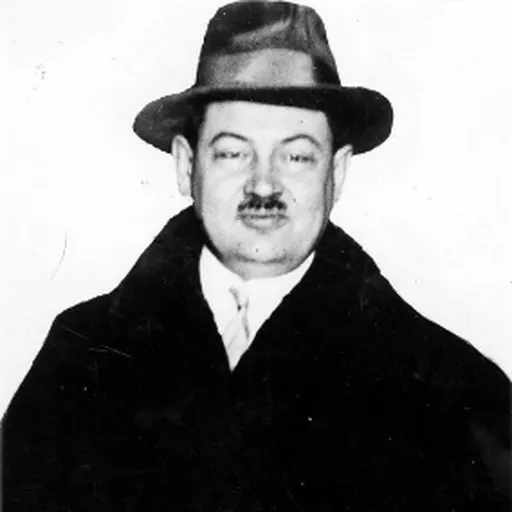
About Tadeusz Hołówko
Lived 1889 – 1931 (aged 41). Tadeusz Hołówko was a Polish politician and opinion journalist.
Tadeusz Ludwik Hołówko (September 17, 1889 – August 29, 1931), codename Kirgiz, was an interwar Polish politician, diplomat and author of many articles and books.
He was most notable for his moderate stance on the "Ukrainian problem" faced by the Polish government, which due to its nationalist policies in Poland's largely Ukrainian- and Belarusian-populated eastern territories, faced increasing tensions there. Despite, or perhaps because of, being a relative moderate in policies toward the Ukrainian population, and a supporter of peaceful cooperation, he was assassinated in 1931 by two members of the radical Organization of Ukrainian Nationalists.
Life Born on September 17, 1889, in Semipalatinsk, Governor-Generalship of the Steppes, Russian Empire (now Semey, Kazakhstan), Hołówko became a close collaborator of Józef Piłsudski, first in the Polish Socialist Party (PPS), later in the Polish Military Organization (POW) and finally in the pro-Sanation Nonpartisan Bloc for Cooperation with the Government (BBWR) party and the Polish government (the Ministry of Foreign Affairs). In 1918 he became a vice-minister in the first government of the Second Polish Republic led by Prime Minister Ignacy Daszyński.
One of the organizers of the POW and the BBWR, he was the BBWRs vice president and chief ideologist. From 1930 he was a deputy to the Polish parliament (Sejm); he advocated increasing the presidential and executive powers and decreasing the powers of the Sejm. He is credited by many English and Polish authors for advocating and improving relations with Poland's ethnic minorities, chiefly the Ukrainians and Belarusians. However, certain Ukrainian authors consider otherwise pointing out his opposition to granting autonomy to Ukrainian regions and even to creation of the Ukrainian university in Galicia, as well as to his efforts aimed at convincing the Ukrainian leaders to recall their complaints about pacification submitted to the League of Nations. Modern research however notes he was supportive of giving wide autonomy to minorities for example, by advocating for using the Belarusian language in schools, but not Ukrainian. that sought to destabilize the Soviet Union by encouraging national uprisings among the non-Russian nations that had been conquered by the Soviet Union, particularly the Ukrainians and the peoples of the Caucasus. but their problems were marginalized by the Polish government, whose heavy-handed policies were only serving to antagonize the Ukrainian population. Eventually the extremists among the Ukrainians started sabotage and assassination campaigns, and the Polish government responded with further repressions. Hołówko was one of the few who tried to deal with that problem with negotiations and compromise; he mediated between willing Polish and Ukrainian politicians and proposed various plans to solve the tensions, from releasing Ukrainian prisoners and granting the minorities more rights,
His death, widely discussed in the Polish press, and mentioned in the international press and even at a League of Nations session, was part of a vicious circle involving the Polish government's repressive policies towards members of the Ukrainian community (the Polish government's "pacification" campaign) Some time later, the Polish police commissioner in charge of investigating Hołówko's death, , himself became an OUN assassination victim. "Independence of Poland is inconceivable without independent Lithuania, Latvia, Estonia, Finland, Ukraine and Belarus. Independence of Poland is only one of many examples of a process seen throughout modern Europe - freeing of nations from political slavery. If Poland is alone, if other countries created on the ruins of Russian Empire will fall - dark will be Poland's future." ..."such policies [needs to be used] that ethnic minorities would feel good in Poland, not attempting to break away from Polish state, but on the opposite, they would see such a break away as a defeat. [...] [Thus] those national movements must be supported [...] Therefore that population which would have complete freedom within borders of the Republic would not be loured by Russia."
Don’t just read it —
keep it.
Full-length biographies made to live with: read them, listen on the way to work, watch them tonight.
- E-book
- Audio
- Video
Instant download · yours to keep · every purchase keeps this site free
Important facts
People in Tadeusz Hołówko's life
Named in this biography and alive at the same time
Related people
Same field, nearest in time






Contemporaries
People whose lives overlapped Tadeusz Hołówko's




Frequently asked questions
Who was Tadeusz Hołówko?
Polish politician (1889-1931)
When was Tadeusz Hołówko born?
Tadeusz Hołówko was born on 17 September 1889 in Semey.
When did Tadeusz Hołówko die?
Tadeusz Hołówko died on 29 August 1931 in Truskavets.
What was Tadeusz Hołówko's occupation?
Tadeusz Hołówko was a politician and opinion journalist.
What nationality was Tadeusz Hołówko?
Tadeusz Hołówko was Polish.
Sources & further reading
Cite this page
APA: Biography.guide. (2026). Tadeusz Hołówko. https://biography.guide/tadeusz-holowko/
MLA: "Tadeusz Hołówko." Biography.guide, https://biography.guide/tadeusz-holowko/.
Chicago: "Tadeusz Hołówko." Biography.guide. https://biography.guide/tadeusz-holowko/.
Data last updated: 2026-09-22 · Spot an error? Report a correction.
Portrait: Wikimedia Commons · author & licence
Page generated 2026-09-27 05:02 UTC