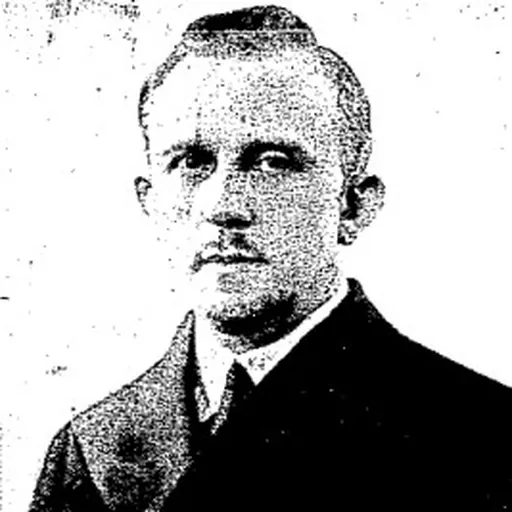
About Szymon Federbusch
Lived 1892 – 1969 (aged 76–77). Szymon Federbusch was a Polish writer and rabbi.
Simon Federbusch (February 15, 1892 – August 20, 1969) was a Galician-born Jew who served as a rabbi in Poland, Finland, and the United States.
Life Federbusch was born on February 15, 1892, in Narol, eastern Galicia, Austria-Hungary. He was the son of Hersch and Czarna Federbusch.
Federbusch was ordained a rabbi when he was eighteen. He attended university in Kraków, Lviv, and Vienna, graduating from the latter university with a Ph.D. in 1922. In 1918, he became a leader of Zeire Mizrachi, the first Mizrachi association of university students. He served in Polish Sejm as a representative of the Lwów (Lviv) district in 1922 to 1928. While in the Sejm, he supported measures on Jewish education and the economic improvement of Polish Jews and was a member of Sejm commissions on education, culture, and restoring places destroyed during World War I. While living in Lwów, he edited the Hebrew weekly Gilyonoth, the Hebrew monthly Mizrahah from 1928 to 1931, and the Yiddish weekly Yiddishe Bletter starting in 1928.
Ordained by prominent Polish rabbis before World War I, Federbusch received his rabbinical degree from the Israelitisch-Theologische Lehranstalt in Vienna in 1923. Active in the Mizrachi movement since he was a student, he was a founder of Ha-Po'el ha-Mizrachi and served as president of the Mizrachi Organization of Galicia from 1924 to 1930. In 1930, he became rabbi of the United Hebrew Congregation of Helsinki, Finland. He was elected Chief Rabbi of Finland a year later. As Chief Rabbi, he promoted interfaith understanding, helped defeat a bill that would have banned shechita, and secured Finnish entry visas for refugees from Nazi Germany. He immigrated to America in 1940 and settled in New York City, where he became rabbi and principal of the Yeshiva Rabbi Israel Salanter in the Bronx until his death.
Starting in 1918, Federbusch contributed to the Yiddish, Hebrew, and Polish Jewish press, writing articles in newspapers like Ha-Tsfira and Haynt. In America, he contributed to publications like Hadoar. In 1964, he edited Yorbukh, a trilingual anthology from the World Federation of Polish Jews. He wrote a number of works on Jewish studies, the Talmud, and Jewish rights. Two of his works, the 1954 Mishpat Hamelukha Beyisrael and the Benetivot Hatalmud in 1958, won him the Lamed Prize.
Federbusch died in South Nassau Communities Hospital on August 20, 1969. He had a widow, Miriam Horowitz, and two sons, Dr. Urieland Federbush and Rabbi Emanuel A. Federbush. His funeral was in the Riverside Memorial Chapel. He was buried in Israel.
Don’t just read it —
keep it.
Full-length biographies made to live with: read them, listen on the way to work, watch them tonight.
- E-book
- Audio
- Video
Instant download · yours to keep · every purchase keeps this site free
Important facts
Related people
Same field, nearest in time




Contemporaries
People whose lives overlapped Szymon Federbusch's

Frequently asked questions
Who was Szymon Federbusch?
Galician-born rabbi in Poland, Finland, and America
When was Szymon Federbusch born?
Szymon Federbusch was born in 1892 in Narol.
When did Szymon Federbusch die?
Szymon Federbusch died on 20 August 1969 in New York City.
What was Szymon Federbusch's occupation?
Szymon Federbusch was a writer and rabbi.
What nationality was Szymon Federbusch?
Szymon Federbusch was Polish.
Sources & further reading
· Wikipedia: Szymon Federbusch
Cite this page
APA: Biography.guide. (2026). Szymon Federbusch. https://biography.guide/szymon-federbusch/
MLA: "Szymon Federbusch." Biography.guide, https://biography.guide/szymon-federbusch/.
Chicago: "Szymon Federbusch." Biography.guide. https://biography.guide/szymon-federbusch/.
Data last updated: 2026-09-22 · Spot an error? Report a correction.
Portrait: Wikimedia Commons · author & licence
Page generated 2026-09-27 05:04 UTC