
About Suzuki Harunobu
Lived 1725 – 1770 (aged 44–45). Suzuki Harunobu was a Japanese ukiyo-e artist, xylographer and illustrator.
Suzuki Harunobu (; ) was a Japanese designer of woodblock print art in the style. He was an innovator, the first to produce full-color prints in 1765, rendering obsolete the former modes of two- and three-color prints. Harunobu used many special techniques, and depicted a wide variety of subjects, from classical poems to contemporary beauties. Like many artists of his day, Harunobu also produced a number of , or erotic images. During his lifetime and shortly afterwards, many artists imitated his style. A few, such as Harushige, even boasted of their ability to forge the work of the great master. Much about Harunobu's life is unknown.
Influences alt=A man and a woman dressed in kimono and headscarves walk through the snow. alt=A young man wearing a long-sleeved kimono and sandals playing the flute.
Though some scholars assert that Harunobu was originally from Kyoto, pointing to possible influences from Nishikawa Sukenobu, much of his work, in particular his early work, is in the Edo style. His work shows evidence of influences from many artists, including Torii Kiyomitsu, Ishikawa Toyonobu, the Kawamata school, and the Kanō school. However, the strongest influence upon Harunobu was the painter and printmaker Nishikawa Sukenobu, who may have been Harunobu's direct teacher.
Artistic career
Little is known of Harunobu's early life; his birthplace and birthdate are unknown, but it is believed he grew up in Kyoto. It is said he was 46 at his death in 1770. Unlike most artists, Harunobu used his real name rather than an artist name. He was from a samurai family, and had an ancestor who was a retainer of Tokugawa Ieyasu in Mikawa Province; this Suzuki accompanied Ieyasu to Edo when the latter had his capital built there. Harunobu's grandfather Shigemitsu and father Shigekazu were stripped of their status when they were found to be involved in financing of gambling and other activities; they were exiled from Edo and relocated to Kyoto. At some point, Harunobu became a student of the master Nishikawa Sukenobu.
Harunobu began his career in the style of the Torii school, creating many works which, while skillful, were not innovative and did not stand out. It was only through his involvement with a group of literati samurai that Harunobu tackled new formats and styles.
In 1764, as a result of his social connections, he was chosen to aid these samurai in their amateur efforts to create . Calendars prints of this sort from prior to that year are not unknown but are quite rare, and it is known that Harunobu was close acquaintances or friends with many of the prominent artists and scholars of the period, as well as with several friends of the . Harunobu's calendars, which incorporated the calculations of the lunar calendar into their images, would be exchanged at Edo gatherings and parties.
These calendar prints would be the very first (brocade prints). As a result of the wealth and connoisseurship of his samurai patrons, Harunobu exclusively created these prints using the best materials available. Harunobu experimented with better woods for the woodblocks, using cherry wood instead of catalpa, and used not only more expensive colors, but also a thicker application of the colors, in order to achieve a more opaque effect.
The most important of Harunobu's innovations in the creation of was the use of multiple separate wood blocks in the creation of a single image, an expense afforded through the wealth of his clients. Just 20 years previously, the invention of had made it possible to print in three or four colors; Harunobu applied this new technique to prints using up to ten different colors on a single sheet of paper. The new technique depended on using notches and wedges to hold the paper in place and keep the successive color printings in register. Harunobu was the first artist to consistently use more than three colors in each print. , unlike their predecessors, were full-color images. As the technique was first used in a calendar, the year of their origin can be traced precisely to 1765.
In the late 1760s, Harunobu thus became one of the primary producers of images of (pictures of beautiful women), actors of Edo and related subjects for the Edo print connoisseur market; however, he did not produce prints of kabuki actors, reported to have said, "Why should I paint pictures of such trash as Kabuki actors". In a few special cases, notably his famous set of eight prints entitled (Eight Parlor Views), the patron's name appears on the print along with, or in place of, Harunobu's own. The Zashiki hakkei series exemplifies the mitate genre favoured by Harunobu, in which a traditional theme is playfully reimagined in a contemporary setting: it reworked the traditional Eight Views of Ōmi (Ōmi hakkei), scenes near Lake Biwa said to have been designated by the former regent Konoe in the early sixteenth century, which were themselves modelled on the Chinese theme of the Eight Views of Xiao and Xiang (Xiāoxiāng bājǐng), a set of landscapes in Hunan province traditionally associated with allegorical meanings such as exile or enlightenment. The presence of a patron's name or seal, and especially the omission of that of the artist, was another novel development in of this time.
Between 1765 and 1770, Harunobu created over twenty illustrated books and over one thousand color prints, along with a number of paintings. He came to be regarded as the master of during these last years of his life, and was widely imitated until, a number of years after his death, his style was eclipsed by that of new artists, including Katsukawa Shunshō and Torii Kiyonaga.
Style In addition to the revolutionary innovations that came with the introduction of , Harunobu's personal style was unique in a number of other respects. His figures are all very thin and light; some critics say that all his figures look like children. However, it is these same young girls who epitomize Harunobu's personal style. Richard Lane describes this as "Harunobu's special province, one in which he surpassed all other Japanese artists - eternal girlhood in unusual and poetic settings". Though his compositions, like most prints, may be said to be fairly simple overall, it is the overall composition that concerned Harunobu. Unlike many of his predecessors, he did not seek to have the girls' kimono dominate the viewer's attention.
Harunobu is also acclaimed as being one of the greatest artists of this period in depicting ordinary urban life in Edo. His subjects are not restricted to geisha, courtesans, actors, and sumo wrestlers, but include street vendors, errand boys, and others who help to fill in the gaps in describing the culture of this time. His work is rich in literary allusion, and he often quotes Japanese classical poetry, but the accompanying illustrations often gently poke fun at the subject.
Many of his prints have a solid, single-color background, created by a technique called . Though many other artists used the same technique, Harunobu is generally regarded as having used it to the strongest effect. The colored background sets a mood and tone for the entire image.
Collections
Harunobu's work is held in several museums worldwide, including:
Asian Art Museum British Museum Brooklyn Museum Harvard Art Museums Hill-Stead Museum Kislak Collection of Japanese Prints Metropolitan Museum of Art Museum of Fine Arts, Boston National Museum of Korea Nelson-Atkins Museum of Art Philadelphia Museum of Art Portland Art Museum Suntory Museum of Art University of Michigan Museum of Art Victoria and Albert Museum Virginia Museum of Fine Arts
In philately Harunobu's works have been featured three times in commemorative postage stamps issued by the Japanese post office: 1957 Philatelic Week 1969 16th Universal Postal Union Congress 1981 Philatelic Week (se-tenant pair) 2021 Philanippon 2022 Philately Week His works have also been depicted in topical stamps from Ajman, Antigua and Barbuda, Dominica, Fujeira, Gambia, Guyana, Hungary, Kathiri State of Seiyun, Liberia, Mahra State, the Federated States of Micronesia, Paraguay, St Vincent, Sharjah, Sierra Leone, Turks and Caicos, United Nations Vienna, Vietnam and Yemen.
Works
Don’t just read it —
keep it.
Full-length biographies made to live with: read them, listen on the way to work, watch them tonight.
- E-book
- Audio
- Video
Instant download · yours to keep · every purchase keeps this site free
Important facts
more
Suzuki Hozumi, Chōyeiken, Chōeiken, Harunobu Suzuki, JirobeiPeople in Suzuki Harunobu's life
Named in this biography and alive at the same time
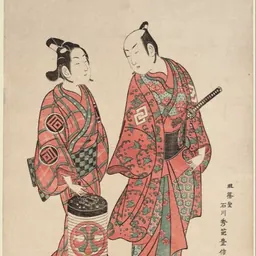



Related people
Same field, nearest in time



Contemporaries
People whose lives overlapped Suzuki Harunobu's




Frequently asked questions
Who was Suzuki Harunobu?
Japanese printmaker
When was Suzuki Harunobu born?
Suzuki Harunobu was born in 1725 in Edo.
When did Suzuki Harunobu die?
Suzuki Harunobu died on 15 June 1770 in Edo.
What was Suzuki Harunobu's occupation?
Suzuki Harunobu was an ukiyo-e artist, xylographer and illustrator.
What nationality was Suzuki Harunobu?
Suzuki Harunobu was Japanese.
Sources & further reading
Cite this page
APA: Biography.guide. (2026). Suzuki Harunobu. https://biography.guide/suzuki-harunobu/
MLA: "Suzuki Harunobu." Biography.guide, https://biography.guide/suzuki-harunobu/.
Chicago: "Suzuki Harunobu." Biography.guide. https://biography.guide/suzuki-harunobu/.
Data last updated: 2026-09-20 · Spot an error? Report a correction.
Page generated 2026-09-27 04:59 UTC