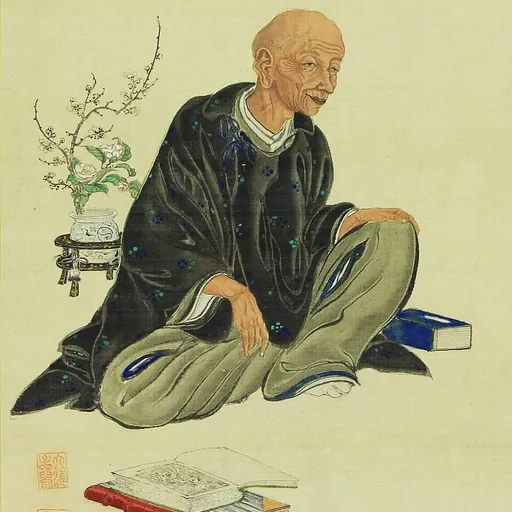
About Sugita Genpaku
Lived 1733 – 1817 (aged 83). Sugita Genpaku was a Japanese linguist, writer, translator and rampō physician.
was a Japanese physician and scholar known for his translation of Kaitai Shinsho (New Book of Anatomy) and a founder of Rangaku (Western learning) and Ranpō (Dutch style medicine) in Japan. He was one of the first Japanese scholars in Edo (modern day Tokyo) to study the Dutch language and is credited with being one of the first Japanese physicians to study Western medical teachings in Japan.
In 1771 Genpaku and Maeno Ryōtaku, a Japanese scholar studying the Dutch language, translated a Dutch book of anatomy Ontleedkundige Tafelen, originally published in German by physician and professor Johann Adam Kulmus in 1734. Genpaku was inspired to translate the Dutch text after witnessing the dissection of a female criminal while viewing Ontleedkundige Tafelen as an anatomical reference throughout the dissection. He was inspired by the German drawings of human organs, which accurately depicted the organs and vasculature he saw during the dissection. The German drawings were more anatomically detailed and accurate than Chinese texts and after the dissection he and his colleagues made it their scholarly mission to produce a Japanese translation of the Ontleedkundige Tafelen. It took three full years and eleven manuscripts to produce the first translation of the text entitled Kaitai Shinsho in 1774.
Early life Born in the Wakasa-Obama estate of Feudal Lord Wakasa in 1733, Genpaku was the son of a physician, Hosen Sugita, who was the official doctor of Feudal Lord Wakasa. Genpaku's mother, daughter of Genkō Yomogida, died during childbirth. Around age 17, Genpaku began studying surgery under Gentetsu Nishi. He also studied Confucianism under Saburoemon Miyase. Genpaku moved away from his father's home at age 25 after being granted permission from his liege lord to begin working as a medical practitioner. His first business was located at 4-chōme, Nihonbashidōri and was attached to the home of painter Sekkei Kusumoto.
Career
Genpaku was forced to relocate his medical practice from Nihonbashidōri-dōri to Hakoya-chō in 1759 and later to Horidome-chō in 1762, both due to losing his property from fires. He later left Horidome-chō and moved to property owned by Feudal Lord Sakai around 1770.
Under the rule of the Tokogawa shoguns, Genpaku lived in a period Japanese isolation from the Western world and most of East Asia. The period of isolation, sakoku, was driven by the shogun's desire to halt the spread of Christianity propagated largely by Portuguese missionaries. During this period, Nagasaki was the only port of entry and only Holland was allowed to enter Japan, as their transactions were understood to be exclusively pertaining to trade. In the early eighteenth century, Western texts were severely restricted in Japan and Western knowledge predominately spread orally, mediated through translators whose grasp of Japanese was limited. As relations evolved with the Dutch, the eighth shogun, Tokugawa Yoshimune (ruled 1716–45), allowed Rangaku (Western learning) to take hold in Japan. Yoshimune launched efforts to systematically study Dutch in 1740, giving rise to the scholarly pursuit of rangaku, however this learning was still restricted from the general public. In many cases by the police who were known to destroy Dutch texts. In mid eighteenth century, Dutch books became sought after as scholarly texts by the Japanese, and it was during this time that Genpaku came into the medical profession.
With the acceptance of rangaku, Dutch physicians presented lectures and demonstrations to the Shōgun in Edo. Genpaku attended one such demonstration in 1768 where a Dutch surgeon, Rudolf Bauer, cured a patient with gangrene of the tongue by drawing blood from the infected area. Collectively, these physicians shared a sentiment of radical social equality. Genpaku wrote in Keiei yawa:Other than the differences between males and females, there are no distinctive differences between human beings, from the emperor to all commoners. Where there are no differences, then, humans themselves have artificially created above and below, and the names of the four social statuses. Yet there is no difference between us, because we are all human. According to court records, the woman was executed for killing her adopted children. Genpaku and Ryōtaku watched the dissection while referencing Ontleedkundige Tafelen and were struck by the anatomical accuracy of the text, which different greatly from the Chinese texts and understanding of anatomy they previously held. On their walk home from the execution grounds where they witnessed the dissection, Genpaku and Ryōtaku decided to dedicate themselves to making a Japanese translation of Ontleedkundige Tafelen. In addition to his influence on Japanese medicine, Genpaku's Japanese translations of Dutch texts were translated into Chinese. These works were among the first Western medical texts in Chinese.
Notable works Although Genpaku is most well known for his translation of Ontleedkundige Tafelen, he published many other works including medical, political, and historical works. Yojo-Schichi-Fuka (Seven Articles About Hygiene)
Gallery
Don’t just read it —
keep it.
Full-length biographies made to live with: read them, listen on the way to work, watch them tonight.
- E-book
- Audio
- Video
Instant download · yours to keep · every purchase keeps this site free
Important facts
People in Sugita Genpaku's life
Named in this biography and alive at the same time


Related people
Same field, nearest in time



Contemporaries
People whose lives overlapped Sugita Genpaku's




Frequently asked questions
Who was Sugita Genpaku?
Japanese scholar
When was Sugita Genpaku born?
Sugita Genpaku was born on 20 October 1733 in Yaraichō.
When did Sugita Genpaku die?
Sugita Genpaku died on 1 June 1817.
What was Sugita Genpaku's occupation?
Sugita Genpaku was a linguist, writer, translator and rampō physician.
What nationality was Sugita Genpaku?
Sugita Genpaku was Japanese.
Sources & further reading
Cite this page
APA: Biography.guide. (2026). Sugita Genpaku. https://biography.guide/sugita-genpaku/
MLA: "Sugita Genpaku." Biography.guide, https://biography.guide/sugita-genpaku/.
Chicago: "Sugita Genpaku." Biography.guide. https://biography.guide/sugita-genpaku/.
Data last updated: 2026-09-20 · Spot an error? Report a correction.
Page generated 2026-09-27 05:09 UTC