
About Sue Savage-Rumbaugh
Born 1946. Sue Savage-Rumbaugh is an American primatologist, psychologist, mammalogist and biologist.
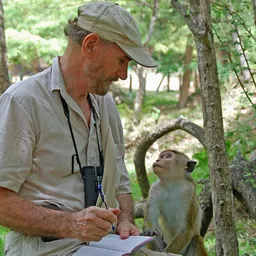
Emily Sue Savage-Rumbaugh (born August 16, 1946) is an American psychologist and primatologist most known for her work with two bonobos, Kanzi and Panbanisha, investigating their linguistic and cognitive abilities using lexigrams and computer-based keyboards. Originally based at Georgia State University's Language Research Center in Atlanta, Georgia, she worked at the Iowa Primate Learning Sanctuary in Des Moines, Iowa from 2006 until her departure in November 2013.
Early life, family and education
Savage-Rumbaugh was born in Springfield, Missouri, to Euell Rubert and Joyce Rubert. She studied psychology at Colorado College before transferring to Southwest Missouri State University, where she earned her BA degree in 1970. She planned to attend grad school at Harvard University under B.F. Skinner, but after a fellowship there fell through, she switched gears. A lecture by Roger Fouts, who was working to teach young chimpanzees sign language at University of Oklahoma (UO), caught her interest. She decided to study at UO instead, getting an MS degree and, in 1975, a Ph.D. in psychology, under the direction of William Lemmon, who ran UO's Institute for Primate Studies. Her dissertation, "Mother-infant behavior in group-living captive chimpanzees," examined the way captive animals used gestures and posture to communicate.
While at UO, Sue had married William Savage, Jr. Their marriage ended in divorce after Sue took a position in Atlanta, moving with her son from a previous marriage.
Career After getting her Ph.D., Savage-Rumbaugh (then known as "Sue Savage") moved to Atlanta, where she conducted research at Emory University's Yerkes Primate Center and joined the Language Analog (LANA) project co-headed by Duane Rumbaugh, professor and chair of psychology at Georgia State University. (The two married and became long-time collaborators.) The LANA project aimed to teach a juvenile chimpanzee, Lana, to communicate using a computer and graphic symbols donned "lexigrams."
She was subsequently a professor and researcher at Georgia State University's Departments of Biology and Psychology (also in Atlanta) for 25 years, associated closely with the school's Language Research Center. In September 2012, Savage-Rumbaugh was placed on leave after a group of 12 former employees alleged that she had neglected the bonobos in her care. Though Savage-Rumbaugh was internally cleared of wrongdoing and reinstated in November of that year, she collapsed on the job, underwent a six-month medical leave, and upon her return was ordered to leave in light of recent new hires. – and again to her home state of Missouri.
Research
Savage-Rumbaugh is a developer of the Yerkish language; this is a lexigram in that language, representing her. Savage-Rumbaugh was the first scientist to conduct language research with bonobos.
At the Georgia State University's Language Research Center, Savage-Rumbaugh helped pioneer the use of a number of new technologies for working with primates. These include a keyboard which provides for speech synthesis, allowing the animals to communicate using spoken English, and a "primate friendly" computer-based joystick terminal that permits the automated presentation of many different computerized tasks. Information developed at the center regarding the abilities of non-human primates to acquire symbols, comprehend spoken words, decode simple syntactical structures, learn concepts of number and quantity, and perform complex perceptual-motor tasks has helped change the way humans view other members of the primate order.
Savage-Rumbaugh's work with Kanzi, the first ape to spontaneously acquire words in the same manner as children, was detailed in Language Comprehension in Ape and Child published in Monographs of the Society for Research in Child Development (1993). It was selected by the "Millennium Project" as one of the top 100 most influential works in cognitive science in the 20th century by the University of Minnesota Center for Cognitive Sciences in 1991.
Her view of language – that it is not confined to humans and is learnable by other ape species – is generally criticized and not accepted by researchers from linguistics, psychology and other sciences of the brain and mind. For example, the cognitive scientist Steven Pinker strongly criticized the position of Savage-Rumbaugh and others in his award-winning The Language Instinct, arguing that Kanzi and other non-human primates failed to grasp the fundamentals of language.
According to Alexander Fiske-Harrison, who visited Savage-Rumbaugh in 2001 for the Financial Times, her methods differ from the more clinical techniques of other researchers such as Frans de Waal by taking a "holistic approach to the research, rearing the apes from birth and immersing them in a "linguistic world"."
She was asked how she and her (now former) husband Duane Rumbaugh's study was influenced by living and working together while still at Georgia State University, responding "I don't think anyone could ever be accountable for as many apes as we have here if we weren't together. Duane and I reside immediately next to the research centre and are available 24 hours a day, 365 days a year. We go if an ape is sick, if one of the apes has escaped, or if Panbanisha is scared because the river is going to flood."
According to Terrace et al (1979) in their analysis titled "Can An Ape Create a Sentence", apes do not create sentences. They do not move on from the phase of imitation nor begin to create sentences by adding complexity as the mean sentence length increases. When analyzed, creative combinations that appear meaningful can be explained by simpler nonlinguistic properties. Further examination by Thompson and Church "An Explanation of the Language of a Chimpanzee" (1980) point to pair-associative learning followed by reinforcement as an explanation for sentence-like productions.
Honors and awards
Savage-Rumbaugh received the Leighton A. Wilkie Award in Anthropology from Indiana University in 2000. In 2011, she was recognized as one of Time magazine's 100 Most Influential People in the World.
Savage-Rumbaugh has been awarded honorary Ph.D.s by the University of Chicago in 1997 She has a son, Shane, whom Rumbaugh adopted.
Don’t just read it —
keep it.
Full-length biographies made to live with: read them, listen on the way to work, watch them tonight.
- E-book
- Audio
- Video
Instant download · yours to keep · every purchase keeps this site free
Important facts
People in Sue Savage-Rumbaugh's life
Named in this biography and alive at the same time




Related people
Same field, nearest in time




Contemporaries
People whose lives overlapped Sue Savage-Rumbaugh's



Frequently asked questions
Who is Sue Savage-Rumbaugh?
psychologist
When was Sue Savage-Rumbaugh born?
Sue Savage-Rumbaugh was born on 16 August 1946.
What is Sue Savage-Rumbaugh's occupation?
Sue Savage-Rumbaugh is a primatologist, psychologist, mammalogist and biologist.
What nationality is Sue Savage-Rumbaugh?
Sue Savage-Rumbaugh is American.
Sources & further reading
· Wikipedia: Sue Savage-Rumbaugh
· DBpedia: Sue Savage-Rumbaugh
Cite this page
APA: Biography.guide. (2026). Sue Savage-Rumbaugh. https://biography.guide/sue-savage-rumbaugh/
MLA: "Sue Savage-Rumbaugh." Biography.guide, https://biography.guide/sue-savage-rumbaugh/.
Chicago: "Sue Savage-Rumbaugh." Biography.guide. https://biography.guide/sue-savage-rumbaugh/.
Data last updated: 2026-09-22 · Spot an error? Report a correction.
Page generated 2026-09-27 05:19 UTC