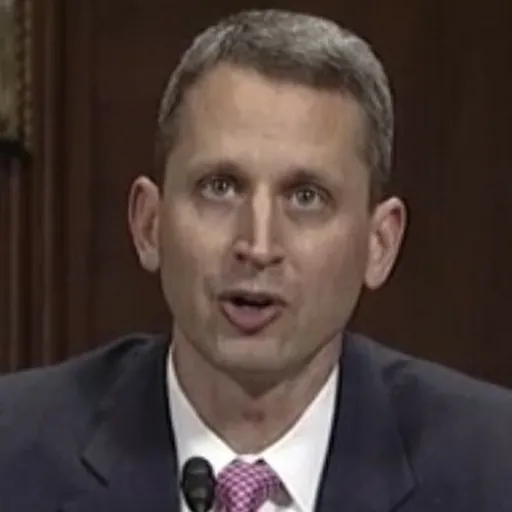
About Stuart Kyle Duncan
Born 1972. Stuart Kyle Duncan is an American lawyer.
Stuart Kyle Duncan (born 1972) is a United States circuit judge of the United States Court of Appeals for the Fifth Circuit. Prior to his appointment to the Fifth Circuit by President Donald Trump, Duncan was prominent for working against LGBT rights, including leading efforts against same-sex marriage.
Early career After graduating from law school, Duncan clerked for Louisiana-based Circuit Judge John M. Duhé Jr. of the Fifth Circuit. From 2012 to 2014, Duncan served as general counsel of the Becket Fund for Religious Liberty, where he managed Becket's nationwide public-interest litigation. He has been a member of the Federalist Society since 2012.
Duncan spent four years as an assistant professor of law at the University of Mississippi Law School. He also spent two years as an associate-in-law at Columbia University Law School, three years as an Assistant Solicitor General in the Office of the Solicitor General in the Texas Attorney General's Office, and one year in the appellate practice group at Vinson & Elkins LLP.
Federal judicial service On September 28, 2017, President Donald Trump announced his intent to nominate Duncan to an undetermined seat on the United States Court of Appeals for the Fifth Circuit. On November 29, 2017, a hearing was held on his nomination before the Senate Judiciary Committee. Louisiana senator John Kennedy initially withheld his support for Kyle Duncan to serve as a federal appeals court judge, but ended up announcing he would support Duncan and praised his performance after his confirmation hearing.
On January 3, 2018, his nomination was returned to the President under Rule XXXI, Paragraph 6 of the United States Senate. On January 5, 2018, President Donald Trump announced his intent to renominate Duncan to a federal judgeship. On January 8, 2018, his renomination was sent to the Senate. On January 18, 2018, his nomination was reported out of committee by an 11–10 vote. Duncan's nomination was opposed by Democrats and supported by Republicans. On April 23, 2018, the Senate invoked cloture on Duncan's nomination by a 50–44 vote. On April 24, 2018, his nomination was confirmed by a 50–47 vote. He received his judicial commission on May 1, 2018.
LGBT rights Duncan often worked against LGBT groups in private practice, which led many advocacy groups to oppose his nomination for judgeship. In 2015, Duncan argued before the Supreme Court against the constitutionality of same-sex marriage. In 2021, The Washington Blade characterized him as leading efforts to defend state bans on same-sex marriage. He also defended in courts North Carolina's bathroom bill that prohibited transgender students from using the bathroom that corresponded to their gender identity.
Stanford Law School protest On March 9, 2023, Duncan arrived to Stanford Law School in order to participate in a discussion on "Guns, Covid and Twitter," having been invited by the university's Federalist Society chapter. The event became a cause célèbre, and was marked by protests led by the student coalition Identity and Rights Affirmers for Trans Equality (IRATE) after a request for his speech to be canceled was denied. According to The Stanford Daily, "Throughout Duncan's speech, student protesters booed and made various loud comments, frequently drowning out his voice. In fliers put up in advance of the event, protesters called Duncan a right-wing advocate for laws that would harm women, immigrants and LGBTQ+ people." After ten minutes of protests had occurred, Duncan, according to David Lat writing in the Original Jurisdiction, "became angry, departed from his prepared remarks, and laced into the hecklers." On March 11, Stanford president Marc Tessier-Lavigne and Stanford Law dean Jennifer Martínez issued a letter of apology to Duncan, writing that students may "exercise their right to protest but not to disrupt the proceedings."
Notable cases Duncan wrote for the court in In re Larry Swearingen, No. 19-20565, denying the fourth habeas corpus petition and a delay of execution for Larry Swearingen, who was convicted of the 1998 murder of Melissa Trotter. While Swearingen maintained his innocence, Duncan stated that the latest petition did not meet the requirements for a federal habeas corpus petition. The latest appeal was made based upon two letters from Brady Mills, director of the Texas crime lab. Mills' first letter noted that the criminologist used the terms "unique" and "to the exclusion of others" to describe the piece of pantyhose found in Swearingen's home matching the piece of pantyhose used to murder Trotter. Mills noted this was "common language throughout the forensic community, at the time" but would not be used today. Mills' second letter addressed the testimony regarding blood found under Trotter's fingernails that did not match Swearingen's as being a product of contamination. The letter stated that the blood could have been from contamination but also could have been evidence. The court noted that these "'new' claims in this latest phase could not possibly have made any difference to the outcome of his trial" and have "not come close to establishing that 'no reasonable fact-finder' would have found him guilty." Following a failed petition to the U.S. Supreme Court, Swearingen was executed by the State of Texas on August 22, 2019. The opinion attracted attention for also rejecting a request to refer to Varner with feminine pronouns, and going at length into perceived problems with granting such a request. Judge James L. Dennis, a Clinton appointee, dissented and wrote that Duncan misconstrued the motion. In Dennis's view, it was merely a polite request that this specific proceeding use Varner's pronouns, usually granted as a courtesy; not an overarching demand requiring six pages of obiter dictum about the threat of courts being forced to use custom pronouns everywhere. Dennis also wrote that there was no need to rule on the matter at all. The ruling attracted attention from LGBT advocates, who saw it as confirmation of their warnings about Duncan prior to his confirmation as a judge. It has also been described as characteristic of the socially conservative jurisprudence that has won Duncan scholarly acclaim by his fellow social conservatives in academia (such as Adrian Vermeule).
Duncan penned the court's opinion in Hill v. Washburne regarding Albert Hill III's challenge to the validity of his late father Albert Hill Jr.'s will. Hill III is the great-grandson of late Texas oil tycoon H.L. Hunt and had previously agreed to a nine-figure settlement in exchange for not contesting the will of his father, Hill Jr. This is one of many challenges resulting from the estate of H.L. Hunt, who died in 1974, and the fifth challenge to the Hill Jr./Hill III settlement agreement.
Duncan authored the Fifth Circuit's April 2020 opinion in In re Abbott, granting mandamus to uphold an order by Texas Governor Greg Abbott that temporarily banned abortions during the coronavirus pandemic. This opinion has received scholarly attention as an example of common-good constitutionalism, a socially conservative judicial philosophy recently proposed by Harvard Law professor Adrian Vermeule.
Duncan was on the three-judge panel which halted the Biden Administration's OSHA rules mandating COVID-19 vaccinations or weekly COVID testing in the workplaces with 100 employees or more. The Fifth Circuit stayed the implementation of the OSHA rules by a per curiam decision in BST Holdings, LLC v. OSHA. The court stated that "ecause the petitions give cause to believe there are grave statutory and constitutional issues with the Mandate, the Mandate is hereby stayed pending further action by this court."
In May 2026, Duncan ruled to restrict the mailing of mifepristone prescriptions, one of the most common means of abortion in the U.S. The anti-abortion ruling defied precedent, with the Associated Press writing, "There is little precedent for a federal court overruling the scientific regulations of the FDA."
Don’t just read it —
keep it.
Full-length biographies made to live with: read them, listen on the way to work, watch them tonight.
- E-book
- Audio
- Video
Instant download · yours to keep · every purchase keeps this site free
Important facts
People in Stuart Kyle Duncan's life
Named in this biography and alive at the same time


Related people
Same field, nearest in time


Contemporaries
People whose lives overlapped Stuart Kyle Duncan's

Frequently asked questions
Who is Stuart Kyle Duncan?
United States Circuit Judge for the Fifth Circuit
When was Stuart Kyle Duncan born?
Stuart Kyle Duncan was born in 1972 in Baton Rouge.
What is Stuart Kyle Duncan's occupation?
Stuart Kyle Duncan is a lawyer.
What nationality is Stuart Kyle Duncan?
Stuart Kyle Duncan is American.
Sources & further reading
· Wikipedia: Stuart Kyle Duncan
· DBpedia: Kyle Duncan (judge)
Cite this page
APA: Biography.guide. (2026). Stuart Kyle Duncan. https://biography.guide/stuart-kyle-duncan/
MLA: "Stuart Kyle Duncan." Biography.guide, https://biography.guide/stuart-kyle-duncan/.
Chicago: "Stuart Kyle Duncan." Biography.guide. https://biography.guide/stuart-kyle-duncan/.
Data last updated: 2026-09-21 · Spot an error? Report a correction.
Portrait: Wikimedia Commons · author & licence
Page generated 2026-09-27 04:59 UTC