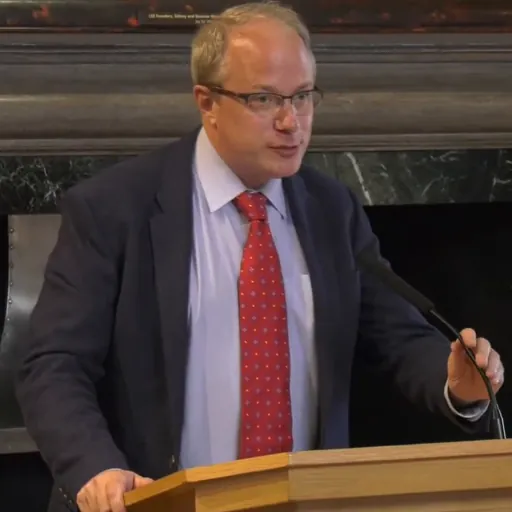
About Adrian Vermeule
Born 1968. Adrian Vermeule is an American professor, legal scholar and jurist.
Early life and education Cornelius Adrian Comstock Vermeule was born on May 2, 1968, in Cambridge, Massachusetts. His father, Cornelius Clarkson Vermeule III, was a curator of ancient and classical art at the Museum of Fine Arts, Boston. His mother, Emily Vermeule, was a professor of philology and archaeology at Harvard University. Vermeule graduated from Harvard College in 1990 with a Bachelor of Arts, summa cum laude, in East Asian languages and civilizations. He then attended Harvard Law School, graduating in 1993 with a Juris Doctor, magna cum laude.
After graduating from law school, Vermeule was a law clerk to Judge David Sentelle of the U.S. Court of Appeals for the District of Columbia Circuit from 1993 to 1994 and to Justice Antonin Scalia of the U.S. Supreme Court from 1994 to 1995.
Career Vermeule joined the faculty of the University of Chicago Law School in 1998. He teaches administrative law, legislation, and constitutional law.
In 2015, Vermeule co-founded the book review magazine The New Rambler. Vermeule became a contributing editor to Compact in 2022.
In February 2020, Vermeule sparked a controversy when he used Twtter to post an image of 26 attendees at a conferences for political conservatives with the caption: “The very first group for the camps.” He later clarified the Tweet was intended as a joke describing how far left academics might want to imprison political conservatives in concentration camps if they had the power to do so. The Harvard Crimson wrote at the time: "The comment drew criticism from professors and Harvard alumni, who interpreted the line as a reference to Nazi concentration camps during the Holocaust."
Legal and political philosophy
Integralism
A convert to Catholicism, Vermeule has become an advocate of integralism, a form of modern legal and political thought originating in historically Catholic-dominant societies. Integralism advocates for a political and social order based on the primacy of the Catholic faith. Rather than electoral politics, the path to confessional political order in integralist theory is "strategic ralliement", or transformation of institutions and bureaucracies from within. Ralliement lays the groundwork for a realized integralist regime to succeed the liberal democratic order. The new state would "exercise coercion over baptized citizens in a manner different from non-baptized citizens".
Judicial interpretation
On judicial interpretation, Vermeule believes:
Vermeule is a judicial review skeptic. Jonathan Siegel has written that Vermeule's approach to the interpretation of law:
In 2007, Vermeule said about the United States Supreme Court that it should stay away from controversial political matters, such as abortion laws and anti-sodomy statutes and defer to Congress, as the elected representatives of the people, except in extremely obvious cases. This would require both liberals and conservatives to step back and realize that the benefits of such a court would outweigh the drawbacks for both. Vermeule was thus suggesting "a kind of arms-control agreement, a tacit deal".
Vermeule believes that legal change can only come about through cultural improvements. In an interview in 2016 after his conversion to Catholicism, Vermeule said, I put little stock or faith in the law. It is a tool that may be put to good uses or bad. In the long run it will be no better than the polity and culture in which it is embedded. If that culture sours and curdles; so will the law; indeed that process is well underway and its tempo is accelerating. Our hope lies elsewhere.
Vermeule specified that common-good constitutionalism is "not tethered to particular written instruments of civil law or the will of the legislators who created them". However, the determination of the common good made by the legislators is instrumental insofar as it embodies the background principles of the natural law. In other words, while the legislative intent is not per se controlling, positive law always seeks to put into effect natural law principles, and the intended principles behind the positive law are controlling. In that vein, he also says that "officials (including, but by no means limited to, judges)" will need "a candid willingness to 'legislate morality'" in order to create a "just and well-ordered society." Garrett Epps, a professor of law at the University of Baltimore, also wrote a critique in The Atlantic, linking common-good constitutionalism to integralism and arguing that Vermeule's approach represents authoritarianism and objects "not [because] it is harmful and antihuman, but simply that, in the end, it is so banal.
Responses Vermeule's common good constitutionalism has drawn a range of responses, both positive and negative. Legal scholar Richard H. Helmholz, in a review of Common Good Constitutionalism, described it as "a serious contribution to some of the most pressing legal debates of our times... Vermeule's book has the merit of providing some of the details about how such a change might occur. It also includes some marching orders." Jack Goldsmith praised Common Good Constitutionalism as "the most important book of American constitutional theory in many decades".
Legal scholar Conor Casey has criticized critics of common good constitutionalism as having fundamentally misunderstood it. According to Casey, common good constitutionalism "is entirely consistent with the natural law legal tradition and emphatically not an argument for authoritarianism unbound from legal and democratic constraint or concern for human rights".
According to Eric Levitz, the values Vermeule promotes are those of Catholicism and the Christian right. Constitutional law professor Garrett Epps characterizes Vermeule as "an authentic Christian nationalist to whom the Constitution is only an obstacle". Vermeule's common-good constitutionalism argument is, according to Epps, really "authoritarian extremism" which "has absolutely nothing to do with the actual United States Constitution, and in many ways flatly contradicts it. ... In fact, the Constitution as such is not a binding text to Vermeule" since it must be, in Vermeule's words, "read into" in order to arrive at the results he prefers. In the end, Epps criticizes Vermeule's concept as a "banal" anti-constitutional theory akin to Falangism. Levitz notes that Vermeule received little support from conservatives for his arguments, although some did object to characterizing him as "authoritarian".
Elliot Kaufman, writing in the conservative magazine National Review, has described Vermeule as a "reactionary" and an "illiberal" following in the footsteps of German Nazi thinker Carl Schmitt. In Kaufman's view, Vermeule's illiberalism is "dangerous". Law professor Rick Hills described Vermeule's recent writings as a kind of "anti-liberal chic", or "a really cheap way to signal one's willingness to offend without putting any specific cards on the table about one's own specific views about, say, the acceptability of locking up demonstrators who offend the regime in power".
Peter J. Wallison, who served as White House Counsel during the Reagan presidency, described Vermeule's book as "more an embarrassment than a legal masterpiece" and that "the political structure he devises is highly authoritarian, perhaps even totalitarian". Wallison complained that Vermeule "never successfully defines what he means by the common good or how it can be achieved" and for failing to understand the distinction between textualism and originalism.
Personal life and views Vermeule was raised as an Episcopalian, abandoning the denomination in college, but returning to it later in life. He announced his conversion to Catholicism in 2016.
Scholarly works Books
Selected articles
Don’t just read it —
keep it.
Full-length biographies made to live with: read them, listen on the way to work, watch them tonight.
- E-book
- Audio
- Video
Instant download · yours to keep · every purchase keeps this site free
Important facts
People in Adrian Vermeule's life
Named in this biography and alive at the same time








Related people
Same field, nearest in time


Contemporaries
People whose lives overlapped Adrian Vermeule's




Frequently asked questions
Who is Adrian Vermeule?
American legal scholar
When was Adrian Vermeule born?
Adrian Vermeule was born on 2 May 1968 in Cambridge.
What is Adrian Vermeule's occupation?
Adrian Vermeule is a professor, legal scholar and jurist.
What nationality is Adrian Vermeule?
Adrian Vermeule is American.
Sources & further reading
Cite this page
APA: Biography.guide. (2026). Adrian Vermeule. https://biography.guide/adrian-vermeule/
MLA: "Adrian Vermeule." Biography.guide, https://biography.guide/adrian-vermeule/.
Chicago: "Adrian Vermeule." Biography.guide. https://biography.guide/adrian-vermeule/.
Data last updated: 2026-09-22 · Spot an error? Report a correction.
Portrait: Wikimedia Commons · author & licence
Page generated 2026-09-27 05:03 UTC