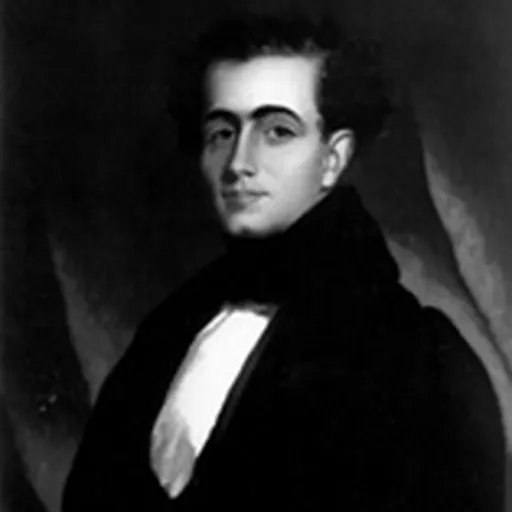
About Stevens Thomson Mason
Lived 1760 – 1803 (aged 42). Stevens Thomson Mason was an American politician and lawyer.
Colonel Stevens Thomson Mason (December 29, 1760 – May 10, 1803) was an American lawyer, military officer and planter who served in the Continental Army during the Revolutionary War. Mason was also a delegate in the Virginia General Assembly and a Republican U.S. Senator from 1794 to 1803.
Early and family life Mason was born to Thomson Mason (1733–1785); Especially after his father's 1785 death at the family's Raspberry Plain plantation in what had become Loudoun County, Mason operated farms using enslaved labor, as would his descendants. In the 1787 Virginia tax census, Stevens T. Mason owned 33 slaves over 16 years of age, as well as 38 slaves under age 18, 28 horses, 76 cattle, 4 wheeled vehicles and a stud horse.
During the American Revolutionary War, as his uncle George served in the Virginia General Assembly and drafted the Virginia Declaration of Rights as well as the first Virginia constitution and state seal, Stevens Mason served as an officer in the Continental Army and in the Virginia militia. By the Battle of Yorktown, he was a brigadier general in the Virginia militia as well as an aide to General George Washington.
Political career Following the war, Loudoun County voters elected him as one of their (part-time) representatives in the Virginia State House of Delegates in 1783, and he served alongside veteran John Carter, although neither won re-election the following year. In 1787 he won election to the Virginia State Senate representing Loudoun and nearby Fauquier Counties (thus serving in 4 General Assembly sessions), but failed to win re-election in 1791, being replaced by veteran politician Francis Peyton. Meanwhile Stevens Thomson Mason also won election (alongside Levin Powell) as Loudoun County's delegate to the Virginia Ratification Convention in 1788, during which his uncle (one of Stafford County's representatives) unsuccessfully fought against ratification, but ultimately caused Virginia's congressional delegates to propose the Bill of Rights modeled on his Virginia Declaration of Rights and which was later approved by Congress and the states as a series of ten Constitutional amendments. Less than two years following his uncle's death, in 1794, Loudoun County voters returned Stevens Thomson Mason to the Virginia House of Delegates. Fellow legislators elected him to the United States Senate to fill the vacancy caused by the resignation of James Monroe. Stevens Thomson Mason won re-election in 1797 and again in 1803, and thus served from 18 November 1794, until his death in Philadelphia, Pennsylvania.
While in the Senate Mason handed a copy of the secret Jay Treaty to Pierre Adét, French minister to the United States. The senator along with Senator Pierce Butler leaked the document to the American press. Since his country was at war with Great Britain and hated the idea of a treaty of “amity” between it and the United States, Adét gave the document to Benjamin Bache, publisher of The Aurora — a newspaper — with the hope of raising just the sort of public outcry that ensued—and even, perhaps, of blocking ratification of the treaty.
Mason was the only senator to vote against the confirmation of Oliver Ellsworth as the chief justice of the Supreme Court.
Death and legacy He is interred in the family burying ground at Raspberry Plain in Loudoun County, Virginia.
Marriage and children Mason married Mary Elizabeth Armistead on May 1, 1783. The couple had six children:
John Thomson Mason (January 8, 1787 – April 17, 1850) Armistead Thomson Mason (1787 – February 6, 1819) Stevens Thomson Mason (1789 – 17 November 1815) Mary Thomson Mason (1791–1813) Emily Rutger Mason (1793–1837) Catherine Mason (born 1795)
Relations Brother of John Thomson Mason (1765–1824); half-brother of William Temple Thomson Mason (1782–1862); first cousin of George Mason V (1753–1796); first cousin once removed of Thomson Francis Mason (1785–1838), George Mason VI (1786–1834), Richard Barnes Mason (1797–1850), and James Murray Mason (1798–1871); father of Armistead Thomson Mason (1787–1819) and John Thomson Mason (1787–1850); uncle of John Thomson Mason Jr. (1815–1873); and grandfather of Stevens Thomson Mason (1811–1843), first governor of Michigan. His great granddaughter Kate Mason Rowland would be one of the founding members of the Daughters of the Confederacy and also write a two-volume biography of George Mason IV.
Don’t just read it —
keep it.
Full-length biographies made to live with: read them, listen on the way to work, watch them tonight.
- E-book
- Audio
- Video
Instant download · yours to keep · every purchase keeps this site free
Important facts
Family & relationships
People in Stevens Thomson Mason's life
Named in this biography and alive at the same time



Related people
Same field, nearest in time



Contemporaries
People whose lives overlapped Stevens Thomson Mason's




Frequently asked questions
Who was Stevens Thomson Mason?
American politician (1760-1803)
When was Stevens Thomson Mason born?
Stevens Thomson Mason was born on 29 December 1760 in Stafford County.
When did Stevens Thomson Mason die?
Stevens Thomson Mason died on 10 May 1803 in Philadelphia.
What was Stevens Thomson Mason's occupation?
Stevens Thomson Mason was a politician and lawyer.
What nationality was Stevens Thomson Mason?
Stevens Thomson Mason was American.
Sources & further reading
· Wikipedia: Stevens Thomson Mason
· DBpedia: Stevens Thomson Mason (senator)
Cite this page
APA: Biography.guide. (2026). Stevens Thomson Mason. https://biography.guide/stevens-thomson-mason/
MLA: "Stevens Thomson Mason." Biography.guide, https://biography.guide/stevens-thomson-mason/.
Chicago: "Stevens Thomson Mason." Biography.guide. https://biography.guide/stevens-thomson-mason/.
Data last updated: 2026-09-21 · Spot an error? Report a correction.
Portrait: Wikimedia Commons · author & licence
Page generated 2026-09-27 04:59 UTC