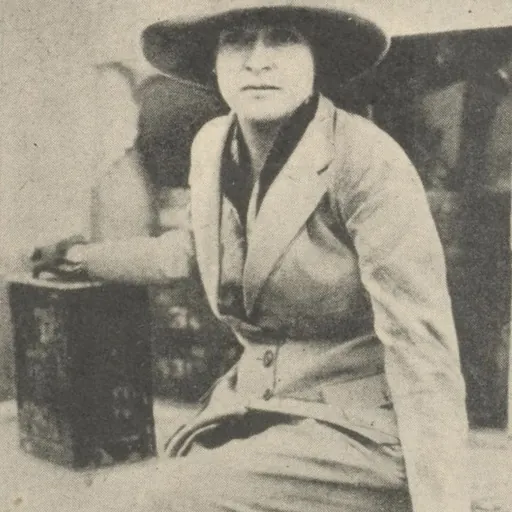
Stella Court Treatt
British adventurer, explorer, writer and filmmaker
About Stella Court Treatt
Lived 1895 – 1976 (aged 81). Stella Court Treatt was a British documentary filmmaker.
Stella Maud Court Treatt, FRGS (née Hinds; 1895 – 1976) was a South African filmmaker, author, and adventurer who with her first husband Chaplin Court Treatt undertook the Court Treatt Expedition 1924–1926, the first successful attempt to drive a motor car from Cape Town to Cairo.
Early and personal life Stella Maud Hinds was born in Blaauwbank, the South African Republic, on 11 March 1895. Her father was Thomas Charles Hinds, a burgher of the South African Republic with a farm near Magaliesburg. Stella's sister, (Hilda) Grace Hinds, was the mother of John Cranko, the South African ballet dancer and choreographer. In 1924, after an interval securing permissions in England, Stella and Chaplin Court Treatt, together with Stella's brother, Errol Hinds, and several others, undertook a seventeen-month car journey from Cape Town to Cairo. Stella Maud Treatt and Chaplin Court Treatt divorced after several trips together sometime in 1935 or 1936.
Cape to Cairo Expedition
The Court Treatt expedition was the first successful attempt to drive a motor car from Cape Town ("the Cape"), South Africa, to Cairo, Egypt. The party consisted of Stella Court Treatt, Chaplin Court Treatt, Thomas A. Glover, a cinematographer, Fred C. Law, special correspondent for the London Daily Express, Stella's brother Errol, Julius Mapata, the expedition's guide and translator, and Captain F.C. Blunt and Mr. McEleavey, representatives of the Crossley Motor company. They reached Cairo sixteen months later, on 24 January 1926. Their route was so winding and full of detours that it was reported they had travelled more than . The expedition was explicitly modeled after the fashion of Cecil Rhodes' "red line" connecting Cape Town to Cairo, and they restricted their route to territories under British rule. Fred Law's account of the beginning of the trip, Woman Pioneer of Empire: Cape to Cairo venture Begun (Daily Express, 24 September 1924), began with an invocation of Rhodes' vision of a network of roads and railroads linking up British colonial possessions to afford white settlement and the more effective domination of the continent and its people: "The second step towards the fulfilment of Cecil Rhodes' scheme to open up the routes through darkest Africa began this morning, when Major and Mrs. C. Court Treatt left Capetown in an attempt to reach Cairo by motorcar." Their route took them from Cape Town through Britstown, Pretoria, Polokwane (formerly, Pietersburg), Bulawayo (in Zimbabwe, formerly, Rhodesia, where they visited Cecil Rhodes' grave), Livingstone (in Zambia, formerly Northern Rhodesia), Kabwe (in Zambia, formerly called Broken Hill), Mbala (in Zambia, formerly called Abercorn), Karonga (Malawi, formerly Nyasaland), Mwaya (Tanzania, formerly Tanganyika), Nairobi (Kenya), Mongalla (South Sudan, formerly the Anglo-Egyptian Sudan), Rumbek, Wau, Al-Ubayyid (Sudan, formerly Anglo-Egyptian Sudan; spelled, 'El Obeid,' by Treatt), Ed Dueim, Khartoum, Wadi Halfa, and finally Aswan (Egypt) to Cairo in Egypt. After stopping briefly for Christmas at Al-Ubayyid, they resumed their journey on Christmas morning, reaching the west bank of the Nile River on 27 December, and spent the night at El Doueim, where they were provided lodging by the Governor of Anglo-Egyptian Sudan while a steamer transported their cars across the Nile to the east side. They arrived at Khartoum on 28 December, drove to Omdurman across a bridge at the confluence of the White Nile and Blue Nile on 29 December, and spent New Year's Eve at the small town of Shendi. On 5 January 1926, they reached Halfa in Egypt, getting to Luxor on 20 January and were on relatively good roads on the last leg of their trip. On the morning of 24 January, they were welcomed by the press and a reception committee at the pyramids of Giza, and drove past crowds of well wishers along the Kasr el Nil road, arriving in Cairo in the afternoon to finish the first trip by motor vehicle from Cape Town to Cairo.
Return to England When the Treatts returned to England, "their journey was celebrated as a triumph of the British spirit and the superiority of British engineering." In 1927, not long after their return, Stella published Cape to Cairo: The Record of a Historic Motor Journey and the film of the expedition, Cape to Cairo, was screened in Britain and the United States, "accompanied by lectures and numerous interviews starring the glamorous Stella Court Treatt".
The General Strike of 1926, which began three months after their return to England, provided a backdrop for Stella's account of the Treatt expedition.
Sudan Expedition In 1928, after spending two years in England, the Treatts set out again for Sudan to make a moving picture of Sudan's wildlife. The film is organized around a racist visual trope of 'primitive Africans' and their close linkages to wildlife.
Stark Nature (1930) was also organized around a similar visual trope of 'primitive Africans' and 'modern Europeans.' The film opens with cabaret dancing in London to supply a contrast with African dance. In Sudan Sand: filming the baggara Arabs (1930) Stella describes building an artificial river to provide a suitable setting for a wildlife film: "there is more forest than we know what to do with. The real difficulty lies in finding a suitable forest with a natural water course running in the same place."
Stark Nature (1930) received mixed reviews. Some complained that all the cutting between "primitive and modern" dance sequences was overwrought; others wrote that the narrative was too artificial for a "Nature film."
Published works Writing
Filmography
Don’t just read it —
keep it.
Full-length biographies made to live with: read them, listen on the way to work, watch them tonight.
- E-book
- Audio
- Video
Instant download · yours to keep · every purchase keeps this site free
Important facts
Family & relationships
People in Stella Court Treatt's life
Named in this biography and alive at the same time


Related people
Same field, nearest in time





Contemporaries
People whose lives overlapped Stella Court Treatt's
Frequently asked questions
Who was Stella Court Treatt?
British adventurer, explorer, writer and filmmaker
When was Stella Court Treatt born?
Stella Court Treatt was born on 11 March 1895 in Randfontein.
When did Stella Court Treatt die?
Stella Court Treatt died on 20 December 1976 in Johannesburg.
What was Stella Court Treatt's occupation?
Stella Court Treatt was a documentary filmmaker.
What nationality was Stella Court Treatt?
Stella Court Treatt was British.
Sources & further reading
· Wikipedia: Stella Court Treatt
· DBpedia: Stella Court Treatt
Cite this page
APA: Biography.guide. (2026). Stella Court Treatt. https://biography.guide/stella-court-treatt/
MLA: "Stella Court Treatt." Biography.guide, https://biography.guide/stella-court-treatt/.
Chicago: "Stella Court Treatt." Biography.guide. https://biography.guide/stella-court-treatt/.
Data last updated: 2026-09-22 · Spot an error? Report a correction.
Portrait: Wikimedia Commons · author & licence
Page generated 2026-09-27 05:02 UTC