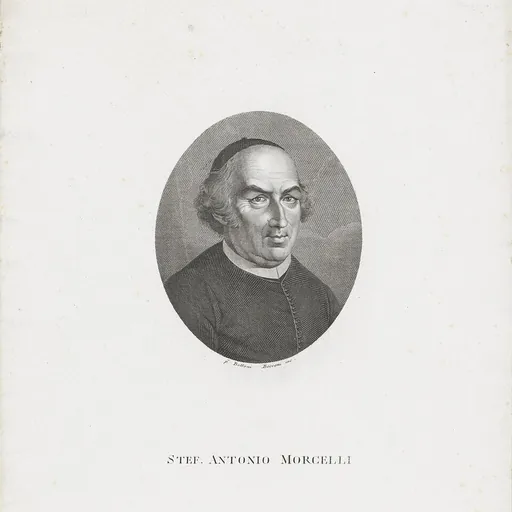
Stefano Antonio Morcelli
Italian Jesuit scholar
About Stefano Antonio Morcelli
Lived 1737 – 1822 (aged 84). Stefano Antonio Morcelli was an Italian epigrapher, archaeologist and catholic theologian.
Stefano Antonio Morcelli (17 January 1737 – 1 January 1822) was an Italian Jesuit scholar, known as an epigraphist. His work De stilo Latinarum inscriptionum libri III, published in three volumes in 1781, which shows a rigorous method, a novelty and originality of approach, as well as a solid preparation, gave him his European fame and is considered a milestone in the development of epigraphy.
Life Morcelli was born at Chiari near Brescia. He studied at the Jesuit College of Brescia and was admitted into the Society of Jesus, 3 November 1753. He successively taught grammar at Fermo, humanities at Ragusa, and oratory at the Roman College where he established an academy of archaeology at the Kircherian Museum.
After the suppression of the Society of Jesus (1773), he became librarian to Cardinal Albani and in 1791, he was appointed to a provostship in his native town. He declined the offer of the Archbishopric of Ragusa and continued his literary labors in Rome. His first publication was De stilo inscriptionum latinarum (On the style of Latin inscriptions, 1780). In the town of Chiari, his birthplace, to which he afterwards withdrew, he founded an institution for the education of girls, reformed the entire school system, devoted his library to public use, and restored many buildings and churches. Meantime his reputation as an epigraphist, numismatist, and archaeologist increased. Besides his numerous works on this subjects, he published five volumes of sermons and ascetic treatises. When the Society of Jesus was re-established, he again took his place in its ranks, and died in Chiari in January 1822, aged eighty-four.
Works He owes his reputation not only to his extensive knowledge of ancient inscriptions, but also to his classical Latinity. Among his works are: De stilo inscriptionum latinarum (Rome, 1781); Inscriptiones commentariis subjectis (Rome, 1783) To a second edition of these two works was added the Πάρεργον Inscriptionum novissimarum (Padua, 1818–22); Μηνολόγιον τῶν Εὐαγγελίων Ἑορταστικὸν sive Kalendarium Ecclesiæ Constantinopolitanæ etc. (Rome, 1788); Africa Christiana (Brescia, 1816-7); Opuscoli Ascetici (Brescia, 1819 or 1820).
Morcelli was also an important numismatist, and was influential on such scholars as Celestino Cavedoni.
Don’t just read it —
keep it.
Full-length biographies made to live with: read them, listen on the way to work, watch them tonight.
- E-book
- Audio
- Video
Instant download · yours to keep · every purchase keeps this site free
Important facts
People in Stefano Antonio Morcelli's life
Named in this biography and alive at the same time
Related people
Same field, nearest in time




Contemporaries
People whose lives overlapped Stefano Antonio Morcelli's





Frequently asked questions
Who was Stefano Antonio Morcelli?
Italian Jesuit scholar
When was Stefano Antonio Morcelli born?
Stefano Antonio Morcelli was born on 17 January 1737 in Chiari.
When did Stefano Antonio Morcelli die?
Stefano Antonio Morcelli died on 1 January 1822 in Chiari.
What was Stefano Antonio Morcelli's occupation?
Stefano Antonio Morcelli was an epigrapher, archaeologist and catholic theologian.
What nationality was Stefano Antonio Morcelli?
Stefano Antonio Morcelli was Italian.
Sources & further reading
· Wikipedia: Stefano Antonio Morcelli
· DBpedia: Stefano Antonio Morcelli
Cite this page
APA: Biography.guide. (2026). Stefano Antonio Morcelli. https://biography.guide/stefano-antonio-morcelli/
MLA: "Stefano Antonio Morcelli." Biography.guide, https://biography.guide/stefano-antonio-morcelli/.
Chicago: "Stefano Antonio Morcelli." Biography.guide. https://biography.guide/stefano-antonio-morcelli/.
Data last updated: 2026-09-20 · Spot an error? Report a correction.
Page generated 2026-09-27 05:10 UTC