
Stanley Green
Human billboard, active in Oxford St. (London) in the period 1968-1993
About Stanley Green
Lived 1915 – 1993 (aged 78). Stanley Green was a British writer and pamphleteer.
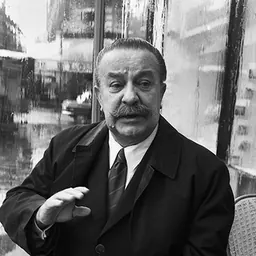
Stanley Owen Green (22 February 1915 – 12 December 1993), known as the "Protein Man", was an English human billboard in central London in the latter half of the 20th century. One writer called him "the most famous non-famous person in London". According to Lynne Truss, Green became such a ubiquitous figure around Oxford Street in the West End that he was "present in every black-and-white picture of London crowds that one has ever seen".
For 25 years, from 1968 until 1993, Green patrolled Oxford Street with a placard recommending "protein wisdom", a low-protein diet that he said would dampen the libido and make people kinder. His 14-page self-published pamphlet, Eight Passion Proteins with Care, went through 84 editions and sold 87,000 copies over 20 years. Green's "campaigning for the suppression of desire", as one writer described it, was not always popular, but Londoners developed an affection for him. The Sunday Times interviewed him in 1985, and the fashion house Red or Dead used his "less passion from less protein" slogan in one of its collections. When he died aged 78, The Daily Telegraph, The Guardian and The Times all published obituaries, and the Museum of London acquired his pamphlets and placards. In 2006 his biography was included in the Oxford Dictionary of National Biography. He was shocked while in the Navy by the obsession with sex.
After leaving the Navy in September 1945 having served through the Second World War, Green worked for the Fine Art Society. In March 1946, he failed the entrance exam for the University of London, then worked for Selfridges and the civil service, and as a storeman for Ealing Borough Council. When he died on 12 December 1993 at the age of 78, The Daily Telegraph, The Guardian and The Times all published obituaries. Other artefacts went to the Gunnersbury Park Museum.
Years after his death Green was still remembered by writers and bloggers. In 2006 he was given an entry in the Oxford Dictionary of National Biography, In 2013 Martin Gordon included a track about him on his album Include Me Out. He was also the subject of an eponymous biographical song on the Melancholy Thug's album A Trip to the Sewers of Paris (2018). Peter Watts wrote in Londonist in 2016 that Green was for a time "the most famous non-famous person in London, a figure recognised by millions even if few ever actually spoke to him. Oxford Circus has never felt quite the same without him." When Green died, Lynne Truss suggested in The Times that he be inserted retroactively into the final paragraph of Charles Dickens' novel Little Dorrit:
Notes and references
Don’t just read it —
keep it.
Full-length biographies made to live with: read them, listen on the way to work, watch them tonight.
- E-book
- Audio
- Video
Instant download · yours to keep · every purchase keeps this site free
Important facts
People in Stanley Green's life
Named in this biography and alive at the same time




Related people
Same field, nearest in time



Contemporaries
People whose lives overlapped Stanley Green's




Frequently asked questions
Who was Stanley Green?
human billboard, active in Oxford St. (London) in the period 1968-1993
When was Stanley Green born?
Stanley Green was born on 22 February 1915 in Harringay.
When did Stanley Green die?
Stanley Green died on 4 December 1993 in Northolt.
What was Stanley Green's occupation?
Stanley Green was a writer and pamphleteer.
What nationality was Stanley Green?
Stanley Green was British.
Sources & further reading
Cite this page
APA: Biography.guide. (2026). Stanley Green. https://biography.guide/stanley-green/
MLA: "Stanley Green." Biography.guide, https://biography.guide/stanley-green/.
Chicago: "Stanley Green." Biography.guide. https://biography.guide/stanley-green/.
Data last updated: 2026-09-26 · Spot an error? Report a correction.
Page generated 2026-09-27 05:15 UTC