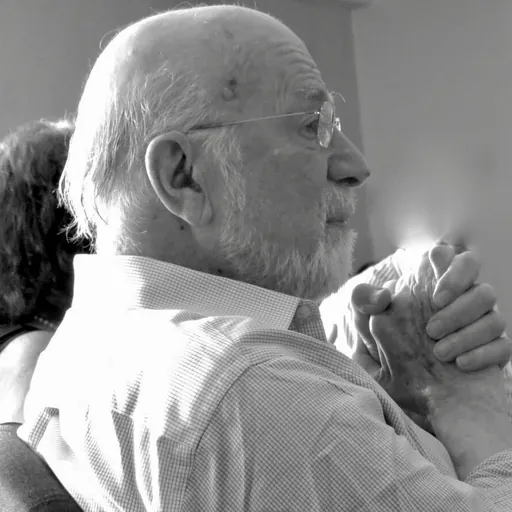
About Stanley Cavell
Lived 1926 – 2018 (aged 91). Stanley Cavell was an American philosopher, university teacher, autobiographer, aesthetician and writer.
Stanley Louis Cavell (; September 1, 1926 – June 19, 2018) was an American philosopher. He was the Walter M. Cabot Professor of Aesthetics and the General Theory of Value at Harvard University. He worked in the fields of ethics, aesthetics, and ordinary language philosophy. As an interpreter, he produced influential works on Wittgenstein, Austin, Emerson, Thoreau, and Heidegger. His work is characterized by its conversational tone and frequent literary references.
Life Cavell was born as Stanley Louis Goldstein to a Jewish family in Atlanta, Georgia. She trained him in music from his earliest days. During the Great Depression, Cavell's parents moved several times between Atlanta and Sacramento, California. As an adolescent, Cavell played lead alto saxophone as the youngest member of a black jazz band in Sacramento. Around this time he changed his name, anglicizing his father's original Polish name, Kavelieruskii (sometimes spelled "Kavelieriskii"). He entered the University of California, Berkeley, where, along with his lifelong friend Bob Thompson, he majored in music, studying with, among others, Roger Sessions and Ernest Bloch. After graduation, he studied composition at the Juilliard School of Music in New York City, only to discover that music was not his calling.
He entered graduate school in philosophy at UCLA and then transferred to Harvard University. As a student there he came under the influence of J. L. Austin, whose teaching and methods "knocked him off ... [his] horse." In 1954 he was awarded a Junior Fellowship at the Harvard Society of Fellows. Before completing his Ph.D., he became an Assistant Professor of Philosophy at the University of California, Berkeley, in 1956. Cavell's daughter by his first wife (Marcia Cavell), Rachel Lee Cavell, was born in 1957. In 1962–63 Cavell was a Fellow at the Institute for Advanced Study in Princeton, New Jersey, where he befriended the British philosopher Bernard Williams. Cavell’s marriage to Marcia ended in divorce in 1961.
In the summer of 1964, Cavell joined a group of graduate students, who taught at Tougaloo College, a historically black Protestant college in Mississippi, as part of what became known as the Freedom Summer. He and Cathleen (Cohen) Cavell were married in 1967. In April 1969, during the student protests (chiefly arising from the Vietnam War), Cavell, helped by his colleague John Rawls, worked with a group of African-American students to draft language for a faculty vote to establish Harvard's Department of African and African-American Studies.
In 1976, Cavell's first son, Benjamin, was born. Cavell received a MacArthur Fellowship in 1992. In 1996-97 Cavell was president of the American Philosophical Association (Eastern Division). In 1984, his second son, David, was born.
Cavell died in Boston, Massachusetts of heart failure on June 19, 2018, at the age of 91. He was buried at Mount Auburn Cemetery.
Philosophy Although trained in the Anglo-American analytic tradition, Cavell frequently interacted with the continental tradition. He includes film and literary study in philosophical inquiry. and Ralph Waldo Emerson. His work was for a time frequently compared to that of Jacques Derrida, whom he met in 1970. Although their exchange was congenial, Cavell denied the full extent to which deconstruction could undermine the possibility of meaning, instead taking an explicitly ordinary language approach to language and skepticism. He writes about Wittgenstein in a fashion known as the New Wittgenstein, which according to Alice Crary interprets Wittgenstein as putting forward a positive view of philosophy as a therapeutic form. Cavell's work incorporates autobiographical elements concerning how his movement between and within these thinkers' ideas influenced his views in the arts and humanities, beyond the technical study of philosophy.
Cavell established his distinct philosophical identity with Must We Mean What We Say? (1969), a collection of essays that addresses topics such as language use, metaphor, skepticism, tragedy, and literary interpretation from the point of view of ordinary language philosophy, of which he is a practitioner and ardent defender. One of the essays discusses Søren Kierkegaard's work on revelation and authority, The Book on Adler, in an effort to help reintroduce the book to modern philosophical readers. In The World Viewed (1971) Cavell looks at photography, film, modernism in art and the nature of media, mentioning the influence of art critic Michael Fried on his work.
Cavell is well-known for The Claim of Reason: Wittgenstein, Skepticism, Morality, and Tragedy (1979), which forms the centerpiece of his work and has its origins in his doctoral dissertation. In Pursuits of Happiness (1981), Cavell describes his experience of seven prominent Hollywood comedies: The Lady Eve, It Happened One Night, Bringing Up Baby, The Philadelphia Story, His Girl Friday, Adam’s Rib, and The Awful Truth. Cavell argues that these films, from 1934–1949, form part of what he calls the genre of "The Comedy of Remarriage," and finds in them great philosophical, moral, and political significance. Specifically, Cavell argues that these comedies show that "the achievement of happiness requires not the [...] satisfaction of our needs [...] but the examination and transformation of those needs." According to Cavell, the emphasis these movies place on remarriage draws attention to the fact that, within a relationship, happiness requires "growing up" together with one's partner.
In Cities of Words (2004) Cavell traces the history of moral perfectionism, a mode of moral thinking spanning the history of Western philosophy and literature. Having used Emerson to outline the concept, the book suggests ways we might want to understand philosophy, literature, and film as preoccupied with features of perfectionism. In Philosophy the Day After Tomorrow (2005), a collection of essays, Cavell makes the case that J. L. Austin's concept of performative utterance requires the supplementary concept of passionate utterance: "A performative utterance is an offer of participation in the order of law. And perhaps we can say: A passionate utterance is an invitation to improvisation in the disorders of desire." The book also contains extended discussions of Friedrich Nietzsche, Jane Austen, George Eliot, Henry James, and Fred Astaire, as well as familiar Cavellian subjects such as Shakespeare, Emerson, Thoreau, Wittgenstein, and Heidegger. Cavell's final book published during his lifetime, Little Did I Know: Excerpts from Memory (2010), is an autobiography written in the form of a diary. In a series of consecutive, dated entries, he inquires about the origins of his philosophy by telling the story of his life.
A scholarly journal, Conversations: The Journal of Cavellian Studies, engages with his philosophical work. It is edited by Sérgio Dias Branco and Amir Khan and published by the University of Ottawa.
Honorary degrees Doctor of Humane Letters, Kalamazoo College, 1980 Doctor of Letters, Iona College, 1985 Doctor of Humane Letters, University of Chicago, 1987 Docteur, Honoris Causa, Université de Strasbourg, 1996 Doctor Philosophiae Honoris Causa, Hebrew University, 1997 Doctor of Letters, Honoris Causa, University of East Anglia, 2009 Docteur, Honoris Causa, École normale supérieure de Lyon, 2010 Doctor of Letters, Wesleyan University, 2010 Doctor of Theology, Institut protestant de théologie de Paris, 2010
Selected honors Junior Fellow, Society of Fellows, Harvard University, 1953–56 Fellow, Institute for Advanced Study, Princeton, New Jersey, 1962–1963 Distinguished Teaching Award, University of California, Berkeley, 1961 Fellow, Wesleyan University Center for the Humanities, 1970–1971 Fellow, American Academy of Arts and Sciences, 1978– Fellow, MacArthur Foundation This New Yet Unapproachable America: Lectures after Emerson after Wittgenstein (1988) Conditions Handsome and Unhandsome: The Constitution of Emersonian Perfectionism (1990) A Pitch of Philosophy: Autobiographical Exercises (1994) Philosophical Passages: Wittgenstein, Emerson, Austin, Derrida (1995) Contesting Tears: The Melodrama of the Unknown Woman (1996) Emerson's Transcendental Etudes (2003) Cavell on Film (2005) Cities of Words: Pedagogical Letters on a Register of the Moral Life (2004) Philosophy the Day after Tomorrow (2005) Little Did I Know: Excerpts from Memory (2010) Here and There: Sites of Philosophy (2022)
Don’t just read it —
keep it.
Full-length biographies made to live with: read them, listen on the way to work, watch them tonight.
- E-book
- Audio
- Video
Instant download · yours to keep · every purchase keeps this site free
Important facts
People in Stanley Cavell's life
Named in this biography and alive at the same time




Related people
Same field, nearest in time


Contemporaries
People whose lives overlapped Stanley Cavell's


Frequently asked questions
Who was Stanley Cavell?
American philosopher (1926-2018)
When was Stanley Cavell born?
Stanley Cavell was born on 1 September 1926 in Atlanta.
When did Stanley Cavell die?
Stanley Cavell died on 19 June 2018 in Boston.
What was Stanley Cavell's occupation?
Stanley Cavell was a philosopher, university teacher, autobiographer, aesthetician and writer.
What nationality was Stanley Cavell?
Stanley Cavell was American.
Sources & further reading
Cite this page
APA: Biography.guide. (2026). Stanley Cavell. https://biography.guide/stanley-cavell/
MLA: "Stanley Cavell." Biography.guide, https://biography.guide/stanley-cavell/.
Chicago: "Stanley Cavell." Biography.guide. https://biography.guide/stanley-cavell/.
Data last updated: 2026-09-23 · Spot an error? Report a correction.
Portrait: Wikimedia Commons · author & licence
Page generated 2026-09-27 05:05 UTC