
About Stanisław Skalski
Lived 1915 – 2004 (aged 88). Stanisław Skalski was a Polish flying ace, military officer, writer, airman and fighter pilot.
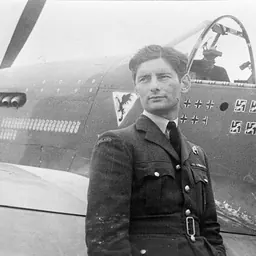
Stanisław Skalski, (27 November 1915 – 12 November 2004) was a Polish aviator and fighter ace who served with the Polish Air Force and British Royal Air Force during the Second World War. Skalski was the top Polish fighter ace of the war and chronologically the first Allied fighter ace of the war, credited, according to the Bajan's list, with 18 11/12 victories and two probable. Some sources, including Skalski himself, give a number of 22 11/12 victories.
He returned to Poland after the war but was imprisoned by the communist authorities under the pretext that he was a spy for Great Britain. While in arrest he was tortured and then, in a show trial, sentenced to death on 7 April 1950. Skalski refused to ask for clemency but after his mother's intervention with the president of communist Poland, Boleslaw Bierut, his sentence was commuted to life imprisonment. He remained in prison until 1956 when a court overturned the previous verdict. After the "Polish October" and subsequent liberalization and end of Stalinist terror, he was rehabilitated and rejoined the Polish armed forces. In 1972 he was moved to inactive service and in 1988, on the cusp of fall of communism in Poland he was promoted to the rank of brigadier general.
Early life and career Stanisław Skalski was born on 27 November 1915 in Kodyma in Podolia Governorate, Russian Empire (now in Ukraine). In 1936, he entered the Cadet School in Dęblin. After completing Pilot Training in 1938, Skalski was ordered to the 142nd Fighter Squadron in Toruń (142 eskadra "Toruńska"). On 1 September 1939 he attacked a German Henschel Hs 126 reconnaissance aircraft, which was eventually shot down by Marian Pisarek. Skalski then landed next to it, helped to bandage wounded crew members and arranged for them to be taken to a military hospital. The following day, nine PZL P-11s of the 142 Squadron, led by Major Lesnievski, intercepted two formations of Dornier Do 17s over River Vistula. Attacking head on, the Polish pilots managed to shoot down seven twin-engined bombers, two of them credited to Skalski. By 16 September Skalski reached flying ace status, claiming a total of six German aircraft and making him the first Allied air ace of the Second World War. Soon after he fled the country with other Polish pilots to Romania, and from there via Beirut to France and after went on to fight with the Royal Air Force in the Battle of Britain.
RAF service
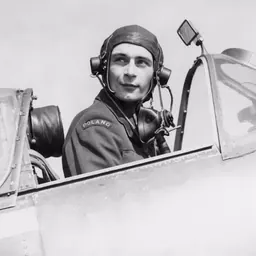
In August 1940, Pilot Officer Skalski joined No. 501 Squadron RAF. From 30 August to 2 September 1940 he shot down a He 111 bomber and three Messerschmitt Bf 109s. On 5 September Skalski himself was shot down. Skalski bailed out with severe burns, and was hospitalized for six weeks. He returned to his unit in late October 1940. During the Battle of Britain, he was credited with four planes shot down and one shared.
In March 1941 Skalski was assigned to No. 306 (Polish) Squadron RAF, flying in Circus sorties over France. On 15 August 1941 he crashed while landing Spitfire W3170 after returning from a mission. On 1 March 1942, he became a flight commander in No. 316 (Polish) Squadron RAF. On 29 April 1942 Flight Lieutenant Skalski was made Commanding Officer of the No. 317 (Polish) Squadron RAF for five months. From November 1942 he was an instructor with No. 58 Operational Training Unit. The Poles arrived at Bu Grara airfield, west of Tripoli in March 1943 and attached to No. 145 Squadron RAF. The PFT took part in actions in Tripolitania and in Sicily. On 28 March the PFT engaged in combat for the first time.
Return to Poland and arrest
After the war Skalski returned to Poland in 1947 and joined the Air Force of the Polish Army. In 1948 however he was arrested under the false charge of espionage. In 1950, he was sentenced to death, he spent three years awaiting the execution, after which his sentence was changed to life imprisonment in Wronki Prison.
After the end of Stalinism in Poland, in 1956 he was released, rehabilitated, and allowed to join the military. He served at various posts in the Headquarters of the Polish Air Force. He wrote memoires of the 1939 campaign Czarne krzyże nad Polską ("Black crosses over Poland", 1957). On 20 May 1968 he was nominated the secretary general of the Aeroklub Polski and on 10 April 1972 he retired. On 15 September 1988 he was promoted to the rank of brigadier general. He was buried at the Powązki Military Cemetery.
Remembrance
In 2005, a commemorative plaque was unveiled at his birth home in Warsaw at al. Wyzwolenia 10. In the same year, Skalski was the subject of a documentary film entitled Spętany anioł (Shackled Angel) by Zbigniew Kowalewski.
In 2007, Skalski's biography by Katarzyna Ochabska was published.
In 2008, Agnieszka Bujas directed a film Żyłem jak chciałem (I Lived Life My Way) which is devoted to the life and legacy of Skalski.
In 2015, another biography of Skalski was published. It was written by Grzegorz Sojda and Grzegorz Śliżewski and was titled Generał pilot Stanisław Skalski: portret ze światłocieniem.
On 2 November 2015, Vice Secretary of State, Maciej Jankowcki, acting on behalf of the Minister of Defence granted the name of Stanisław Skalski to 22nd Air Base in Malbork.
Promotions
Awards Polish:
British:
French:
Don’t just read it —
keep it.
Full-length biographies made to live with: read them, listen on the way to work, watch them tonight.
- E-book
- Audio
- Video
Instant download · yours to keep · every purchase keeps this site free
Important facts
People in Stanisław Skalski's life
Named in this biography and alive at the same time


Related people
Same field, nearest in time
Contemporaries
People whose lives overlapped Stanisław Skalski's






Frequently asked questions
Who was Stanisław Skalski?
Polish fighter ace and general (1915-2004)
When was Stanisław Skalski born?
Stanisław Skalski was born on 27 November 1915 in Labushne.
When did Stanisław Skalski die?
Stanisław Skalski died on 12 November 2004 in Warsaw.
What was Stanisław Skalski's occupation?
Stanisław Skalski was a flying ace, military officer, writer, airman and fighter pilot.
What nationality was Stanisław Skalski?
Stanisław Skalski was Polish.
Sources & further reading
· Wikipedia: Stanisław Skalski
Cite this page
APA: Biography.guide. (2026). Stanisław Skalski. https://biography.guide/stanislaw-skalski/
MLA: "Stanisław Skalski." Biography.guide, https://biography.guide/stanislaw-skalski/.
Chicago: "Stanisław Skalski." Biography.guide. https://biography.guide/stanislaw-skalski/.
Data last updated: 2026-09-20 · Spot an error? Report a correction.
Page generated 2026-09-27 05:19 UTC