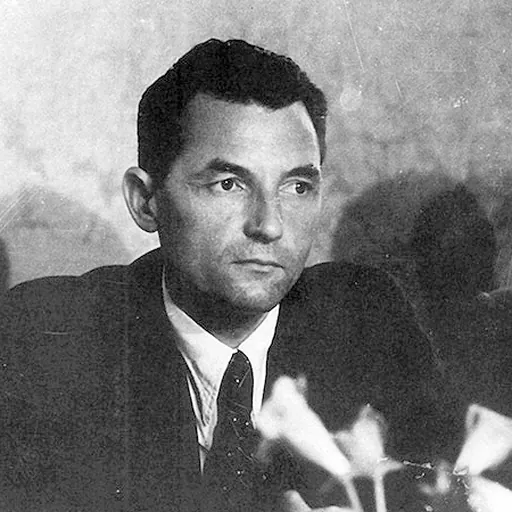
About Stanisław Radkiewicz
Lived 1903 – 1987 (aged 84). Stanisław Radkiewicz was a Polish politician.
Stanisław Radkiewicz (; 19 January 1903 – 13 December 1987) was a Polish communist activist with Soviet citizenship, a member of the pre-war Communist Party of Poland and of the post-war Polish United Workers' Party (PZPR). As head of the Ministry of Public Security of Poland (Urząd Bezpieczeństwa or UB) between 1944 and 1954, he was one of the chief organisers of Stalinist terror in Poland. He also served as a political commissar and was made a divisional general in Communist Poland.
Unlike other individuals responsible for the Stalinist terror in the 1940s and 1950s, Radkiewicz was never held responsible for his crimes, although in 1956, after the Poznań protests and his official "self-critique", he was removed from his post as Minister of Public Security and made Minister of State Agricultural Farms (PGRs).
Early life
Radkiewicz was born in the village of Rozmierki in the Slonimsky Uyezd of the Grodno Governorate of the Russian Empire (present-day Belarus). He was the son of farmer Franciszek and Paulina née Lenczewska. He finished third grade.
World War II
During World War II, he volunteered for the Red Army, but was later transferred and made a political commissar of the Polish 1st Tadeusz Kościuszko Infantry Division
On 31 December 1944, the PKWN was transformed into the Provisional Government of the Republic of Poland and the UB was renamed Ministry of Public Security of Poland (MBP), although it continued to be known by its UB acronym partly because local offices continued under the old name. In the period after 1945, the secret police grew rapidly under Radkiewicz's direction, with twelve thousand agents in April 1945 and twenty-four thousand in December 1945. At its height, in 1953, the organisation had thirty-three thousand agents.
Radkiewicz's UB focused its activities on several main areas: agitation and armed terror, including secret murders, directed at the only legal political opposition to the Communists, the Polish People's Party (also known as "Polish Peasant Party", PSL) (which was forced to merge into the Communist controlled satellite United People's Party (ZSL) in 1949)
Action against the Polish People's Party In December 1945, Radkiewicz directed a general action against the only legal opposition party in Poland at the time, the PSL. As a result, between the spring of 1945 and January 1947, at least 140 members of the PSL were murdered by the UB, among them notable figures such as Narcyz Wiatr and Władysław Kojder.
Action against the Catholic Church in Poland As early as September 1945, Radkiewicz ordered the organisation of the 5th Department of UB whose task was to "counter organisations and groups active against the interests of the (Communist) Party". Within the 5th Department, Section V was charged with investigating and building actions against the Catholic Church. Within the section, Sub-Section I was charged with investigating those active in the Catholic Church (including the clergy) while Sub-Section II's focus was to be on the Catholic press and secular Catholic organisations. – presented a seminar entitled On the Clergy's Offensive Against Our Task at a conference for secret police chiefs and Radkiewicz was the main discussant. In her presentation, Brystiger stated that the "final time of merciless fight with the Church" was coming soon and that, in order to win it, the secret services of the Polish United Workers' Party would need to employ "any means necessary". Radkiewicz, in his follow up remarks, noted that, "The clergy is not like the PSL (The Polish People's Party). With them it won't be as easy as it was with the PSL". and in July 1955 he stepped down from the Political Bureau of the PZPR. After workers' unrest in Poznan in 1956 and the Polish October reforms, several other members of the security services responsible for the Stalinist terror in Poland were put on trial (among others Roman Romkowski, Józef Różański and Anatol Fejgin), but Radkiewicz went unpunished. After he made a public critique of his actions, he was made the Minister of State Farms. He died on 13 December 1987, aged 84, in Warsaw. Over the years, he had been awarded the Order of the Cross of Grunwald and the Order of the Banner of Labour (Order Sztandaru Pracy).
Awards and decorations
60px Medal "For participation in the fights in defense of the people's power"
Don’t just read it —
keep it.
Full-length biographies made to live with: read them, listen on the way to work, watch them tonight.
- E-book
- Audio
- Video
Instant download · yours to keep · every purchase keeps this site free
Important facts
People in Stanisław Radkiewicz's life
Named in this biography and alive at the same time


Related people
Same field, nearest in time





Contemporaries
People whose lives overlapped Stanisław Radkiewicz's
Frequently asked questions
Who was Stanisław Radkiewicz?
Polish politician (1903-1987)
When was Stanisław Radkiewicz born?
Stanisław Radkiewicz was born on 19 January 1903 in Razmierki.
When did Stanisław Radkiewicz die?
Stanisław Radkiewicz died on 13 December 1987 in Warsaw.
What was Stanisław Radkiewicz's occupation?
Stanisław Radkiewicz was a politician.
What nationality was Stanisław Radkiewicz?
Stanisław Radkiewicz was Polish.
Sources & further reading
· Wikipedia: Stanisław Radkiewicz
· DBpedia: Stanisław Radkiewicz
Cite this page
APA: Biography.guide. (2026). Stanisław Radkiewicz. https://biography.guide/stanislaw-radkiewicz/
MLA: "Stanisław Radkiewicz." Biography.guide, https://biography.guide/stanislaw-radkiewicz/.
Chicago: "Stanisław Radkiewicz." Biography.guide. https://biography.guide/stanislaw-radkiewicz/.
Data last updated: 2026-09-22 · Spot an error? Report a correction.
Portrait: Wikimedia Commons · author & licence
Page generated 2026-09-27 05:01 UTC