
About Stanisław Gustaw Jaster
Lived 1921 – 1943 (aged 21–22). Stanisław Gustaw Jaster was a Polish partisan.
Stanisław Gustaw Jaster, codenamed Hel (; born 1 January 1921 in Lviv, died after 12 July 1943 in Warsaw) was a Polish scout, an escapee from the Auschwitz concentration camp, and a soldier of the Home Army.
He went missing under unexplained circumstances after 12 July 1943; presumably murdered by fellow conspirators. In 1968, he was accused by of collaborating with the Gestapo and causing the dismantling of the special unit Osa–Kosa 30, which initiated a long-standing and emotional debate. According to many historians and veterans, Jaster was innocent, and his death was the result of a tragic mistake. This case was one of the most mysterious and controversial episodes in the history of the Polish Underground State.
On 25 September 2019, Jaster was posthumously awarded the Knight's Cross of the Order of Polonia Restituta, which can be seen as his symbolic rehabilitation.
Biography
Pre-war period Stanisław Gustaw Jaster was born on 1 January 1921 in Lviv, the elder of two sons of and his wife, Eugenia née Sosnowska. The Jaster family was known for its patriotic traditions. Stanisław Senior, a recipient of several honors, including the Virtuti Militari Order, was involved in independence activities since his school days and, after the outbreak of World War I, volunteered for the Polish Legions. Between 1914 and 1915, he fought in the ranks of the 2nd Infantry Regiment, suffering severe wounds during the Battle of Rarańcza.
In the 1930s, the Jaster family's financial situation was difficult. After leaving government service in 1936, an unemployed Stanisław Senior was forced for a time to run a fruit and vegetable stall at Mier Halls (with the help of his sons). Thanks to his mother's efforts, who was employed at the Municipal Savings Bank, the family managed to avoid a drastic decline in their standard of living. He was eventually admitted to the , where he passed his final high school exams in May 1939. According to some sources, he planned to pursue studies at the Faculty of Architecture of the Warsaw University of Technology, but the outbreak of World War II prevented this. At the same time, he showed an interest in the arts, particularly in painting.
From the September Campaign to arrest In September 1939, along with his father and younger brother, Stanisław Gustaw Jaster likely participated in the defense of Warsaw. Before the city's capitulation, the Jaster family allegedly hid a large cache of weapons in their apartment at 11/13 Pogonowski Street in Żoliborz.
After the beginning of the German occupation, the Jaster family became involved in underground activities. Their apartment was used to store weapons and banned books, hold secret meetings, and read clandestine press. During this time, Stanisław Gustaw likely established contact with two members of the Union of Armed Struggle, who later played significant roles in the Warsaw resistance: and .
Despite the war and occupation, he did not abandon his artistic interests. It is known that he attended clandestine courses in painting and drawing techniques organised by the painter . On 21 November 1940, he was transported to Auschwitz concentration camp. In a group of 300 prisoners, he arrived at the camp the next day.
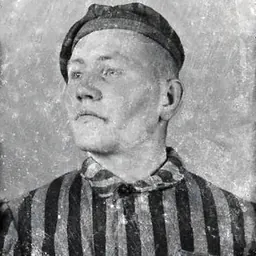
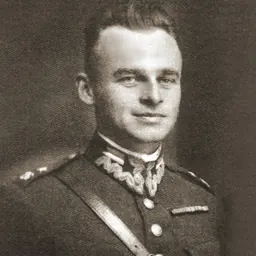
In Auschwitz, he was assigned the camp number 6438. As a prisoner, he first worked on road construction in the so-called Strassenbaukommando, and later in the SS warehouses located in the former Tobacco Monopoly buildings (Hauptwirtschaftslager, or HWL). In 1941, he contracted typhus but managed to recover. His family made unsuccessful attempts to have him released from the camp by appealing to the German authorities. During his time in Auschwitz, Jaster joined the underground Military Organization Union, formed by cavalry officer Witold Pilecki. He did not abandon his passion for painting.
One of the prisoners working in the HWL garages was . In the spring of 1942, the Politische Abteilung (the camp Gestapo) placed him on a list of people scheduled for execution, but the sentence was postponed due to the need for Bendera to finish repairing several cars. With nothing to lose, he decided to risk escaping from the camp. Ultimately, Stanisław Jaster joined the group. His selection was based on his acquaintance with Piechowski and the good reputation he enjoyed among fellow prisoners. the four conspirators, posing as members of the Rollwagenkommando, made their way near the HWL warehouses. Bendera opened the garage with a counterfeit key, while his companions entered the HWL basement through a previously loosened manhole cover into the coke bunker. Using forged keys, they opened the boiler room and office, and broke open the door to the armory with a crowbar they found in the basement. In the armory, they dressed in SS uniforms and took rifles, pistols, grenades, ammunition, and food. From the garage, they took an open-top Steyr 220, a car frequently used by the head of HWL, SS-Hauptsturmführer Kreutzmann (some sources, likely erroneously, claim that the vehicle belonged to the camp commandant). They then left the camp without any interference from the Germans and drove southeast. Near Maków Podhalański, the car broke down, forcing the escapees to abandon the vehicle and continue on foot. Soon after, the group split up. It made a significant impression in the camp and had a positive effect on the prisoners' morale. Several wanted posters were issued for the escapees, which included their descriptions. The German authorities also offered a reward of 500,000 PLN for the capture of the escapees or information on their whereabouts. Kazimierz Piechowski, citing Alfons Kiprowski's account, claimed that seven SS officers and non-commissioned officers, who were held responsible for allowing the escape, were punished by being sent to the Eastern Front. who had escaped arrest as he was outside the house during the Gestapo raid. Initially, he was associated with the unit of Lieutenant , codenamed Stasinek, but later he received an official assignment to the Organization of Special Combat Actions (Osa–Kosa 30), which was an elite and deeply covert operational unit of the Commander-in-Chief of the Home Army. He adopted the codename Hel (a reference to a light, low-density gas that "constantly dissipates"). and was involved in organizing a failed assassination of the starosta of Garwolin, Karl Freudenthal. Certain evidence suggests that alongside his service in the ranks of Osa–Kosa 30, he might also have had connections with the organization Wachlarz.
The Jaster brothers hoped to rescue their mother from the Germans. Due to his acquaintance with soldiers from the Grey Ranks, , codenamed Katoda, and Jan Rodowicz, codenamed Anoda, Stanisław took part in a "guest" operation to rescue prisoners near Celestynów (from 19 to 20 May 1943). During the attack on the German transport, he distinguished himself with exceptional courage and composure; contrary to his hopes, however, he did not find his mother among the freed prisoners.
Jaster was aware that by staying in Warsaw, as a person intensely sought by the Gestapo, he was taking great risks. To minimise the danger, he often tried to change his clothing and appearance (for example, he bleached his hair and used dental prosthetics). Being a blond man close to two meters tall, he successfully exploited his "Nordic appearance" to pass as a Gestapo agent in civilian clothes. Over time, he began using false documents issued to "SS-Unterscharführer, Josef Schmidt". The newlyweds, along with the entire wedding party, were taken to Pawiak prison, where, after a quick selection, 56 detainees were held. Most of the captured soldiers from Osa–Kosa 30 were soon executed. The remaining detainees were deported to concentration camps, or their fate remains unknown.
Although Hel had received an invitation, he did not attend the church. After the bust, the brothers immediately moved out of their apartment on Wilanowska Street, and shortly after, the Gestapo showed up there.
Although the surviving soldiers were forbidden from contacting one another, Bogna relayed Jaster's request for a meeting, and Wiktor agreed.
This is the last confirmed information about the fate of Stanisław Jaster. The rumour that Jaster had been accused of treason and executed by the verdict of the Polish Underground was made more credible in the late 1960s in the memoirs of Home Army officers and Emil Kumor. However, these accounts do not provide details of the circumstances of his death. Moreover, no other sources confirm that the Home Army's counterintelligence conducted an investigation into Hel, nor that his case was brought before the Military Special Court. suspected that Jaster's extrajudicial execution was ordered by the aforementioned Captain Szymon, and the sentence was carried out by soldiers from his three-man protective team of the Commander-in-Chief of the Home Army, led by Jerzy Nowakowski, codenamed Jureczek. He was said to have revealed the wedding attendees to the Germans, identified those arrested at Pawiak, and later set a trap for Wiktor.
Kunicki's memoirs sparked a long and emotional debate. The accusations he raised caused significant upheaval among Hel'''s family, friends, and the veteran community. Furthermore, no documents from the Special Military Court of the Home Army contained any records of an investigation into Jaster or a written verdict. He suggested that Jaster's accusers may have mistaken him for another Home Army soldier codenamed Hel, Karol Biskupski. Piotr Stachiewicz (veteran and chronicler of the Parasol Battalion) and one of the last living soldiers of Osa–Kosa 30, Stefan Smarzyński, codenamed Balon, came forward in support of Kunicki. In the article Żołnierz czy konfident? (Soldier or Informant?), published in Polityka in July 1971, they engaged in a polemic with Ambroziewicz and his supporters. They presented the following arguments, which they believed indicated Jaster's guilt:
As many as four soldiers and underground collaborators – Emil Kumor, Józef Saski, codenamed Katoda, , codenamed Kmita, and lawyer Zbigniew Witkowski – received information from Captain Szymon that Hel was a traitor and that his guilt had been indisputably proven during the investigation. The latter group issued numerous letters and statements in his defense, addressed to the press, publishing houses, veteran organizations, and the Auschwitz-Birkenau State Museum. Among those who spoke were two of his fellow escapees from Auschwitz, Józef Lempart and Kazimierz Piechowski, as well as Alfons Kiprowski, a would-be escapee, all of whom categorically denied that the escape could have been staged by the Germans. Leon Wanat sent a letter to the weekly Polityka, in which he affirmed that he was certain he had accurately remembered the informant's appearance.
In response to the mounting criticism, Kunicki was forced to admit that he had not directly participated in the investigation of Jaster and that his information on the matter came from Captain Krzywicki, codenamed Szymon, through third parties, including Emil Kumor (who had also received this information from Szymon via a third party, the artist Łukasz Powoski). Despite the numerous counterarguments presented publicly, the accusations made by Kunicki and Kumor, supported by Smarzyński and Stachiewicz, continued to be repeated in later historical, memoir, and press publications (including in the memoirs of the commander of the Zagra-Lin unit, ).
After a hiatus of several years, the discussion was revived by Adam Cyra, a senior curator at the Auschwitz-Birkenau State Museum, who analyzed German documents and numerous statements that had been submitted to the museum following the publication of Cichy front. Based on this, Cyra published two articles in the weeklies Kierunki (1986) and Panorama (1987), where he presented several pieces of evidence defending Jaster and called for his rehabilitation. In her conclusion, Czarnecka asserted that "there is no strong evidence of Staszek's guilt, and much speaks in his favor", adding that, unless new documents are found, "this case can be considered closed". She also believed that Jaster "fell victim to an underground mistake".
However, Hubert Kuberski disagrees, emphasizing that due to the deaths of key witnesses and the lack of definitive documentary evidence (owing to the destruction of the Warsaw Gestapo archives in August 1944 and insufficient research in German archives), Czarnecka's conclusions can only be considered "weak clues", and a definitive resolution to the question of Jaster's alleged betrayal remains impossible.
Throughout the years of debate, proponents of Jaster's innocence presented the following arguments in his defense:
All the materials that Aleksander Kunicki and Emil Kumor used to accuse Hel came from third parties, with the original source being just one person – Captain Ryszard Jamontt-Krzywicki, codenamed Szymon. A concentration camp prisoner was essentially the "property" of the police organ that sent them to the camp. To recruit Jaster as an informant and fake his escape from Auschwitz, the head of the security police and security service in Warsaw, SS-Obersturmbannführer Ludwig Hahn, would have had to approve it. The lack of preserved German documents, due to their destruction during the Warsaw Uprising, prevents confirmation of the allegation that Jaster was an informant. If Jaster had been a Gestapo informant, the Germans would not have described him as "wanted" in their internal documentation. After his arrest, they would not have referred to him as someone who was arrested, nor would they have canceled the warrants issued for him. Hels connections within the Warsaw underground were extensive, reaching beyond his primary unit, as evidenced by his participation in the Celestynów action. It seems improbable that the Germans would have used such a valuable informant solely to dismantle Osa–Kosa 30. Additionally, there is no evidence that Hel's alleged betrayal led to arrests in other units of the Home Army. The records of the Home Army's Military Special Court do not contain the files from the investigation into Jaster, nor a written verdict. The search only uncovered documents related to the trial of another Home Army soldier with the codename Hel – Karol Biskupski from the Baszta regiment. the German security apparatus dealt a series of painful blows to the Polish Underground State, culminating in the arrest of Home Army Commander-in-Chief General Stefan Rowecki, codenamed Grot, on 30 June 1943. In the atmosphere of "spy mania" that engulfed the Home Army structures at the time, Hel could easily have fallen victim to false accusations and a lynching. This gesture has been interpreted as his symbolic rehabilitation.
Commemoration Stanisław Gustaw Jaster, along with his parents and his brother Andrzej, have been commemorated with symbolic inscriptions on the family tomb at the Evangelical–Augsburg Cemetery in Warsaw.
The fate of Stanisław Gustaw Jaster, codenamed Hel, is the subject of the documentary Jaster. Tajemnica Hela'', directed by and , which premiered on 13 September 2014.
Don’t just read it —
keep it.
Full-length biographies made to live with: read them, listen on the way to work, watch them tonight.
- E-book
- Audio
- Video
Instant download · yours to keep · every purchase keeps this site free
Important facts
People in Stanisław Gustaw Jaster's life
Named in this biography and alive at the same time



Related people
Same field, nearest in time


Contemporaries
People whose lives overlapped Stanisław Gustaw Jaster's




Frequently asked questions
Who was Stanisław Gustaw Jaster?
Polish escapee from Auschwitz (1921–1943)
When was Stanisław Gustaw Jaster born?
Stanisław Gustaw Jaster was born in 1921 in Lviv.
When did Stanisław Gustaw Jaster die?
Stanisław Gustaw Jaster died in 1943 in Warsaw.
What was Stanisław Gustaw Jaster's occupation?
Stanisław Gustaw Jaster was a partisan.
What nationality was Stanisław Gustaw Jaster?
Stanisław Gustaw Jaster was Polish.
Sources & further reading
· Wikipedia: Stanisław Gustaw Jaster
· DBpedia: Stanisław Gustaw Jaster
Cite this page
APA: Biography.guide. (2026). Stanisław Gustaw Jaster. https://biography.guide/stanislaw-gustaw-jaster/
MLA: "Stanisław Gustaw Jaster." Biography.guide, https://biography.guide/stanislaw-gustaw-jaster/.
Chicago: "Stanisław Gustaw Jaster." Biography.guide. https://biography.guide/stanislaw-gustaw-jaster/.
Data last updated: 2026-09-20 · Spot an error? Report a correction.
Page generated 2026-09-27 05:24 UTC