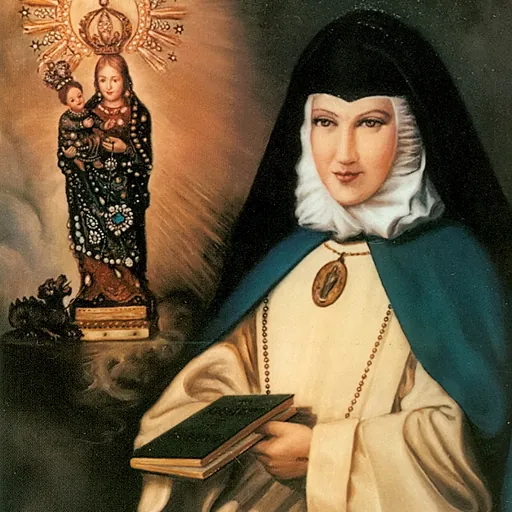
About Sor Patrocinio
Lived 1811 – 1891 (aged 79–80). Sor Patrocinio was a Spanish cloistered nun and nun.
María Rafaela de los Dolores y del Patrocinio, more commonly known as Sor Patrocinio ("Sister Protection", of Mary), also known as "the nun of the wounds" (San Clemente, Cuenca, 1811 – Guadalajara, 1891), was a Spanish nun of the Order of the Immaculate Conception. She was prominent in the Spanish social and political spheres in the second half of the 19th century through her influence over Queen Isabel II and the queen's husband, King Francisco de Asís de Borbón.
Patrocinio's reported mystical experiences and supernatural phenomena have been a source of controversy, at the time and later. She was instrumental in the founding or reform of many monasteries of the Order in both Spain and France. The cause for her beatification is currently being studied by the Holy See.
Early life Patrocinio was born María Josefa de los Dolores Anastasia de Quiroga y Capopardo on 27 April 1811 in San Clemente de la Mancha, in the province of Cuenca, on a farm called Venta del Pinar. Her parents, Diego de Quiroga y Valcárcel and Dolores Capopardo y del Castillo, were members of the royal court in Madrid, who were fleeing the city due to the upheavals of the Spanish War of Independence then taking place, when her mother was overtaken by birth pangs and had to take shelter at the farm.
On the death of Quiroga's father, her impoverished family returned to Madrid. Her mother intended her to marry Salustiano Olózaga, then a young lawyer; but this plan was rejected by Patrocinio herself. The two would later meet again during her trial in 1835, and during her exile in France following the revolutionary events of 1868.
In 1826 Quiroga was sent to the monastery of the nuns of the Order of Santiago in Madrid, under the guidance of her aunt, the Marquesa of Santa Coloma for her education. On 19 January 1829, under the patronage of the Duchess of Benavente, she was admitted as a novice in the Conceptionist Monastery of Caballero de Gracia and received her religious name. That same year, while still a novice, she sustained a wound in the left side, which she understood to be a stigma. On 20 January 1830, she professed religious vows in the Order.
Further mystical experiences
Starting early in 1830, Patrocinio reported mystical visions, many of them with bodily symptoms. On 20 May - Ascension Day - wounds appeared in her hands and feet, resembling those inflicted by the crown of thorns. On 8 June, two days after Corpus Christi day, she fell into an ecstatic state and reported that the voice of Christ spoke to her from a wall hanging. Her wounds were characterised by the large amount of blood that issued from them.
When the death of King Fernando VII in 1833 was followed by the Carlist war, "the clericals, who favoured Don Carlos, saw in her a useful instrument. She was made to prophesy the success of the Pretender (Don Carlos) and to furnish proof of the illegitimacy of the young Queen Isabel". had supplied her with "a relic which, when applied to any part of the body, would cause a wound which would then have to kept open as the source of suffering and mortification as offerings to God as penitence for sins... showing no-one their cause, and if questioned she had to say that they had come to her supernaturally". The dogma she mentions is that of the Immaculate Conception of Mary, which was promulgated on 8 December 1854. Thus Patrocinio, through her social relations at the highest level, had come to exert a theological influence.
Further moves and foundations
To distance her from Madrid and from her perceived influence over the monarchs, in 1852 she was sent to Rome, where her claim to holiness would be examined. However, she became ill during the journey and did not reach Italy. The government then ordered her to move to the Monastery of Poor Clares in Toledo. Later she founded the first school for small girls from poor families, at the Monastery of Montserrat, in Madrid. Then Generals Narváez and Espartero came to power and sent her away to the Poor Clare Monastery of St. Catherine the Martyr in Baeza. The Archbishop of Toledo ordered her to move to a derelict monastery at Torrelavega to re-found it. Having accomplished this mission she embarked on the foundation of new monasteries, of which the first was at Aranjuez. Here she was again the target of an unsuccessful armed attack. As of 2013 there was still a movement to have her made a saint.
Works
Golden Book (Sp. Libro de Oro o Mes de María), Madrid 1860 Letters of Sor Patrocinio in J. Ortega Rubio, Historia de España, VI, Madrid 1908-1910, pp. 386–437 Novena prayer to Christ of the Word (Sp. Novena al Cristo de la Palabra) Novena prayer to Our Lady of Forgetting, Triumph and Mercies (Sp. Novena a Ntra. Sra. del Olvido, Triunfo y Misericordias)
Don’t just read it —
keep it.
Full-length biographies made to live with: read them, listen on the way to work, watch them tonight.
- E-book
- Audio
- Video
Instant download · yours to keep · every purchase keeps this site free
Important facts
Related people
Same field, nearest in time




Contemporaries
People whose lives overlapped Sor Patrocinio's





Frequently asked questions
Who was Sor Patrocinio?
Spanish nun (1811–1891)
When was Sor Patrocinio born?
Sor Patrocinio was born on 27 April 1811 in San Clemente.
When did Sor Patrocinio die?
Sor Patrocinio died in 1891 in Guadalajara.
What was Sor Patrocinio's occupation?
Sor Patrocinio was a cloistered nun and nun.
What nationality was Sor Patrocinio?
Sor Patrocinio was Spanish.
Sources & further reading
Cite this page
APA: Biography.guide. (2026). Sor Patrocinio. https://biography.guide/sor-patrocinio/
MLA: "Sor Patrocinio." Biography.guide, https://biography.guide/sor-patrocinio/.
Chicago: "Sor Patrocinio." Biography.guide. https://biography.guide/sor-patrocinio/.
Data last updated: 2026-09-20 · Spot an error? Report a correction.
Page generated 2026-09-27 05:10 UTC