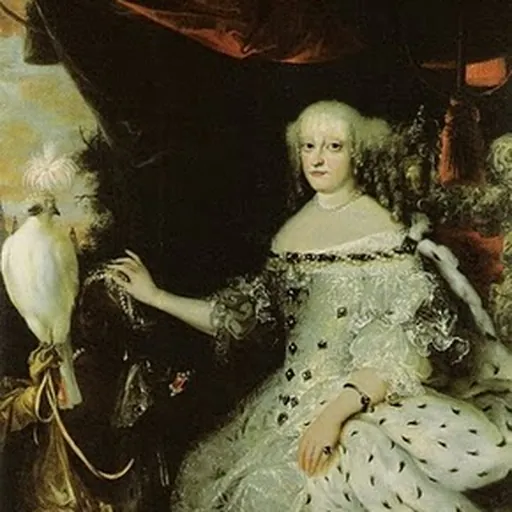
About Sophie Amalie of Brunswick-Lüneburg
Lived 1628 – 1685 (aged 56). Sophie Amalie of Brunswick-Lüneburg was a Danish consort.
Sophie Amalie of Brunswick-Calenberg (24 March 1628 – 20 February 1685) was Queen of Denmark and Norway as the consort of the King Frederick III of Denmark. She is known for her political influence, as well as for her cultural impact: she acted as the adviser of her husband, and introduced ballet and opera to Denmark.
Life Early life Sophie Amalie was born at the Herzberg Castle, in Herzberg am Harz. Her parents were George, Duke of Brunswick-Calenberg, and Anne Eleonore of Hesse-Darmstadt. Nothing is known of her childhood.
Sophie Amalie married Prince Frederick in Castle Glücksburg on 1 October 1643. The marriage was arranged in 1640, as it was considered suitable for the current situation of the groom: he was, at that point, Prince-bishop of Bremen and not heir to the throne, and was not expected to succeed to the throne. It is believed to be a political match, though the exact purpose of it is unknown. They had eight children, including King Christian V of Denmark and Ulrike Eleonora of Denmark who married King Charles XI of Sweden.
The couple settled in Bremen. In 1646–47, they lived in humble circumstances in Flensborg, after having been forced to flee Bremen during the war between Denmark–Norway and Sweden. In 1647, Frederick was elected heir to the Danish throne, and the following year, she followed him to Denmark.
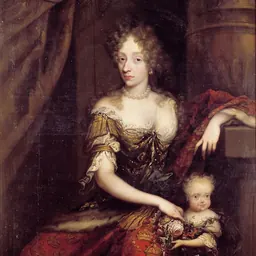
Queen Portrait of Sophie Amalie as queen by an unidentified artist, c. 17th century
In 1648, Frederick and Sophie Amalie became king and queen of Denmark and Norway.
As her husband was introverted, she became the centre of a sumptuous court life, with exclusive luxury items and grand parties, which shed glory on the royal power. Queen Sophie Amalie made a pioneer cultural act in relation to the court parties by replacing the old medieval court entertainments with opera and ballet, which was thus introduced in Denmark by her at the court festivities. She enjoyed fashion, parties and theatre, arranged masquerades and made the French taste fashionable in Denmark. She remodeled the court after a French and German pattern. In 1649, a large order of items arrived for the new court life she arranged, followed also by new staff and new positions. She hired a German chapel master, Kaspar Förster, a French violin orchestra, a French ballet master, D. de Pilloy, and a French court singer and dancer, Anne Chabanceau de La Barre, and a French theatre company was engaged to perform French theater. Sophie Amalie did not understand the Danish language, but spoke German and French, took lessons in singing and dancing by instructors from France and Italy, was dressed by French maids in French fashion, conversed with her children in French and had a French chaplain, and as the first queen of Denmark took a French motto: „En Dieu mon espérance". In 1663, she famously had Leonora Christina Ulfeldt imprisoned in the Blåtårn, and refused to release her as long as she herself was still alive.
While her artistic taste was French, her political views were German-oriented and her influence was feared, especially among the nobility. A characteristic remark was made by nobleman Henrik Bjelke from the first Swedish war: "The king is good, but God save us with honor from here! The queen is not good by any Dane, and she has the king in her power."
Queen Dowager
In 1670, Frederick III died and was succeeded by her eldest son Christian V. Her son the king did what he could to curb her influence in state affairs, which was evidently not easy: in 1671, he wrote to Griffenfeld: "God be praised, the queen dowager has left for Hirsholm today, so I need no longer hear: 'What do I hear now?'"
Despite her son's dislike over her interference, she remained a factor which was taken into consideration in Danish politics, and Griffenfeld was careful to keep in her good graces. It is noted that Griffenfeld assisted her in her ambition to have her younger son Georg elected king of Poland. Griffenfeld and Sophie Amalie also worked in securing peace with Sweden during the Scanian War, as Sophie Amalie wished for peace with Sweden and its ally France because her favorite Catholic brother was Francophile and because she wished for her daughter Ulrika Eleonora to marry the Swedish king. The fall of Griffenfeld was, therefore, a great misfortune for Sophie Amalie and her political position, and it attracted great attention when the queen dowager demonstratively left the capital after the sudden arrest of Griffenfeld. His later pardon is credited with her influence. The Peace of 1680 was a great joy for her, as it resulted in the desired wedding between her daughter and the Swedish king. She accompanied Ulrika Eleonora to Kronborg, but it was noted how she could not make herself to show her daughter the ceremony due to her future rank as queen.
Her relationship to her daughter-in-law Charlotte Amalie was not a good one. Sophie Amalie was reportedly most unwilling to surrender her position as queen and her precedence as the first lady of the court to her daughter-in-law, and was only with great difficulty made to vacate the queen's apartment to her successor. Her daughter-in-law was however not willing to give up her rank, and the precedence conflict between the queen and the queen dowager was prolonged for years: reportedly, the queen dowager demanded that the foreign ambassadors call to be introduced to her first rather than the queen, otherwise, she would have them barred from her court, a situation which created such difficulty that the king sometimes solved the matter by leaving for another palace with his wife so that the queen and the queen dowager would not be present at the same time and thus the rank conflict avoided.
Sophie Amalie is known to have assured the continuing imprisonment of Leonora Christine also as a widow. Upon the accession of Christian V, his wife Charlotte Amalie successfully asked him a promise to release Leonora Christine if the expected child was a son, and when she did give birth to a son in 1671, she called in the promise. When Sophie Amalie was informed, however, she managed to have the king retract his promise by refusing to attend the christening of the crown prince. When Leonora Christine's daughter Ellen Kristine petitioned her for her mother's release, Sophie Amalie successfully asked her son the king to banish Ellen Kristine from the nation.
As queen dowager, Sophie Amalie continued to host a grand court life with many festivities, as she had done as queen. She lived in Sophie Amalienborg in Copenhagen in the winters and at Nykøbing Slot or Hørsholm during the summers. Sophie of Hanover visited her in 1680 and said of her: "If I should praise this queen as she deserved, I would never be finished." She still hosted hunting trips and balls and was described as an avid hunter, and attended masquerade balls at court in costume until her death. When the wedding of her daughter Ulrika Eleonora to the Swedish king was arranged, she welcomed the Swedish envoy Johan Gyllenstierna, who was a known misogynist, with a great banquet, and reportedly, when he entered her palace, there was "no man there, only women and the fairest you could imagine. As a wise man, he soon realized that it was deliberately, as he was unmarried, and the rumour had it, that he could abide no female."
She died in Copenhagen and was buried in the Roskilde Cathedral. After her death, Leonora Christina Ulfeldt was finally released, after twenty-two years of imprisonment.
Issue
Don’t just read it —
keep it.
Full-length biographies made to live with: read them, listen on the way to work, watch them tonight.
- E-book
- Audio
- Video
Instant download · yours to keep · every purchase keeps this site free
Important facts
Family & relationships
People in Sophie Amalie of Brunswick-Lüneburg's life
Named in this biography and alive at the same time


Related people
Same field, nearest in time




Contemporaries
People whose lives overlapped Sophie Amalie of Brunswick-Lüneburg's






Frequently asked questions
Who was Sophie Amalie of Brunswick-Lüneburg?
Queen consort of Denmark and Norway (1628–1685)
When was Sophie Amalie of Brunswick-Lüneburg born?
Sophie Amalie of Brunswick-Lüneburg was born on 24 March 1628 in Herzberg am Harz.
When did Sophie Amalie of Brunswick-Lüneburg die?
Sophie Amalie of Brunswick-Lüneburg died on 20 February 1685 in Copenhagen.
What was Sophie Amalie of Brunswick-Lüneburg's occupation?
Sophie Amalie of Brunswick-Lüneburg was a consort.
What nationality was Sophie Amalie of Brunswick-Lüneburg?
Sophie Amalie of Brunswick-Lüneburg was Danish.
Sources & further reading
· Wikipedia: Sophie Amalie of Brunswick-Lüneburg
· DBpedia: Sophie Amalie of Brunswick-Calenberg
Cite this page
APA: Biography.guide. (2026). Sophie Amalie of Brunswick-Lüneburg. https://biography.guide/sophie-amalie-of-brunswick-luneburg/
MLA: "Sophie Amalie of Brunswick-Lüneburg." Biography.guide, https://biography.guide/sophie-amalie-of-brunswick-luneburg/.
Chicago: "Sophie Amalie of Brunswick-Lüneburg." Biography.guide. https://biography.guide/sophie-amalie-of-brunswick-luneburg/.
Data last updated: 2026-09-26 · Spot an error? Report a correction.
Portrait: Wikimedia Commons · author & licence
Page generated 2026-10-04 11:21 UTC