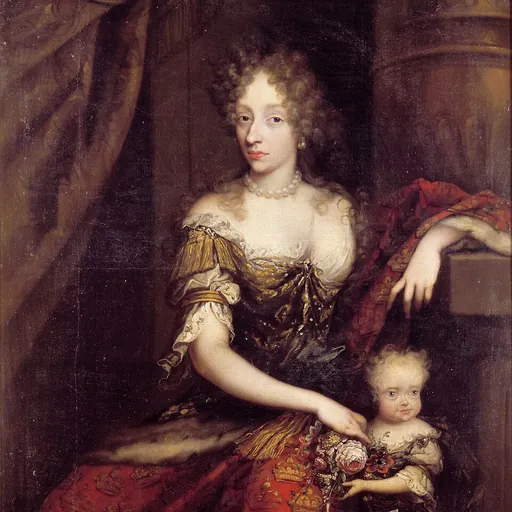
About Charlotte Amalie of Hesse-Kassel
Lived 1650 – 1714 (aged 63). Charlotte Amalie of Hesse-Kassel was a Danish consort.
Charlotte Amalie of Hesse-Kassel (27 April 1650 – 27 March 1714) was Queen of Denmark and Norway by marriage to King Christian V. Although she did not have much political influence, she was a successful businesswoman in her many estates and protected foreign Protestant non-Lutherans from oppression. She gained popularity for defending Copenhagen from Swedish forces in 1700. The city of Charlotte Amalie was named after her in 1691.
Early life Charlotte Amalie was born on 27 April 1650, in Kassel, Hesse, Germany. Her parents were William VI, Landgrave of Hesse-Kassel and Hedwig Sophia of Brandenburg. Her mother was a religiously strict adherent of the Reformed Church and politically oriented toward Brandenburg, both views which were to be shared by her daughter. She was well educated in finances, geography, the languages German, French and Italian, and philosophy. French was to be her preferred written language, though she spoke German with her more intimate friends.
Crown Prince Christian of Denmark and Norway was sent to meet Charlotte Amalie in Hesse in 1665 as a marriage prospect arranged by Danish Queen Sophie Amalie, who desired a daughter-in-law that she could control and expected this to be the case for a member of the reformed church who would be religiously isolated in Lutheran Denmark. She chose the motto and was described as a popular queen. According to English ambassador Molesworth: "Her great excellence assures her of the hearts of her subjects, even though she doesn't share their religion. [...] she is an safe haven for the suffering destitute, who are never disappointed when appealing to her." She was supported in her tolerance by businesspeople, who saw the need of the qualifications of the immigrants, and was opposed by the conservative church, who regarded all non-Lutherans as an affront to the King and God, a view which her husband did lean somewhat towards himself. The law of 1685, in which immigrants of Protestant of churches were granted the privilege of a certain degree of freedom of religion, are attributed to the efforts of Charlotte Amalie, who served as the spokesperson of the foreign Protestant non-Lutherans. She supported the foundation of one French and one German Protestant church with her own funds, even including the congregations in her will.
Court of the Queen Charlotte Amalie of Hesse-Kassel with her court dwarf in 1690. Charlotte Amalie enjoyed the frequent courtly parties, balls, masquerades and representation which court life demanded, brushing away the strict religious scruples voiced by her sister-in-law Ulrika Eleonora as nonsense. She sometimes arranged private parties herself, such as the spontaneously for her court dwarf Frøken Elsebe. Described as charming and entertaining in social life, the Queen had many friends, such as Juliane Elisabeth von Wallenstein, Dorothea Justina Haxthausen and, particularly, her favorite lady-in-waiting and Huguenot relative princess Charlotte Amélie de la Trémoille.
The relationship between Charlotte Amalie and Christian V are described as a mutually respectful friendship instead of a love affair, but both enjoyed each other's company and coexisted harmoniously. In 1672, her husband entered into a permanent love affair to Sophie Amalie Moth, who made the official mistress in Denmark, a public adultery that caused an embarrassing situation for Charlotte Amalie. Nevertheless, "no mistress could deprive her of her position as Queen, and she understood how to defend it"; Charlotte Amalie made the most of her position as Queen, both in public representational life as in her private interactions with the King. It is noted how she was always accompanied him on journeys, on hunting, in warfare, and even at playing cards late in to the evenings. She was present during the Battle of Wismar, riding at the King's side "dressed as an amazon", and accompanied her husband in Sweden during the Scanian War.
Charlotte Amalie is described as a devoted and considered mother and grandmother who was close to her family. However, she did not have a good relationship with her mother-in-law, who wished to keep her precedence and position as first lady of the court despite being a queen dowager. One reason for the animosity was because she unsuccessfully requested the release of her aunt-in-law Leonora Christina Ulfeldt, and were known to have sent gifts to ease Ulfeldt's imprisonment, something which was resented by her mother-in-law, who regarded Ulfeldt a personal enemy.
Queen Dowager Charlottenborg Palace, Dowager Queen Charlotte Amelie's winter residence. In 1699, Charlotte Amalie was widowed. She did not threaten the position of her daughter-in-law at court as her mother-in-law had done. It is reported that she grieved over her son's bigamy, but she did not voice any criticism to him directly. She kept a separate court and made several journeys, particularly to Germany, where she spent 1711–1713 in Oldenburg. The Queen Dowager resided in Charlottenborg Palace, which is named after her, during the winter and in Nykøbing Slot during the summer. She was protector of the famous Marie Grubbe after Grubbe's divorce and remarriage, which had made the new couple social outcasts. They were given refuge by the queen dowager, who allowed them to live in her own dower lands.
In 1700, Copenhagen was attacked by King Charles XII of Sweden during the invasion Zealand. On 13 July, Charlotte Amalie wrote to her friend Dorothea Justina Haxthausen: "I have the pleasure – or if you wish, the opposite – of seeing the fleets of four potentates outside my window. I hope they will disperse without bloodshed", when the Danish fleet was attacked by the Swedish, English and Dutch fleet, followed by the landing of the enemy at Humlebæk. The capital was unprepared for attack, the King was absent in the Duchies, and the city commander Schack could not handle the situation. During this incident, the Queen Dowager strengthened the resolve of the people and helped to organize the defense by convincing the city commandant to give the people access to the cannons and successfully asking the garrison to protect the capital out of loyalty, while she would herself stay and die with them if need be. For this act, she was hailed as a heroine.
Charlotte Amalie died of scarlet fever in Charlottenborg on 27 March 1714, at the age of 63. She was "heartily grieved by many". and buried in Roskilde Cathedral. Her winter residence has housed the Royal Danish Academy of Art since 1754.
Legacy The city of Charlotte Amalie on St. Thomas, U.S. Virgin Islands is named after her.
Issue
Ancestry
Don’t just read it —
keep it.
Full-length biographies made to live with: read them, listen on the way to work, watch them tonight.
- E-book
- Audio
- Video
Instant download · yours to keep · every purchase keeps this site free
Important facts
Family & relationships
People in Charlotte Amalie of Hesse-Kassel's life
Named in this biography and alive at the same time


Related people
Same field, nearest in time




Contemporaries
People whose lives overlapped Charlotte Amalie of Hesse-Kassel's





Frequently asked questions
Who was Charlotte Amalie of Hesse-Kassel?
Queen consort of Denmark and Norway (1650-1714)
When was Charlotte Amalie of Hesse-Kassel born?
Charlotte Amalie of Hesse-Kassel was born on 27 April 1650 in Kassel.
When did Charlotte Amalie of Hesse-Kassel die?
Charlotte Amalie of Hesse-Kassel died on 27 March 1714 in Charlottenborg Palace.
What was Charlotte Amalie of Hesse-Kassel's occupation?
Charlotte Amalie of Hesse-Kassel was a consort.
What nationality was Charlotte Amalie of Hesse-Kassel?
Charlotte Amalie of Hesse-Kassel was Danish.
Sources & further reading
· Wikipedia: Charlotte Amalie of Hesse-Kassel
· DBpedia: Charlotte Amalie of Hesse-Kassel
Cite this page
APA: Biography.guide. (2026). Charlotte Amalie of Hesse-Kassel. https://biography.guide/charlotte-amalie-of-hesse-kassel/
MLA: "Charlotte Amalie of Hesse-Kassel." Biography.guide, https://biography.guide/charlotte-amalie-of-hesse-kassel/.
Chicago: "Charlotte Amalie of Hesse-Kassel." Biography.guide. https://biography.guide/charlotte-amalie-of-hesse-kassel/.
Data last updated: 2026-09-23 · Spot an error? Report a correction.
Portrait: Wikimedia Commons · author & licence
Page generated 2026-09-27 05:06 UTC