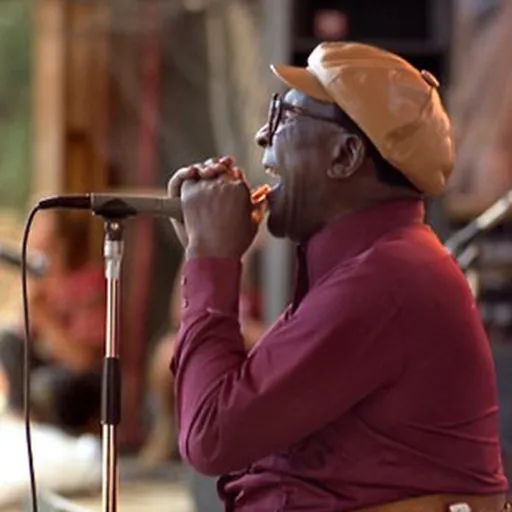
About Sonny Terry
Lived 1911 – 1986 (aged 74). Sonny Terry was an American blues musician, harmonicist, singer, musician and composer.
Saunders Terrell (October 24, 1911 – March 11, 1986), known as Sonny Terry, was an American Piedmont blues and folk musician, who was known for his energetic blues harmonica style, which frequently included vocal whoops and hollers and occasionally imitations of trains and fox hunts.
Early life
Terry was born in Greensboro, Georgia. His father, a farmer, taught him to play basic blues harp as a youth. He sustained injuries to his eyes and went blind by the time he was 16, which prevented him from doing farm work, Terry played "Camptown Races" to the plow horses which improved the efficiency of farming in the area. He began playing blues in Shelby, North Carolina.
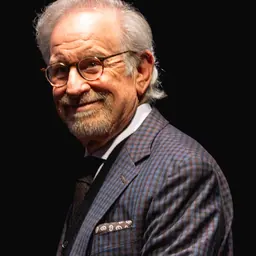
Career After his father died, he began playing with Piedmont blues–style guitarist Blind Boy Fuller. With McGhee, he appeared in the 1979 Steve Martin comedy The Jerk. Terry also appeared in the 1985 film The Color Purple, directed by Steven Spielberg. Terry collaborated with Ry Cooder on "Walkin' Away Blues", and also performed a cover of Robert Johnson's "Crossroad Blues" for the 1986 film Crossroads.
Terry and McGhee were both recipients of a 1982 National Heritage Fellowship awarded by the National Endowment for the Arts, which is the United States government's highest honor in the folk and traditional arts. That year's fellowships were the first bestowed by the NEA.
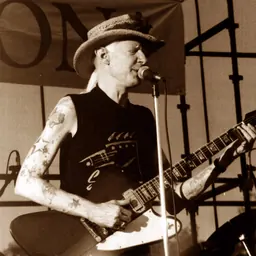
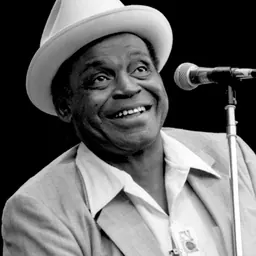
Death Terry died of natural causes in Mineola, New York, in March 1986, three days before Crossroads was released in theaters. He was inducted into the Blues Hall of Fame in the same year. Sing & Play (Society, 1966) A Long Way from Home (BluesWay, 1969) I Couldn't Believe My Eyes (BluesWay, 1969 ) Sonny & Brownie (A&M Records, 1973) Back to New Orleans (Fantasy, 1973) -- album is a re-release of Down Home Blues and Blues in My Soul Robbin' the Grave (Blue Labor, 1974) Whoopin', with Johnny Winter and Willie Dixon (Alligator, 1984) Brownie McGhee and Sonny Terry Sing (Smithsonian Folkways, 1990) Whoopin' the Blues: The Capitol Recordings, 1947–1950 (Capitol, 1995)
Don’t just read it —
keep it.
Full-length biographies made to live with: read them, listen on the way to work, watch them tonight.
- E-book
- Audio
- Video
Instant download · yours to keep · every purchase keeps this site free
Important facts
People in Sonny Terry's life
Named in this biography and alive at the same time



Related people
Same field, nearest in time




Contemporaries
People whose lives overlapped Sonny Terry's




Frequently asked questions
Who was Sonny Terry?
American Piedmont blues musician (1911–1986)
When was Sonny Terry born?
Sonny Terry was born on 24 October 1911 in Greensboro.
When did Sonny Terry die?
Sonny Terry died on 11 March 1986 in Mineola.
What was Sonny Terry's occupation?
Sonny Terry was a blues musician, harmonicist, singer, musician and composer.
What nationality was Sonny Terry?
Sonny Terry was American.
Sources & further reading
Cite this page
APA: Biography.guide. (2026). Sonny Terry. https://biography.guide/sonny-terry/
MLA: "Sonny Terry." Biography.guide, https://biography.guide/sonny-terry/.
Chicago: "Sonny Terry." Biography.guide. https://biography.guide/sonny-terry/.
Data last updated: 2026-09-21 · Spot an error? Report a correction.
Portrait: Wikimedia Commons · author & licence
Page generated 2026-09-27 04:59 UTC