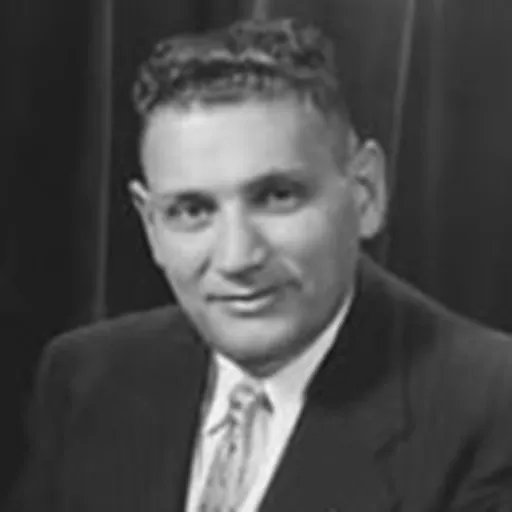
Solomon Kullback
American mathematician and cryptanalyst
About Solomon Kullback
Lived 1907 – 1994 (aged 87). Solomon Kullback was an American mathematician, cryptologist, statistician and university teacher, known for Information theory and Kullback–Leibler divergence.
Solomon Kullback (April 3, 1907 – August 5, 1994) was an American cryptanalyst and mathematician, who was one of the first three employees hired by William F. Friedman at the US Army's Signal Intelligence Service (SIS) in the 1930s, along with Frank Rowlett and Abraham Sinkov. He went on to a long and distinguished career at SIS and its eventual successor, the National Security Agency (NSA). Kullback was the Chief Scientist at the NSA until his retirement in 1962, whereupon he took a position at the George Washington University.
The Kullback–Leibler divergence is named after Kullback and Richard Leibler.
Life and career Kullback was born to Jewish parents in Brooklyn, New York. His father Nathan had been born in Vilna, Russian Empire, (now Vilnius, Lithuania) and had immigrated to the US as a young man circa 1905, and became a naturalized American in 1911. Kullback attended Boys High School in Brooklyn. He then went to City College of New York, graduating with a BA in 1927 and an MA in math in 1929. He learned at Bletchley Park that the British were producing intelligence of high quality by exploiting the Enigma machine. He also cooperated with the British in the solution of more conventional German codebook-based systems. Shortly after his return to the States, Kullback moved into the Japanese section as its chief.
When the National Security Agency (NSA) was formed in 1952, Rowlett became chief of cryptanalysis. The primary problem facing research and development in the post-war period was development of high-speed processing equipment. Kullback supervised a team of about 60 people, including such innovative thinkers in automated data processing development as Leo Rosen and Sam Snyder. His staff pioneered new forms of input and memory, such as magnetic tape and drum memory, and compilers to make machines truly "multi-purpose". Kullback gave priority to using computers to generate communications security (COMSEC) materials.
Kullback's book Information Theory and Statistics was published by John Wiley & Sons in 1959. The book was republished, with additions and corrections, by Dover Publications in 1968.
Retirement Solomon Kullback retired from NSA in 1962, and focused on his teaching at George Washington University and publishing new papers. In 1963 he was elected as a Fellow of the American Statistical Association. He reached the rank of colonel, and was inducted into the Military Intelligence Hall of Fame.
Kullback is remembered by his colleagues at NSA as straightforward; one described him as "totally guileless, you always knew where you stood with him." One former NSA senior recalled him as a man of unlimited energy and enthusiasm and a man whose judgment was usually "sound and right."
Don’t just read it —
keep it.
Full-length biographies made to live with: read them, listen on the way to work, watch them tonight.
- E-book
- Audio
- Video
Instant download · yours to keep · every purchase keeps this site free
Important facts
People in Solomon Kullback's life
Named in this biography and alive at the same time





Related people
Same field, nearest in time



Contemporaries
People whose lives overlapped Solomon Kullback's



Frequently asked questions
Who was Solomon Kullback?
American mathematician and cryptanalyst (1907-1994)
When was Solomon Kullback born?
Solomon Kullback was born on 3 April 1907 in Brooklyn.
When did Solomon Kullback die?
Solomon Kullback died on 5 August 1994 in Boynton Beach.
What was Solomon Kullback's occupation?
Solomon Kullback was a mathematician, cryptologist, statistician and university teacher.
What was Solomon Kullback known for?
Solomon Kullback was known for Information theory and Kullback–Leibler divergence.
What nationality was Solomon Kullback?
Solomon Kullback was American.
Sources & further reading
Cite this page
APA: Biography.guide. (2026). Solomon Kullback. https://biography.guide/solomon-kullback/
MLA: "Solomon Kullback." Biography.guide, https://biography.guide/solomon-kullback/.
Chicago: "Solomon Kullback." Biography.guide. https://biography.guide/solomon-kullback/.
Data last updated: 2026-09-22 · Spot an error? Report a correction.
Portrait: Wikimedia Commons · author & licence
Page generated 2026-09-27 05:02 UTC