
About Sir William Clarke, 1st Baronet
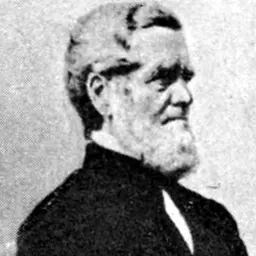
Lived 1831 – 1897 (aged 66). Sir William Clarke, 1st Baronet was an Australian politician, farmer and philanthropist.
Sir William John Clarke, 1st Baronet (31 March 1831 – 15 May 1897), was an Australian businessman and philanthropist in the Colony of Victoria. He was raised to the baronetage in 1882, the first Victorian to be granted a hereditary honour.
Clarke was born in Van Diemen's Land, the son of the pastoralist William John Turner Clarke. He arrived in the Port Phillip District (the future Victoria) in 1850, where he managed many of his father's properties and acquired some of his own. Upon his father's death in 1874, he became the largest landowner in the colony. Clarke was made a baronet for his work as the head of the Melbourne International Exhibition, which brought Australia to international attention. He also served terms as president of the Australian Club, president of the Victorian Football Association, and president of the Melbourne Cricket Club, and was prominent in yachting and horse racing circles. Clarke gave generously to charitable organisations, and also made significant financial contributions to the Anglican Diocese of Melbourne and the University of Melbourne. He was a member of the Victorian Legislative Council from 1878 until 1897, although he was not particularly active in politics.
Early life Clarke was born at Lovely Banks (one of his father's properties, near Jericho) in Van Diemen's Land (later renamed Tasmania), the eldest of three sons of William John Turner Clarke and his wife Eliza (née Dowling).
In 1862 Clarke assumed the management of his father's concerns in Victoria. His father died 1874, and Clarke inherited the bulk of the family's estates on the Australian mainland; his inheritance from his father exceeded £1,500,000 and rendered the younger Clarke as the largest landowner in the Colony of Victoria. Amongst Sir William Clarke's other public donations are the gift of £2000 to the Indian Famine Relief Fund, of £10,000 towards building the Anglican Cathedral at Melbourne, and of £7,000 to Trinity College, Melbourne University.
He was the inaugural president of the Victorian Football Association, presiding from 1877 until 1882.
Clarke was a very prominent Victorian Freemason and was elected provincial grand master of the Irish Constitution in 1881 and then district grand master of both the Scottish and English Constitutions in 1884. In 1889 he became the very first Most Worshipful Grand Master of the United Grand Lodge of Victoria, an amalgamation of the three bodies that had operated at that time under their own constitutions. In 1885 he had largely financed the building of the Freemasons' Hall at 25 Collins Street. Monument to Sir William Clarke, 1st Baronet in the Treasury Gardens in East Melbourne, Victoria.
Personal life and family Clarke was married twice; he first married Mary Walker, daughter of Victorian Politician The Hon. John Walker, on 23 November 1860. Alice Blanche Clarke (4 August 1862 - 1940), who married Chessborough Falconar John Macdonald of Falcon Manor, Towcester, Northamptonshire and Wantabadgery Station, Wagga Wagga, in 1887. Claude Keith MacDonald (1889 - 1915) William Ian MacDonald (1890 - 1937) Queenie Mary MacDonald (1896 - 1968) Rupert Turner Havelock Clarke (16 March 1865 - 1926) who succeeded his father to the Clarke of Rupertswood Baronetcy in 1897. He first married Aimee Mary Cumming (daughter of Victorian Politician The Hon. Thonas Forrest Cumming); the marriage produced two daughters before the couple divorced in 1909.
Mary Clarke died in 1871; Clarke remarried on 21 January 1873 to Janet Marian Snodgrass. Janet was the daughter of Victorian pastoralist and politician The Hon. Peter Snodgrass; Mary Janet Clarke (25 December 1874 - 1960), who married Major The Hon. Robert Lindsay, third son of James Lindsay, 26th Earl of Crawford, in 1903. Joyce Emily Lindsay (1904 - 1998) who married Sir Martin Lindsay, 1st Baronet in 1932, and later divorced in 1967. Robert William Ludovic Lindsay OBE MP (1905 - 2000), who married his first cousin Rosemary Knox in 1946, and served as the Member for Flinders in the Australian House of Representatives from 1954 to 1966. Rosemary Jean Aline Lindsay (1908 - 1968) who married William Charles Ayshford Sanford of Nynehead Court, Somerset in 1928, and later divorced in 1951. William Lionel Russell Clarke (31 March 1876 - 1954), who sold his father's country estate Rupertswood in 1922. He married Florence Douglas Mackenzie in 1908. John Russell Clarke (15 December 1909 - 1963) Janet Marjorie Nina Clarke (b. 3 November 1911) Michael Alastair Clarke (1915 - 2002) who married Helen Rosalind Lewis, daughter of Industrialist and Department of Munitions Director-General Essington Lewis in 1948. Agnes Petrea Josephine Clarke (3 September 1877 - 20 March 1879) Francis Grenville Clarke (14 March 1879 - 1955), who married his cousin Nina Ellis Cotton. He served in the Victorian Legislative Council for 42 years, including 20 as President of the Victorian Legislative Council. He was made a Knight Commander of the Order of the British Empire in 1926, and was thereafter known as Sir Frank Clarke. John Holywell Clarke (1902 - 1918) Margaret Mary Clarke (b. 1904) married John Egerton Oldham in 1933 (divorced 1952) Patricia Kathleen Clarke (1906 - 1973) married Raymond Vincent O’Burne William Antony Francis Clarke (1908 – 1953) who married Jessie Deakin Brookes, a granddaughter of three-time Australian Prime Minister Alfred Deakin Colin Grenville Clarke (1914 – 1962) married Elizabeth Lennox Spiers Valerie Janet Cotton Clarke (1920 – 1977) married Robert John Southey Reginald Hastings Clarke (26 October 1880 - 1914), who married Ernestine Maud Govett. Joan Rosemary Clarke (1908 - ) Reginald Clive Neville Clarke (29 Sept 1910 - 1964) Elizabeth Ernestine Hasting Clarke (1914 - ) Lily Vera Montague Douglas Clarke (21 September 1883 - 1949), who married Major George Landale in 1911. Janet Landale (1912 – 1989) who married Robert Morton. Ivy Victoria Clarke (2 October 1887 - 1962), David William Robert Knox (1916 – 1995) Keith Robert Knox (1919 – 1946) Rosemary Catherine Marion Knox (1920 – 2011), who married her first-cousin Robert William Ludovic Lindsay in 1946.
Later life
In 1876, Clarke and his family moved into Rupertswood, a large country mansion he had built near Sunbury. His city residence was Cliveden, an equally massive mansion in East Melbourne that was completed in 1888 at a cost of £91,000.
Clarke was created a baronet in 1882, by Queen Victoria in recognition for his many donations and for his presiding over the Melbourne International Exhibition in 1880.
During the later decades of the nineteenth century, Sir William and his second wife Janet, Lady Clarke were prominent in Melbourne's high society, and were known for their lavish hospitality, hosting frequent balls, luncheons, dinners, and garden parties.
Clarke died at Melbourne on 15 May 1897. His son Rupert succeeded him as the 2nd Baronet. The baronetcy of Clarke of Rupertswood is one of only two active hereditary titles in an Australian family.
The valuation of Sir William's estate for probate included £418,896 in the Colony of Victoria, and £171,083 outside of the Colony. The total value of his estate was estimated to be well in excess of £1,000,000.
Clarke was a household name in Victoria.
Footnotes
Don’t just read it —
keep it.
Full-length biographies made to live with: read them, listen on the way to work, watch them tonight.
- E-book
- Audio
- Video
Instant download · yours to keep · every purchase keeps this site free
Important facts
Family & relationships
People in Sir William Clarke, 1st Baronet's life
Named in this biography and alive at the same time




Related people
Same field, nearest in time



Contemporaries
People whose lives overlapped Sir William Clarke, 1st Baronet's





Frequently asked questions
Who was Sir William Clarke, 1st Baronet?
Australian politician (1831–1897)
When was Sir William Clarke, 1st Baronet born?
Sir William Clarke, 1st Baronet was born on 31 March 1831 in Jericho, Tasmania, Van Diemen's Land.
When did Sir William Clarke, 1st Baronet die?
Sir William Clarke, 1st Baronet died on 15 May 1897 in East Melbourne.
What was Sir William Clarke, 1st Baronet's occupation?
Sir William Clarke, 1st Baronet was a politician, farmer and philanthropist.
What nationality was Sir William Clarke, 1st Baronet?
Sir William Clarke, 1st Baronet was Australian.
Sources & further reading
· Wikipedia: Sir William Clarke, 1st Baronet
· DBpedia: Sir William Clarke, 1st Baronet
Cite this page
APA: Biography.guide. (2026). Sir William Clarke, 1st Baronet. https://biography.guide/sir-william-clarke-1st-baronet/
MLA: "Sir William Clarke, 1st Baronet." Biography.guide, https://biography.guide/sir-william-clarke-1st-baronet/.
Chicago: "Sir William Clarke, 1st Baronet." Biography.guide. https://biography.guide/sir-william-clarke-1st-baronet/.
Data last updated: 2026-09-20 · Spot an error? Report a correction.
Page generated 2026-09-27 05:23 UTC