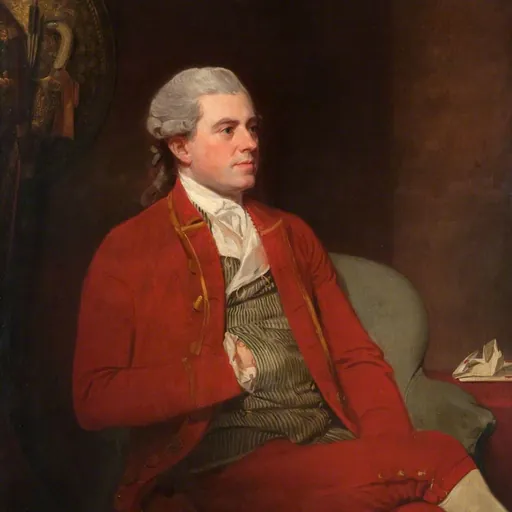
About Sir Thomas Rumbold, 1st Baronet
Lived 1736 – 1791 (aged 55). Sir Thomas Rumbold, 1st Baronet was a politician.
Sir Thomas Rumbold, 1st Baronet (15 January 1736 – 11 November 1791) was a British administrator in India and politician who sat in the House of Commons between 1770 and 1790. He served as Governor of Madras from 1777 to 1780. He became infamous for his corruption and, for in effect stealing, the ring of the Nawab of Arcot. He brought home from India 1.5 million pagodas (a pagoda was worth eight shillings) or about £600,000 (at that time) and was a classic example of a nabob. Attempts were made to investigate the misdemeanour by Henry Dundas but the case did not make much headway.
Life Rumbold was the third son of William Rumbold, an officer of the East India Company's naval service. He joined the company's service as a writer at the age of 16, then transferred to the company's military service. Promoted to captain in 1757, he served as Clive's aide-de-camp at the Battle of Plassey. He subsequently transferred back to the Civil Service, becoming chief at Patna in 1763 and a member of the Bengal Council from 1766 to 1769; he was mentioned as a possible Governor of Bengal in 1771, but Warren Hastings was appointed.
In 1769 Rumbold returned to Britain with a large fortune, knowing the importance of parliamentary influence in the internal politics of the East India Company. He was elected to Parliament in 1770, initially as MP for New Shoreham, a notoriously corrupt and expensive borough where he probably bribed extensively. He received the majority of the votes, but so many were disallowed by the returning officer on grounds of bribery that he was defeated; however, on petition the result was overturned and Rumbold declared duly elected. Initially he voted with the opposition but by 1773 had joined his former commander, Clive, in supporting the government and its conduct of Indian affairs. Rumbold married Joanna Law in 1772. Portrait attributed to Richard Cosway At the next election, in 1774, Rumbold was embroiled in another election-bribery scandal at Shaftesbury: he and Sir Francis Sykes were initially declared elected, but their defeated opponent petitioned to have the result overturned and produced copious evidence of corruption. Rumbold and Sykes were both shown to have bribed at a rate of 20 guineas (£21) a man, the total spent amounting to several thousand pounds. The Commons Committee not only overturned the election result, but ordered that Sykes, Rumbold, and a long list of other inhabitants of the town should be prosecuted by the Attorney General for bribery and perjury. However, the prosecution never took place, and the Commons was eventually persuaded to reverse its condemnations of Sykes and Rumbold so that both were able to stand for the same borough at the next general election, in 1780.
Rumbold continued as an MP until 1790, and died the following year.
Rumbold was painted by: Gainsborough. "Thomas Rumbold and his Son": Victoria Art Gallery. Reynolds. Art Institute of Chicago. Romney (a portrait in the Hunterian Art Gallery),
Descendants His oldest son, William Richard Rumbold having pre-deceased him, he was succeeded as baronet by his son George, a diplomat. Another son, Charles, served as MP for Great Yarmouth. His daughter Elizabeth Anne attempted to restore the reputation of her father in a book published posthumously in 1868.
Don’t just read it —
keep it.
Full-length biographies made to live with: read them, listen on the way to work, watch them tonight.
- E-book
- Audio
- Video
Instant download · yours to keep · every purchase keeps this site free
Important facts
People in Sir Thomas Rumbold, 1st Baronet's life
Named in this biography and alive at the same time

Related people
Same field, nearest in time



Contemporaries
People whose lives overlapped Sir Thomas Rumbold, 1st Baronet's






Frequently asked questions
Who was Sir Thomas Rumbold, 1st Baronet?
British politician
When was Sir Thomas Rumbold, 1st Baronet born?
Sir Thomas Rumbold, 1st Baronet was born on 15 January 1736.
When did Sir Thomas Rumbold, 1st Baronet die?
Sir Thomas Rumbold, 1st Baronet died on 11 November 1791.
What was Sir Thomas Rumbold, 1st Baronet's occupation?
Sir Thomas Rumbold, 1st Baronet was a politician.
Sources & further reading
· Wikipedia: Sir Thomas Rumbold, 1st Baronet
Cite this page
APA: Biography.guide. (2026). Sir Thomas Rumbold, 1st Baronet. https://biography.guide/sir-thomas-rumbold-1st-baronet/
MLA: "Sir Thomas Rumbold, 1st Baronet." Biography.guide, https://biography.guide/sir-thomas-rumbold-1st-baronet/.
Chicago: "Sir Thomas Rumbold, 1st Baronet." Biography.guide. https://biography.guide/sir-thomas-rumbold-1st-baronet/.
Data last updated: 2026-09-23 · Spot an error? Report a correction.
Portrait: Wikimedia Commons · author & licence
Page generated 2026-09-27 05:08 UTC