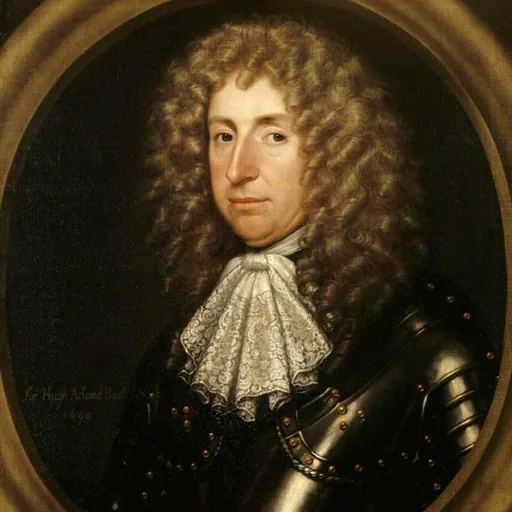
About Sir Hugh Acland, 5th Baronet
Lived 1639 – 1714 (aged 74–75). Sir Hugh Acland, 5th Baronet was an English politician.
Sir Hugh Acland, 5th Baronet ( – 9 March 1714) was an English politician. He obtained a confirmation of the family baronetcy in 1678, and served as a Member of Parliament for two boroughs in Devon in 1679 and from 1685 to 1687. Never very active in national politics, he was one of the many Tories estranged by James II's pro-Catholicism, but remained a Tory after the Glorious Revolution. He continued to hold local office in Devon off and on until his death in 1714, when he was succeeded by his grandson.
Career He was a younger son of Sir John Acland, 1st Baronet and his wife Elizabeth. He matriculated at Exeter College, Oxford on 27 November 1652 and received his B.A. on 22 June 1655.
He was appointed a justice of the peace for Devon in 1670, and in 1672, he succeeded his nephew Arthur as baronet and inherited an estate worth £2,000 per year. In 1673, he was appointed a commissioner for assessment in Devon, and unsuccessfully contested a by-election at Tiverton following the death of Sir Thomas Carew, 1st Baronet. He was appointed to the commission on recusants in 1675 and made a freeman of Exeter; in 1676, he was appointed a deputy lieutenant of the county.
The family baronetcy was of somewhat uncertain status; the letters patent to his father were either lost during the confusion of the English Civil War or never passed the seals. Sir Hugh's predecessors in the baronetcy had generally died in their minorities and had not pursued the claim. Hugh obtained new letters patent dated 21 January 1678 which confirmed the original grant and granted precedence to the baronetcy of the original date of issue, 24 June 1644. In July 1688 he joined with many of the Devonshire gentry in repeating the temporizing answer given by Sir Edward Seymour to the "Three Questions" of James II, and was consequently dismissed from his county offices. John Acland (c. 1674 – 1703) Hugh Acland Rev. Thomas Acland (d. 11 September 1735), rector of South Brent and prebendary of Exeter, married Catherine Wilcocks on 12 February 1712 and had issue Arthur Daniel Acland (d. 1690–1), died without issue Charles Acland (d. 1713) Francis Acland (d. 1719), a merchant in Coimbra, died without issue Elizabeth Acland (d. 1694)
On his death in 1714 he was succeeded in the baronetcy by his grandson, his eldest son John having predeceased him. He was buried on 9 March 1713 or 1714 at Broadclyst.
Don’t just read it —
keep it.
Full-length biographies made to live with: read them, listen on the way to work, watch them tonight.
- E-book
- Audio
- Video
Instant download · yours to keep · every purchase keeps this site free
Important facts
People in Sir Hugh Acland, 5th Baronet's life
Named in this biography and alive at the same time
Related people
Same field, nearest in time


Contemporaries
People whose lives overlapped Sir Hugh Acland, 5th Baronet's





Frequently asked questions
Who was Sir Hugh Acland, 5th Baronet?
English politician
When was Sir Hugh Acland, 5th Baronet born?
Sir Hugh Acland, 5th Baronet was born in 1639.
When did Sir Hugh Acland, 5th Baronet die?
Sir Hugh Acland, 5th Baronet died on 9 March 1714.
What was Sir Hugh Acland, 5th Baronet's occupation?
Sir Hugh Acland, 5th Baronet was a politician.
What nationality was Sir Hugh Acland, 5th Baronet?
Sir Hugh Acland, 5th Baronet was English.
Sources & further reading
· Wikipedia: Sir Hugh Acland, 5th Baronet
· DBpedia: Sir Hugh Acland, 5th Baronet
Cite this page
APA: Biography.guide. (2026). Sir Hugh Acland, 5th Baronet. https://biography.guide/sir-hugh-acland-5th-baronet/
MLA: "Sir Hugh Acland, 5th Baronet." Biography.guide, https://biography.guide/sir-hugh-acland-5th-baronet/.
Chicago: "Sir Hugh Acland, 5th Baronet." Biography.guide. https://biography.guide/sir-hugh-acland-5th-baronet/.
Data last updated: 2026-09-23 · Spot an error? Report a correction.
Portrait: Wikimedia Commons · author & licence
Page generated 2026-09-27 05:05 UTC