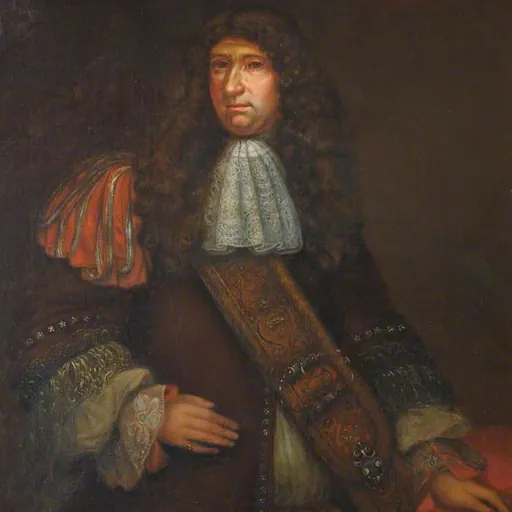
Sir George Downing, 1st Baronet
Anglo-Irish preacher, soldier, statesman and diplomat
About Sir George Downing, 1st Baronet
Lived 1623 – 1684 (aged 60–61). Sir George Downing, 1st Baronet was an English diplomat, soldier, politician and envoy extraordinary and minister plenipotentiary.
Sir George Downing, 1st Baronet ( – 1684) was an Anglo-Irish statesman and diplomat who held office first under the Commonwealth of England, then Charles II. As Teller of the Exchequer, he carried out major reforms in public finance, including securing passage of the Navigation Acts, intended to protect English maritime commerce, especially from the Dutch Republic. He played a significant role in acquiring New York City from the Dutch in 1665. Two New York streets are named after him, one in Greenwich Village and one in Brooklyn, as well as Downing Street, London.
Personal details George Downing was born 1623 in Dublin, Ireland, eldest son of Emmanuel Downing, and his second wife, Lucy Winthrop, younger sister of John Winthrop, Governor of Massachusetts Bay Colony. His father was a barrister of the Inner Temple in London, and a Puritan who undertook missionary work, first in Ireland, and later in New England.
In 1654, he married Frances, sister of Charles Howard, 1st Earl of Carlisle and distantly related to the Duke of Norfolk, the leading Catholic family in England. They had a number of children, including his eldest son and heir George ( – 15 April 1740), William (1663–1704), Charles (died 15 April 1740), Frances (died 1681), Philadelphia (died 8 March 1676), Mary (died 1728), and Lucy (died 1711).
Early career
In 1636, he was in school in Maidstone, Kent. His family joined Winthrop in America in 1638, settling in Salem, Massachusetts. This previously little-used move, opposed strongly by Lord Clarendon as an encroachment on the royal prerogative, effectively made permanent the parliamentary appropriation of supplies (meaning that Parliament gained the right to specify that tax revenues should be used only for a particular purpose, rather than spent as the King's government saw fit). In May 1667, in the war's final year, Downing was made secretary to the commissioners of the treasury, his appointment being much welcomed by Pepys, and he took part in the management and reform of the Treasury.
He was appointed a commissioner of the customs in 1671. The same year he was again sent to Holland to replace Sir William Temple, to break up the policy of the Triple Alliance and incite another war between the Dutch Republic and England in furtherance of the French policy. His unpopularity there was extreme, and after three months' residence, Downing fled to England, in fear of the fury of the mob. For this unauthorised step, he was sent to the Tower of London on 7 February 1672, then released a few weeks afterwards. He defended the Royal Declaration of Indulgence the same year, and made himself useful in supporting the court policy.
Death and legacy
His wife Frances died on 10 July 1683, followed by Downing himself a year later, with probate granted on 19 July 1684. He was buried in the family vault built in All Saints' Church, Croydon, Cambridgeshire, leaving a substantial fortune, which critics claimed he had amassed partly through his exceptional meanness about money. This characteristic was echoed by Samuel Pepys, although Downing's rise was considered undesirable in a generally conservative society, and an achievement that generated suspicion and envy.
Despite his undoubted political, diplomatic, and financial ability, Downing has often been maligned due to his willingness to betray former comrades in order to win favour from his current masters. His modern reputation is undergoing a revision as his contributions in the fields of financial reform and diplomacy are again recognised.
He published a large number of declarations and discourses, mostly in Dutch, enumerated in Sibley's biography, and wrote also "A True Relation of the Progress of the Parliament's Forces in Scotland" (1651), Thomason Tracts, Brit. Mus., E 640 (5).
Footnotes
Don’t just read it —
keep it.
Full-length biographies made to live with: read them, listen on the way to work, watch them tonight.
- E-book
- Audio
- Video
Instant download · yours to keep · every purchase keeps this site free
Important facts
Family & relationships
People in Sir George Downing, 1st Baronet's life
Named in this biography and alive at the same time




Related people
Same field, nearest in time


Contemporaries
People whose lives overlapped Sir George Downing, 1st Baronet's





Frequently asked questions
Who was Sir George Downing, 1st Baronet?
Anglo-Irish preacher, soldier, statesman and diplomat (1623-1684)
When was Sir George Downing, 1st Baronet born?
Sir George Downing, 1st Baronet was born in 1623 in Dublin.
When did Sir George Downing, 1st Baronet die?
Sir George Downing, 1st Baronet died on 19 July 1684 in Cambridgeshire.
What was Sir George Downing, 1st Baronet's occupation?
Sir George Downing, 1st Baronet was a diplomat, soldier, politician and envoy extraordinary and minister plenipotentiary.
What nationality was Sir George Downing, 1st Baronet?
Sir George Downing, 1st Baronet was English.
Sources & further reading
· Wikipedia: Sir George Downing, 1st Baronet
· DBpedia: Sir George Downing, 1st Baronet
Cite this page
APA: Biography.guide. (2026). Sir George Downing, 1st Baronet. https://biography.guide/sir-george-downing-1st-baronet/
MLA: "Sir George Downing, 1st Baronet." Biography.guide, https://biography.guide/sir-george-downing-1st-baronet/.
Chicago: "Sir George Downing, 1st Baronet." Biography.guide. https://biography.guide/sir-george-downing-1st-baronet/.
Data last updated: 2026-09-24 · Spot an error? Report a correction.
Portrait: Wikimedia Commons · author & licence
Page generated 2026-09-27 05:08 UTC